
Denver Art Museum

Audio By Carbonatix
Advertising Can't Do It Alone
The challenges facing local news organizations are very real. That's why reader support matters more than ever. If you believe independent journalism matters, make a contribution today and help us reach our summer fundraising goal of $25,000 by August 9.
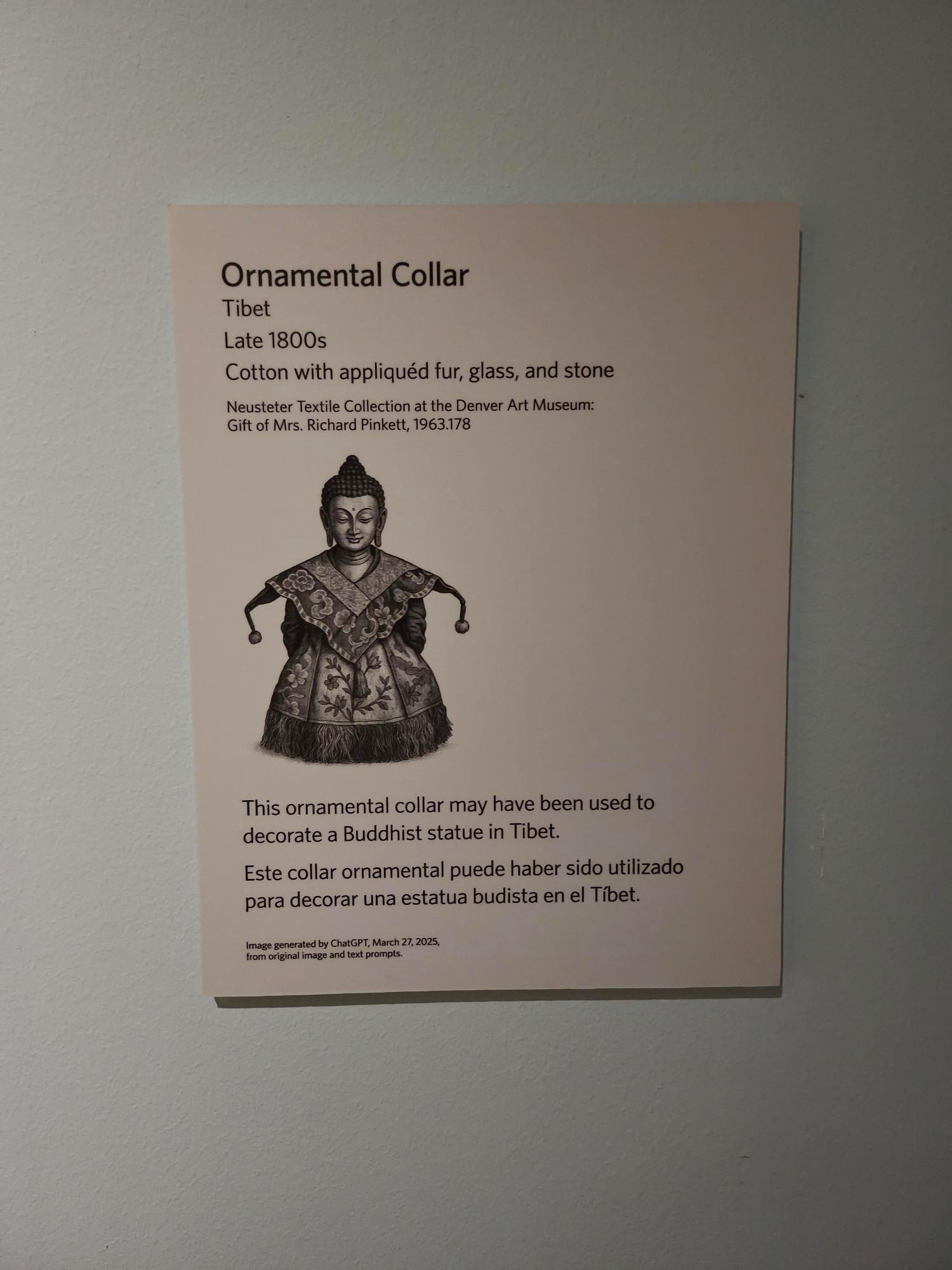
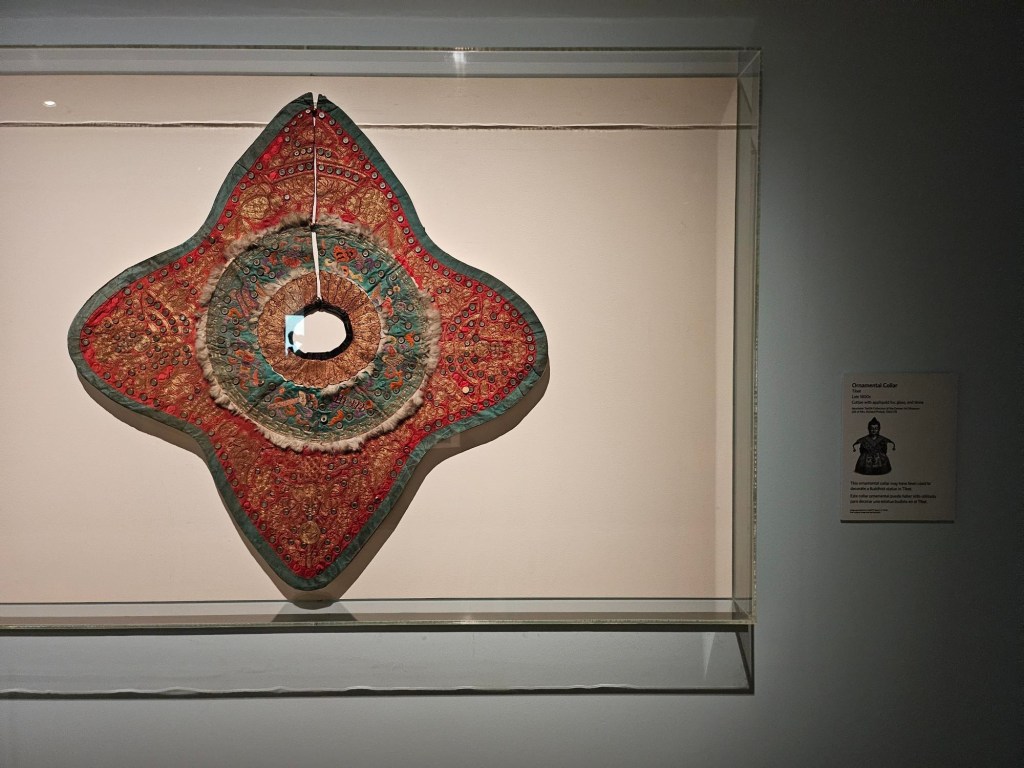
Last month, a local TikToker posted a photo of a Denver Art Museum label, with this text: “Saw my first AI-generated museum label at the Denver Art Museum” accompanied by screaming audio. The label, for an ornamental collar from late-1800s Tibet, depicts an illustration of a Buddhist statue. Under it, a caption reads, “This ornamental collar may have been used to decorate a Buddhist statue in Tibet.” And under that, “Image generated by ChatGPT, March 27, 2025, from original image and text prompts.”
“AI is making the future of art history TERRIFYING,” the poster wrote. And indeed, it is. AI is a touchy subject pretty much anywhere, but especially in art spaces, where people argue that art is human, and human art needs to be supported and protected.
The DAM removed the AI-generated image from the label a few weeks ago, after museum staff received direct visitor feedback expressing concern about the use of an AI‑generated illustration in the galleries, says Andy Sinclair, DAM senior manager of Communications and Media Relations. “From the outset, it was important to us to clearly attribute the illustration as AI‑generated, as transparency about how information is created is essential to maintaining visitor trust and aligns with the museum’s commitment to openness in our interpretive practices,” Sinclair says. “The museum takes visitor trust seriously.”
It was the only label in the DAM’s galleries that incorporated an AI-generated image, and the museum is not currently using AI in any way, Sinclair says. Staff members are thinking about it, though.
“Like many cultural institutions, the DAM has been cautiously exploring how AI might serve as a behind‑the‑scenes tool, especially for administrative efficiency and for supporting research tasks such as organizing information or synthesizing references,” Sinclair says. “These explorations are strictly internal and have not resulted in any additional public‑facing materials.”
So why was the AI-generated label displayed in the first place? Sinclair says it “was part of a small experiment exploring how emerging technologies, like AI, might support museum workflows, including conducting basic research, assisting with visualizations and, at times, as a research tool. The goal was never to replace curatorial expertise, but to better understand what these tools can and cannot do.”
Denver Art Museum
Sinclair adds that the team hoped to add context that would help visitors visualize how the Tibetan collar was used. “We searched extensively for culturally accurate and appropriate reference images, but we were unable to locate a legitimate Tibetan example that was available for fair use,” she says. “Many available photos depicted similar collars worn by people of Chinese or other Asian countries of origin, and we were cautious not to misrepresent Tibetan culture or imagery.”
An AI-generated illustration was explored as a possible solution. “The intent was to use AI as a tool to support clarity and cultural sensitivity, and to support the museum’s mission to provide context to each object, not to replace human judgment,” she adds.
Still, couldn’t a human artist (perhaps even one on the museum staff) have drawn the illustration?
“The label was part of an internal, one-time experiment exploring how emerging technologies, like AI, might support museum workflows, including conducting basic research assisting with visualizations and, at times, as a research tool,” Sinclair repeats. “The goal was never to replace curatorial expertise, but to better understand what these tools can and cannot do.”
And she acknowledges that AI intersects with art and culture in complex ways. “Many questions arise around training data, consent, copyright and how images of cultural objects or living communities are used,” Sinclair says. “There are also broader concerns about authorship, authenticity and whose voices are represented, or misrepresented, when AI is involved. …Because AI is a rapidly evolving technology, its use can raise valid questions for visitors about transparency and responsibility in museum practice.”
Sinclair adds that the DAM is in the early stages of evaluating if and how AI tools might support museum work, but no decisions have been made about future use. “These conversations are being guided by an internal AI committee led by leadership, involving teams across curatorial, interpretation, education, ethics, operations, and information systems,” she says. “Our goal is to approach AI collaboratively and carefully, recognizing both the opportunities and the concerns it raises. Our commitment remains in responsible practice, cultural sensitivity, and alignment with the museum’s mission to serve and respect its communities.”
Future visitors to the DAM could start seeing more AI-generated illustrative images, but Sinclair emphasizes that curators will guide the process. “AI is not a replacement for human expertise; our knowledge, creativity, and cultural insight remain essential and irreplaceable,” she says.
AI is still a relatively new tool, and people in many businesses and organizations are trying to figure out how (or if) to use it. Sinclair says the early experiment with the AI-generated image for the Tibetan collar helped museum staff learn, assess risks and understand where AI may or may not be appropriate.
“We believe museums have an important role in modeling thoughtful and responsible engagement with new technologies,” she says. “We value the feedback we’ve received. Community perspectives help us shape our approach and ensure our decisions reflect the trust placed in us. As we continue these conversations, our commitment remains to accuracy, cultural sensitivity, collaboration, and the human insight that is at the heart of our work.”