Veo

Audio By Carbonatix
A typically quiet weekday committee meeting was packed to the brim on Wednesday, March 18, as Denver City Councilmembers considered the future of rentable electric scooters in the city.
Over thirty people sat shoulder-to-shoulder in the conference room audience, with dozens more relegated to the hallway and an overflow room. Around half of the attendees wore neon green T-shirts and held hand-written signs signaling support for one of the city’s current e-scooter operators, Lime.
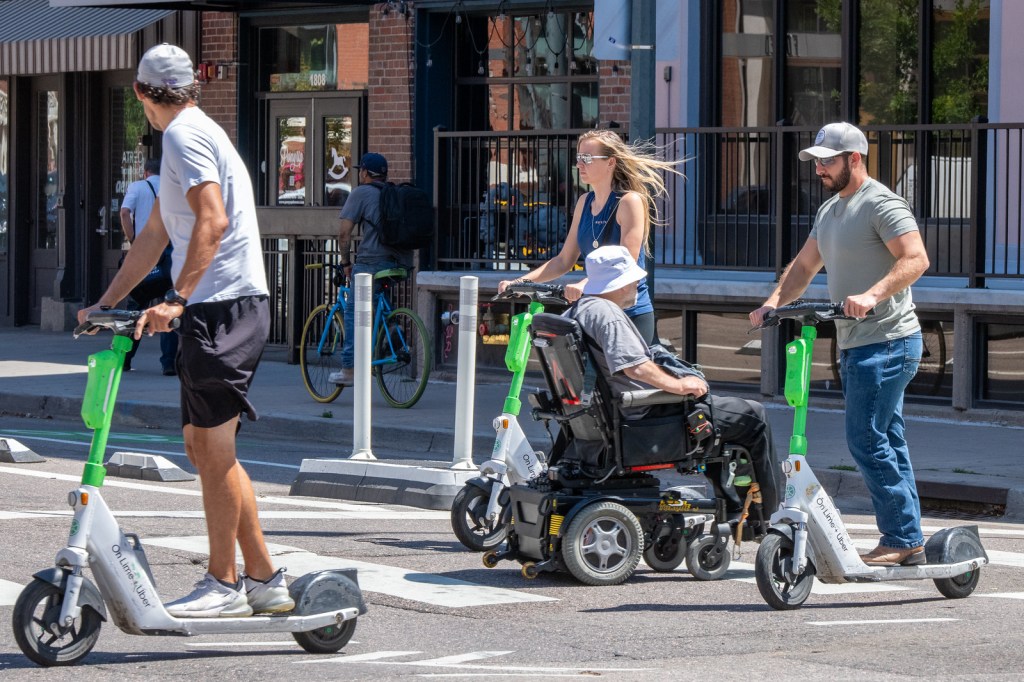
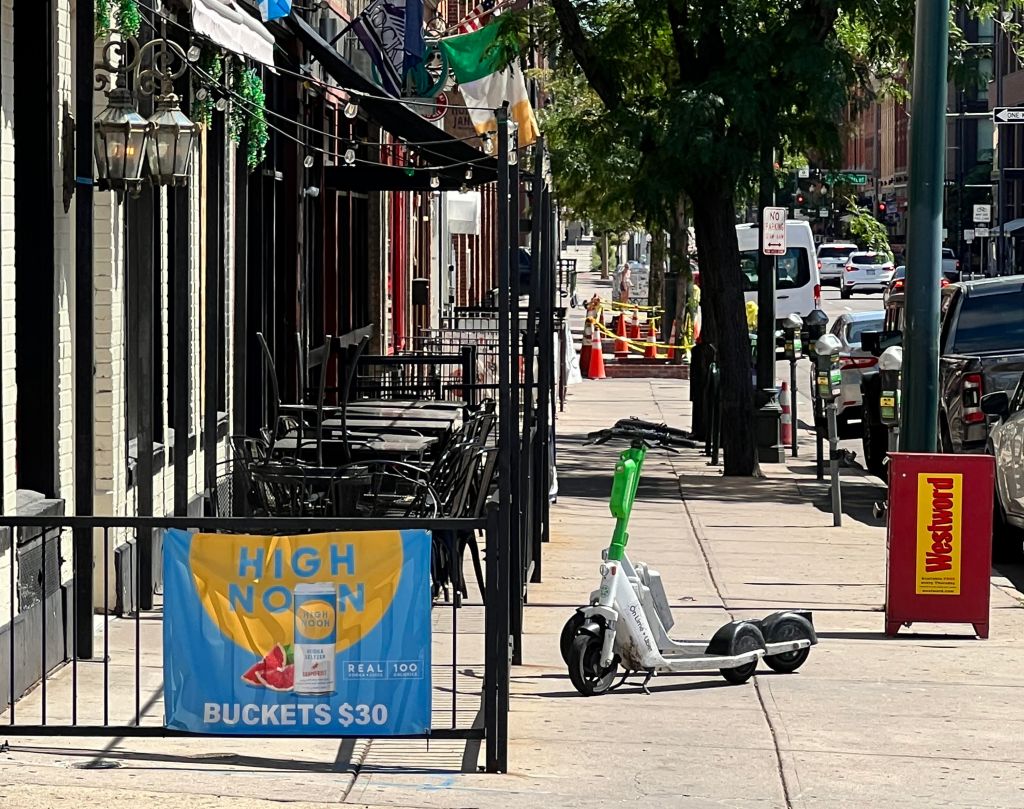
Lime’s contract to rent scooters in Denver expires in May, along with the city’s other operator, Bird. The companies have grown Denver’s micromobility system into one of the largest in the nation. Over 5.4 million scooter trips were taken in Denver last year, and nearly 30,000 residents are signed up for free scooter rides through a world-leading equity program. But along the way, the city has struggled to get a handle on undesirable consequences, such as illegal sidewalk riding, blocked right-of-ways and increasingly frequent injuries.
In December, the city selected Veo to replace Lime and Bird, promising to improve the current system.
Race Isn’t over
During Wednesday’s committee, testimony was split between residents who rely on scooters to get around and fear the change will disrupt their means of transportation, and residents who are fed up with the status quo and blame Bird and Lime for failing to rein in disruptive conduct.
“Lime has positively impacted my life. It has made me a positive impact on my own life. It has helped me get to the births of two of my granddaughters. It has helped me keep a job that I was working after the hours that public transportation, like RTD, is running,” said Arenthian Bohannan, a Lime Access rider. “I ask that you extend this program, at least in the transition phase, so that no one gets left behind.”
Lime has similarly called for an extension. On March 17, the company sent a release requesting that the city grant it a twelve- to eighteen-month transition contract. Meanwhile, Bird has drummed up support from the Denver Regional Mobility & Access Council and the Denver Broncos, which both sent letters to city council asking for Bird’s contract to be renewed.
But not everyone wants Lime and Bird to stick around. Several downtown residents spoke in support of switching to Veo.
“[The city] listened to our concerns over the past years regarding the lip service that the current providers — especially Lime — have given to the safety of pedestrians in the downtown area,” said David Kurth of the Upper Downtown Neighborhood Association. “There’s little or no policing of careless and dangerous scooter rider behavior and improper scooter parking. We were very pleased when a new provider for the shared scooter services was announced.”
For now, the future is uncertain.
JR Goodwin/DRCOG
Councilmembers unanimously voted to postpone consideration of Veo’s licensing agreement on Wednesday. However, the delay is not because members are undecided, but because the council still hasn’t received the final contract. It is not uncommon for committees to vote on a proposal before the contract is finished, but the issue has become a sticking point in recent years. Last week, councilmembers postponed a vote on a proposal to replace Flock artificial intelligence cameras with Axon, a less controversial provider of similar technology, over contract delays.
“You can’t ask this body to vote on things that we don’t read,” Council President Amanda Sandoval said during Wednesday’s meeting, visibly frustrated. “I just can’t do it anymore. I’m tired of doing this.”
Veo’s proposed contract is expected to be finished this week, according to the Denver Department of Transportation & Infrastructure.
“This decision was not made lightly,” said Alaina McWhorter, DOTI’s legislative liaison, of selecting Veo to run the city’s scooter operations. “Veo demonstrated the strongest responses and proposals to continue building out a safe, affordable, equitable and accessible shared bike and scooter program. They really showed up for Denver in this process.”
The Transportation & Infrastructure Committee is scheduled to reconsider Veo’s licensing agreement on April 1.
In the meantime, here’s what we know about the proposal:
What Happens to the Equity Program?
Lime provides low-income residents with three free rides per day, each lasting up to thirty minutes.
Veo will offer low-income residents with sixty minutes of free rides per day, with no limit on the number of rides taken. After the sixty minutes, riders will be charged $0.15 per minute with no unlocking fee. So riders will have fewer total minutes of free rides per day, but more flexibility regarding how many free rides they can take.
The eligibility for Veo’s equity program will be the same as Lime’s: being open to individuals who participate in any local, state or federal assistance program, like Medicaid or SNAP. Users will be able to use their participation in the current Lime Access program as proof of eligibility to enroll in Veo’s program.
Users can begin the enrollment process for Veo’s access program now at veoride.com/denver. To ease the transition, Veo will allow users to access free rides throughout May without proving eligibility as a sort of honor-system grace period.
How Much Will Renting Cost?
Right now, Bird and Lime charge riders $0.44 per minute, plus a $1 unlocking fee.
Veo will charge Denver residents $0.25 per minute and visitors $0.39 per minute, plus the same $1 unlocking fee. The prices will be set in Veo’s licensing agreement, so the company will not be allowed to increase prices during the duration of its contract.
Trips that begin in “equity-focused neighborhoods” will be subject to additional rate discounts.
Veo’s Vehicles
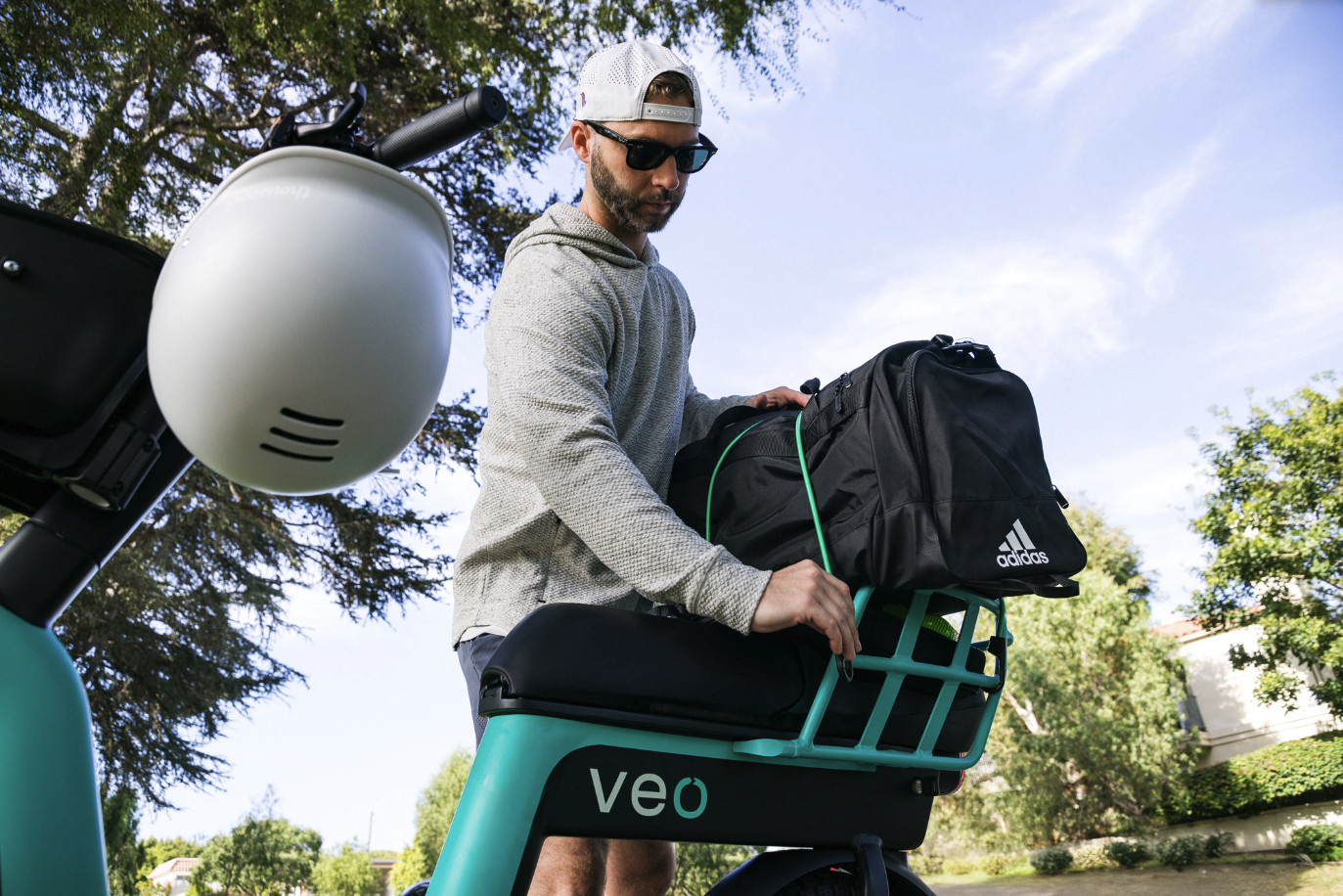
Veo will deploy 9,000 vehicles of five different types, which the company claims is the most diverse fleet of dockless micromobility vehicles in the nation.
One-third of the fleet will be traditional standing e-scooters and one-third will be seated e-scooters, while one-sixth will be two-seated e-bikes, one-sixth will be cargo e-bikes and around fifty to one hundred vehicles will be cargo tricycles.
Veo is scheduled to begin operations on May 1, while Lime and Bird are scheduled to end operations on May 16. So there will be about two weeks of overlap during which Lime and Bird scooters will remain accessible, as Veo rolls out its fleet.
Other Changes?
Veo vehicles are fitted with technology to detect unlawful behavior, such as riding on sidewalks or riding with multiple people on board. Each vehicle also has a QR code that reads “How’s my parking?”, which passersby can use to report improperly parked vehicles.
A voice will emit from the vehicle if a rider does something wrong; for example, “Don’t ride on sidewalks,” or “Hard breaking detected, please ride safely.” It will also explain what’s happening if riders enter a geofenced zone that automatically slows the vehicle, like on 16th Street.
Veo intends to build 150 new parking corrals. If a user ends their ride in a mandatory parking zone, like Union Station, they’ll have to park in a designated corral. To prove they’re in the right spot, riders scan their vehicle’s QR code and then tap their phone to the parking corral. This tap-to-park system is more geographically precise than GPS, intending to ensure proper parking that does not block streets and sidewalks.
Unlike with Lime and Bird, Veo is expected to have a financial partnership with the city. It will pay the city $250 per vehicle per year to operate in Denver, which the city will reinvest in micromobility operations.
The licensing agreement with Veo will last three years, instead of the five-year contracts Lime and Bird had.
LoDoNA
Can Veo Pull It Off?
Though the plan sounds good, the question top of mind on Wednesday is whether Veo will be able to deliver.
Veo operates in more than fifty cities, but it has never had a fleet this large. Its biggest market is currently in Washington, D.C., where it has approximately 4,000 vehicles, compared to the 9,000 Denver desires. This will be Veo’s largest equity program, as well.
“It took a long time for our current operator to get up to this level, and I do have concerns about the ability of a new provider to [do so],” Councilmember Flor Alvidrez said during the hearing.
Veo maintains that it is up to the task.
“As a single operator, a program this large will be the largest in the country,” Alexander Keating, Veo’s vice president of policy and partnerships, said of the equity program. “We process tens of thousands of access applications across all our markets. …We’ve invested very heavily in new systems to make sure that that’s an even more rapid and automated system. We don’t see there to be a challenge to onboard.”
If Veo isn’t able to meet the city’s needs, the licensing agreement allows Denver to bring in a second scooter operator, according to DOTI.