
Photo by Liana Busby

Audio By Carbonatix
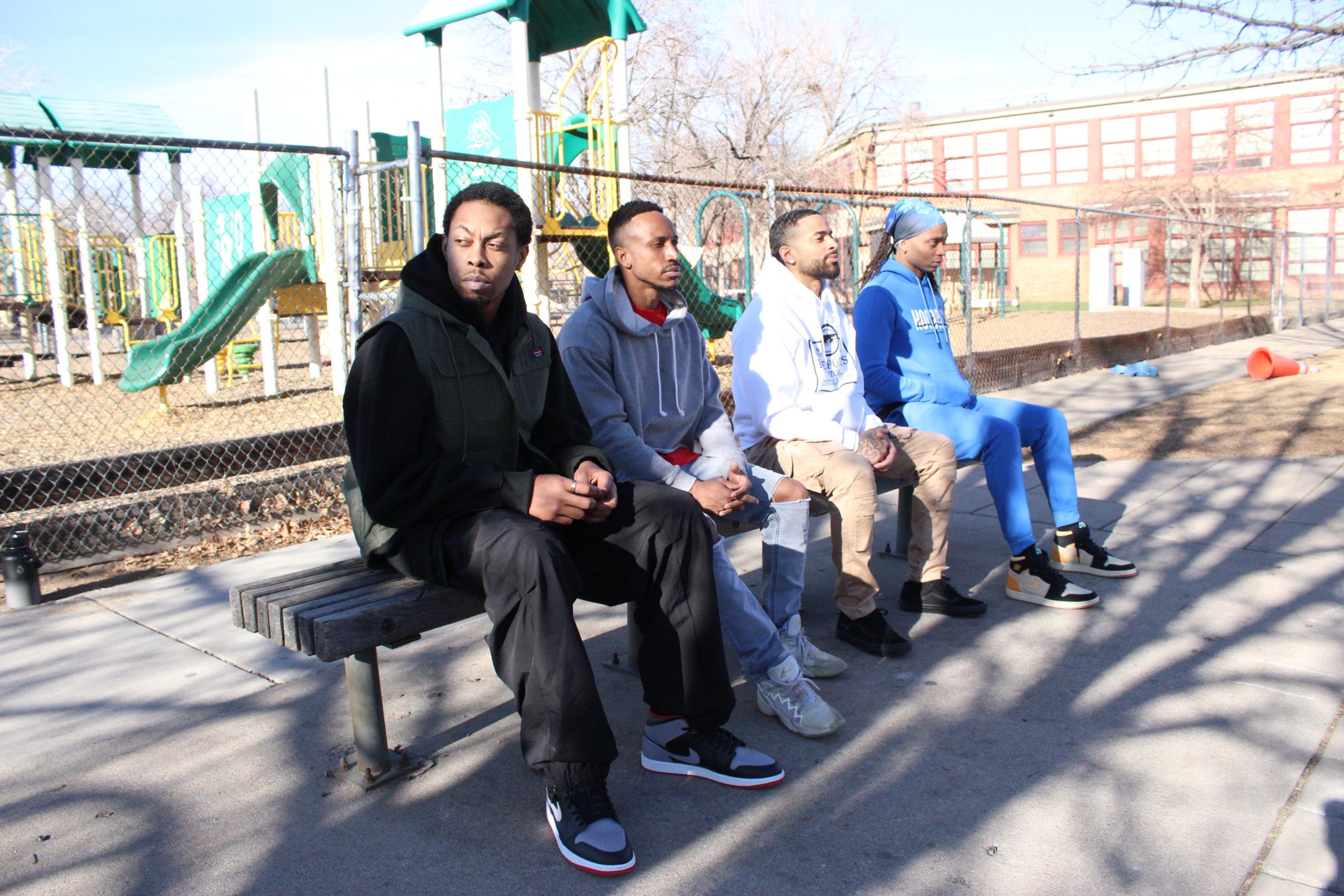
Black Gold opens with a clear, weighty premise: four men from Five Points trying to make sense of what they’ve survived and what it’s cost them. Set in Denver’s historic neighborhood and playing for one night only on May 9 at the Bug Theatre, Myles Juniel’s new play explores addiction, masculinity, brotherhood and the long shadow of unresolved trauma.
“I’ve been sitting with this story for almost three or four years now,” Juniel says. “The process has been so long and strenuous because it’s covering a lot of very, very deep and emotional things that I’ve sat with for the entirety of my life.”
That long incubation shows up in the play’s scope. While Black Gold follows four central characters, it unfolds through a large 23-person ensemble that creates the broader community. Juniel began developing the work in late 2022, but even before that, it was something he had been carrying.
“It was really about an acknowledgement within myself that the idea that it could be time to stop running,” he says, “and what liberation and freedom could look like.”
That question sits at the core of Black Gold. The play doesn’t treat healing as a clean or easy process. Instead, it focuses on confrontation: with past trauma, with fractured relationships and with the internalized expectations that define how these men see themselves.
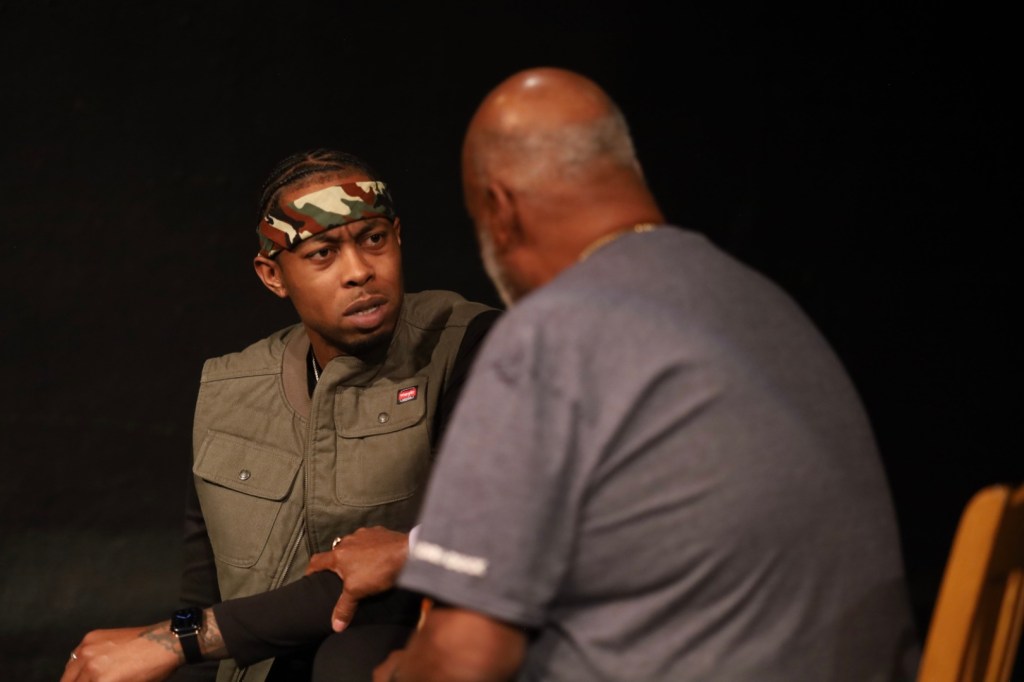
Photo by Abraham Elahmadi
The setting is central to that exploration. Five Points is not just a backdrop but an active force within the play, shaping its characters and their experiences. Often reduced to a shorthand for Denver’s Black history, the neighborhood is presented here with more nuance, emphasizing both its cultural significance and the ways its stories are frequently simplified or overlooked.
“Five Points has been this ever-changing community since the beginning,” Juniel says. “Because so much of its history is overlooked, it has always felt important to me to include Denver, and specifically Five Points, in my work to pay homage and bring light to the community’s stories.”
That emphasis on specificity extends to the play’s themes. Black Gold examines how ideas about masculinity, particularly within Black communities, can limit emotional expression and complicate the path toward healing.
“Something that’s really stuck with me from my childhood was the ideology ‘be a man’ because it’s open-ended,” Juniel says. “It’s whatever whoever is saying it needs it to mean. Mask your emotions; be a man. Open up more; be a man. Not only is it open-ended, but it’s always moving. So, it’s really hard to latch onto and attain, and that was one of the things that really came up for me in the writing process.”

Photo by Abraham Elahmadi
For actor Dwayne Meeks, those tensions are embodied in his character, B.B., an older man serving a life sentence who becomes a mentor figure to younger inmates entering prison. While B.B. may initially register as an antagonist, Meeks sees him as something more instructive.
“He is the example of what happens when we don’t step in early enough to help young African American men with their mental health,” Meeks says. “I like to call B.B. the warning.”
B.B.’s presence in the play highlights one of its central arguments: that many of the struggles these characters face are not individual failures but the result of systemic gaps, particularly around mental health support. Meeks points to the lack of meaningful resources within incarceration as a key part of that reality.
“There’s no help for him. There’s no rehabilitation,” he says. “He’s traumatized and he has trouble grieving.”
At the same time, the character is defined by his attempts to intervene where he can. Even without the possibility of changing his own circumstances, B.B. tries to steer younger men away from repeating his path.
“He truly wants to save them,” Meeks says. “He’s not getting out, but he doesn’t want them to come back to jail.”
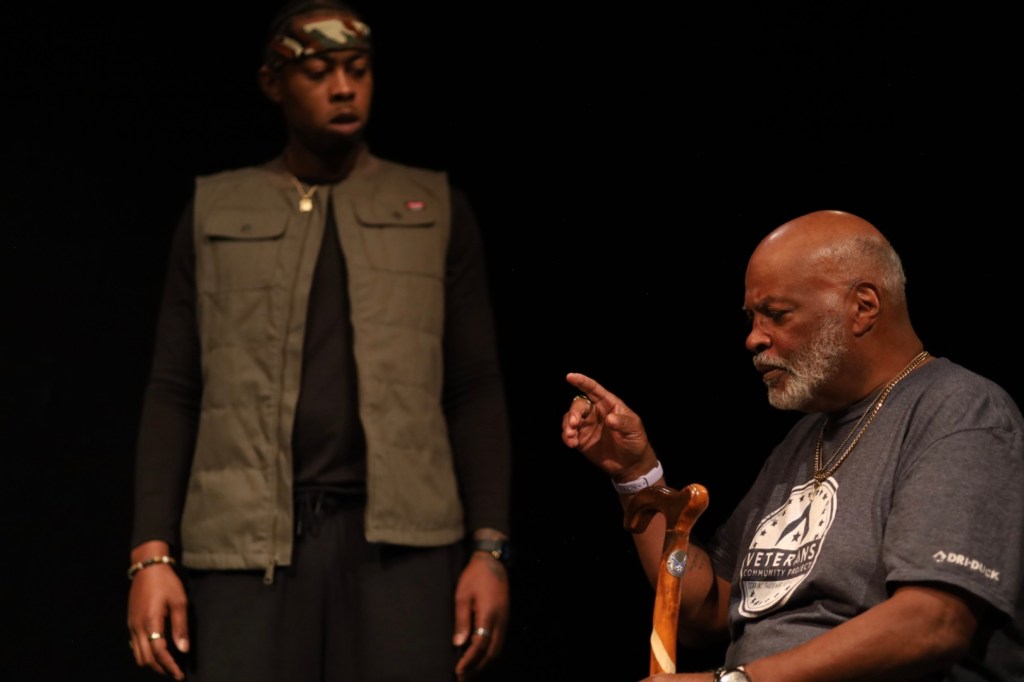
Photo by Abraham Elahmadi
That perspective aligns with Meeks’ work offstage. As the founder of Urban Colors Fatherhood Experience, he focuses on supporting boys and men through mentorship and emotional development. His involvement in Black Gold reflects the production’s broader connection to community-based work.
“I felt honored to be asked and to really be able to add some value to it from an authentic perspective,” Meeks says.
The play’s engagement with mental health extends beyond its narrative. Juniel and Meeks are scheduled to present excerpts and lead discussions at upcoming conferences focused on Black men’s mental health, including a virtual event on May 18 and another in June. For Juniel, that reception underscores the relevance of the story.
“I’ve never had anything be accepted into the National Black Mental Health Conference,” he says. “It’s deeper than just some story and some characters. It’s based on real life and real experiences.”
Those realities are reflected in the statistics Meeks cites: a significant portion of Black adults who need mental health care do not receive it, while suicide rates among Black youth, especially young men, continue to rise.
“Being silent is not strength,” he says. “It truly is deadly.”
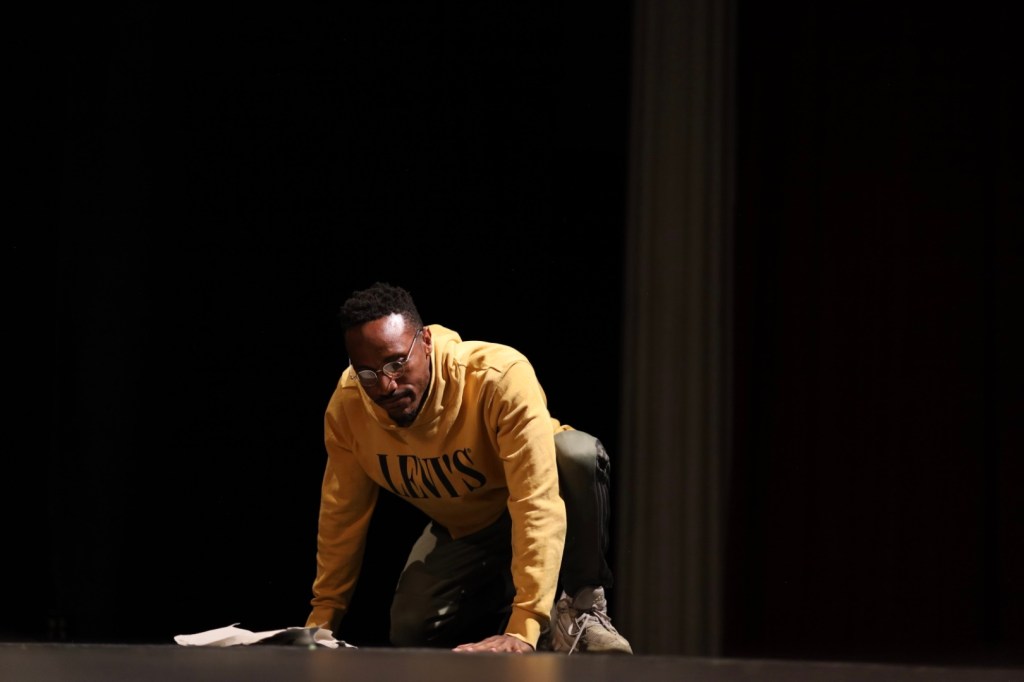
Photo by Abraham Elahmadi
Black Gold positions itself as part of that conversation, using performance as a way to make difficult topics more accessible. Juniel sees the theatrical format as a key part of that accessibility, offering an entry point that feels less formal or intimidating than traditional discussions around mental health.
“A play makes it accessible,” he says. “It’s not some kind of speech or some kind of organized, intimidating thing.”
The choice of venue reinforces that approach. The Bug Theatre’s intimate configuration places the audience in close proximity to the action, allowing little distance between viewer and performer. For a piece built around emotional exposure, that closeness is intentional.
“For how intense some of these scenes are, I really want to be close with the audience,” Juniel says. “As close as we could come to breaking a fourth wall on stage, if you will.”
At its core, Black Gold is structured around the idea of shared experience.
“While the story focuses on these four Black men and their traumas, these experiences that they’re trying to understand and overcome are really, really general,” Juniel says. “Forgiveness, liberation and reshaping your own narrative are things that apply to all of us.”

Photo by Abraham Elahmadi
That universality is part of what the production is testing. With only one confirmed performance so far, the May 9 premiere functions as both debut and proving ground. Conversations with additional venues are ongoing, but for now, the focus is on what happens in that room.
“We don’t know what people are walking in with,” Meeks says. “But when they see this, they are not going to leave the same way that they came in.”
Black Gold is Saturday, May 9, at the Bug Theatre, 3654 Navajo Street, at 6 p.m. Tickets are $43.04. Learn more at ticketstripe.com/events/5653108209935433.