
Hannah Metzger

Audio By Carbonatix
Colorado was poised to become the 17th state to ban child marriage, but the proposal has since been rolled back at the legislature.
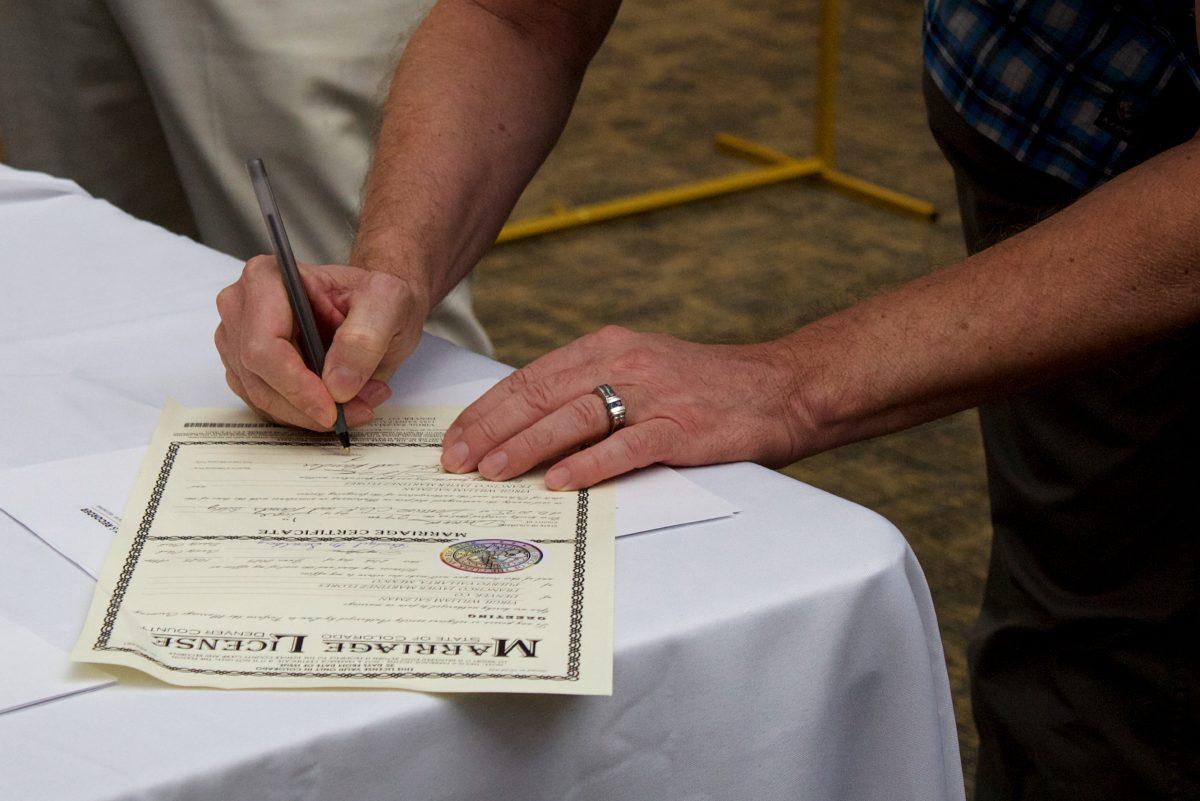
State law allows 16- and 17-year-olds to marry with judicial approval. As introduced, Senate Bill 26-048 would have required that individuals be at least 18 years old to obtain a marriage license. But with a new amendment, the bill would still allow 16- and 17-year-olds to marry with judicial approval, so long as their spouse is no more than ten years older than they are.
In other words, Coloradans as young as 16 would continue to be able to marry adults as old as 26, if a judge says it’s okay. The bill sponsors describe the amendment as a compromise. Opponents took issue with a blanket ban on child marriage for a variety of reasons: Some conservatives want pregnant teenagers and young military couples to be able to marry, while some progressives want potential trafficking victims to be able to appear in front of a judge, and fear the ban could unintentionally support efforts to restrict abortion rights for minors.
“This is not a perfect solution, but it is a meaningful one,” Representative Junie Joseph, a sponsor, said during a committee meeting on April 6. “When we come to this place, we don’t solve all the problems. We just, at times, move the ball forward, just a little bit.”
Advocates who pushed for the child marriage ban disagree. The amended bill is “a ridiculous, pathetic, half-assed measure” that will only help a tiny minority of victims, argues Fraidy Reiss, founder and executive director of Unchained At Last, a nonprofit advocating for the end of child marriage.
“Who wrote this amendment, Jeffrey Epstein?” Reiss asks. “I was forced to marry someone three years older than I, and I can tell you, getting raped repeatedly by someone three years older is not that much better than getting raped by somebody 11 years older.”
Child Marriage in Colorado
Just seven years ago, there was no legal minimum age for marriage in Colorado.
In 2006, lawmakers passed a bill prohibiting people under 18 from entering into common-law marriages. The move followed public outrage over a local 34-year-old man who used his common-law marriage with a 14-year-old girl to fight his sexual assault charge. But there was still no set minimum age for children to enter into ceremonial marriages; state law only specified that children 15 and younger needed a judge’s approval to marry, and those aged 16 and 17 needed either judicial or parental approval.
It wasn’t until 2019 that lawmakers passed a bill prohibiting children under 16 from obtaining a marriage license and requiring judicial approval for 16- and 17-year-olds to marry.
Since that change took effect, minors have been involved in at least 139 marriage license applications in Colorado, according to state data obtained by Westword. And that number could be much higher: Data for 2024 and 2025 is incomplete due to an ongoing data conversion, which has resulted in the age of applicants being “unknown” in over 3,300 marriage license submissions from those years.
During the committee meeting, multiple legislators called Senate Bill 48 unnecessary, arguing that the 2019 law change is already adequate and that some minors should have legal access to marriage.
“I support the full range of decision-making,” said Representative Meg Froelich, noting that a blanket child marriage ban would cause “a pregnant teen [to] be prohibited from marrying the father of her child.”
However, advocates say minors who get married are trapped in a “legal no man’s land,” regardless of their personal reasons for doing so. Married minors cannot file for divorce or protection orders without an adult. They are emancipated from their parents and often no longer covered by child protection services. And marriage shields the adult spouse from statutory rape or sexual assault charges.
The amendment allowing for age gaps of up to ten years aligns the bill with the state’s statutory rape law. It is intended to close the legal loophole that incentivizes rapists to marry their underage victims. But most child marriages occur within that age gap, according to Unchained At Last.
Only 3 percent of minors recently married in Colorado had a spouse over ten years older, according to an analysis by Unchained At Last. At least 4,763 marriage license applications submitted in Colorado between 2000 and 2025 involved someone under the age of 18, according to state data obtained by Westword.
“We’re talking about a devastating human rights abuse and a nightmarish legal trap that destroys almost every aspect of an American girl’s life,” Reiss says. “There’s no reason, when we’re talking about something that dire, that we should accept helping just 3 percent.”
Next Steps
The amendment passed the committee on April 6, with support and opposition from both Democrats and Republicans. The updated bill cleared the full House on May 6 in a 41-23 vote.
The proposal is now in the hands of the Senate, where lawmakers must choose to concur with or fight the amendment. Bill sponsor Senator Nick Hinrichsen says there is “some disagreement” on how to proceed. Senators delayed voting on the House amendment on May 8, rescheduling for May 11.
“While I am more supportive of the Senate bill, I would like to concur,” Hinrichsen says. “While the House version is short of what I’d like, it’s still a step in the right direction.”
Legislators have until the last day of session on May 13 to make a decision. Afterward, the bill will be sent to the governor for final consideration.
If the amendment is not reversed, Reiss says Unchained At Last will “vehemently oppose” the bill and urge the governor to veto it. She fears passing another partial restriction on child marriage will make it harder to pass a full ban in the future, noting that it was already a major hurdle this year.
“We would much, much, much rather see nothing pass than see a ridiculous, pathetic, half-assed measure that protects 3 percent of those impacted by child marriage and, in fact, encourages men in their mid- to late-20s to prey on high school girls,” Reiss says. “That is not a step in the right direction. That’s a slap in the face to the girls of Colorado.”
Bill sponsor Representative Lorena Garcia, who led the amendment stakeholding, called it one of the hardest policies she has ever worked on.
“This is a bill where no one is going to be happy,” Garcia said in committee. “If we are supporting one or two people, it’s worth it.”