
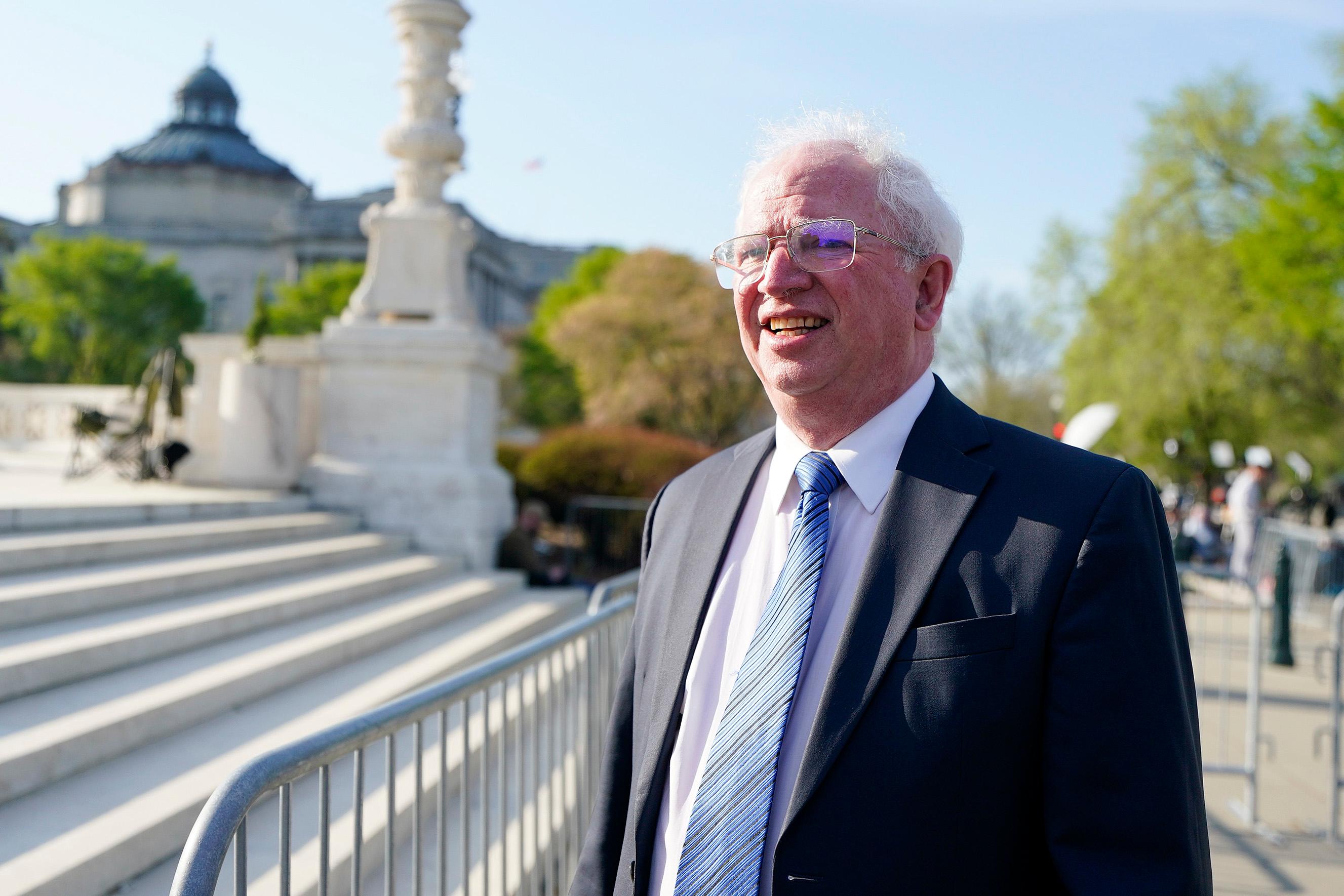
Al Drago/Getty Images

Audio By Carbonatix
Reader support matters more than ever
We're in the final stretch of our summer campaign. Our goal is to raise $25,000 to support the journalism our community relies on. Reader support is helping shape the future of local news.
John Eastman was back in Washington, D.C., late last month, joining a group of lawyers, former aides to Donald Trump and other conservatives to discuss a way to stymie birthright citizenship just weeks after the U.S. Supreme Court rejected the president’s argument against it.
“It was a success that we got as far as we did,” Eastman told the group hosted by the Conservative Partnership Institute and the Immigration Accountability Project, according to Politico. “And that conversation is now going on throughout the country, throughout the country by ordinary citizens and lawmakers and legislators and judges alike.”
According to Eastman, despite the guarantees of the 14th Amendment, the U.S. Constitution doesn’t automatically confer citizenship on virtually all people born in the U.S. He’s been pushing that theory since at least 2005, and his thinking inspired Trump’s original anti-birthright executive order and the case that went before the Supreme Court.
It also formed the basis of the two executive orders that Trump issued on Aug. 6, after his administration missed the deadline for requesting a rehearing of the Supreme Court’s June decision.
“The privilege of United States citizenship remains a priceless and profound gift,” Trump declared in one of his orders. “Since my first day in office, my Administration has guarded against the risks posed by malign foreign actors who attempt to swindle American citizens by taking advantage of the generosity of our Nation. On June 30, 2026, the Supreme Court decided … that the Citizenship Clause of the Fourteenth Amendment to the United States Constitution extends the privilege of citizenship to children born to parents in the United States ‘for whom no extraterritorial fiction applie(s). This order identifies, non-exhaustively, and prescribes action concerning certain categories of children of aliens who do not fall within the rule of birthright citizenship as announced by the Supreme Court.”
Eastman’s name doesn’t appear in any of those Trump documents, but his work on the subject was well-known when the then-law professor at Chapman University was chosen as the University of Colorado Boulder’s Benson Center’s Visiting Scholar in Conservative Thought and Policy for the 2020-21 academic year, an appointment that came with a $186,000 stipend.
Eastman took a break from his CU duties in December 2020, and went to D.C. to advise Trump on how he could claim the presidency before Eastman returned to rally the troops on January 6. His support of the insurrection cost him not just his CU position, but his licenses to practice law in Colorado and California, where he now directs the Claremont Institute Center for Constitutional Jurisprudence.
CU “determined Eastman’s continued pursuit of these duties would likely be disruptive and damage the interests of the campus and the Benson Center,” the university determined in letting him go. (It helped that only a handful of students had signed up for his two classes that term.)
The Bruce D. Benson Center for the Study of Western Civilization was founded by Bruce Benson, the former Republican gubernatorial candidate and president of CU from 2008 to 2019, to support “research that explores the ideas emerging from historically Western traditions and traces their continued influence. It focuses particularly on their role in establishing the foundational ideals and institutions of the United States.”
Not in demolishing those foundational ideals.
Eastman’s strategy for Trump claiming victory in his November 2020 re-election bid counted on the cooperation of then-Vice President Mike Pence, who would have had to postpone the count of electoral votes on January 6, but Pence refused to cooperate.
Pence was just given his own academic slot: He’ll be a visiting faculty member at Colorado Christian University during the 2026-27 academic year, giving lectures and hosting classroom discussions on constitutional government, public policy and leadership.
“Throughout my years in public service, I have seen the importance of preparing leaders who understand that faith, freedom, character and constitutional government are inseparable from the future of America,” Pence says in a CCU announcement of the appointment. “We are in a pivotal moment as a nation and it will be a privilege to join the ongoing work of CCU in raising up the next generation of great American leaders.”
Meanwhile, the National Endowment for the Humanities, which Trump shook up soon after his actual re-election in 2024, recently announced a $3 million award to the Benson Center — to be matched by $3 million in private philanthropic commitments — to support the development of a multidisciplinary academic program integrating the study of the Western tradition with American history, government and civics.
That study can start by researching Eastman’s role in the January 6 insurrection … and invite Pence to Boulder to offer an eyewitness account.