
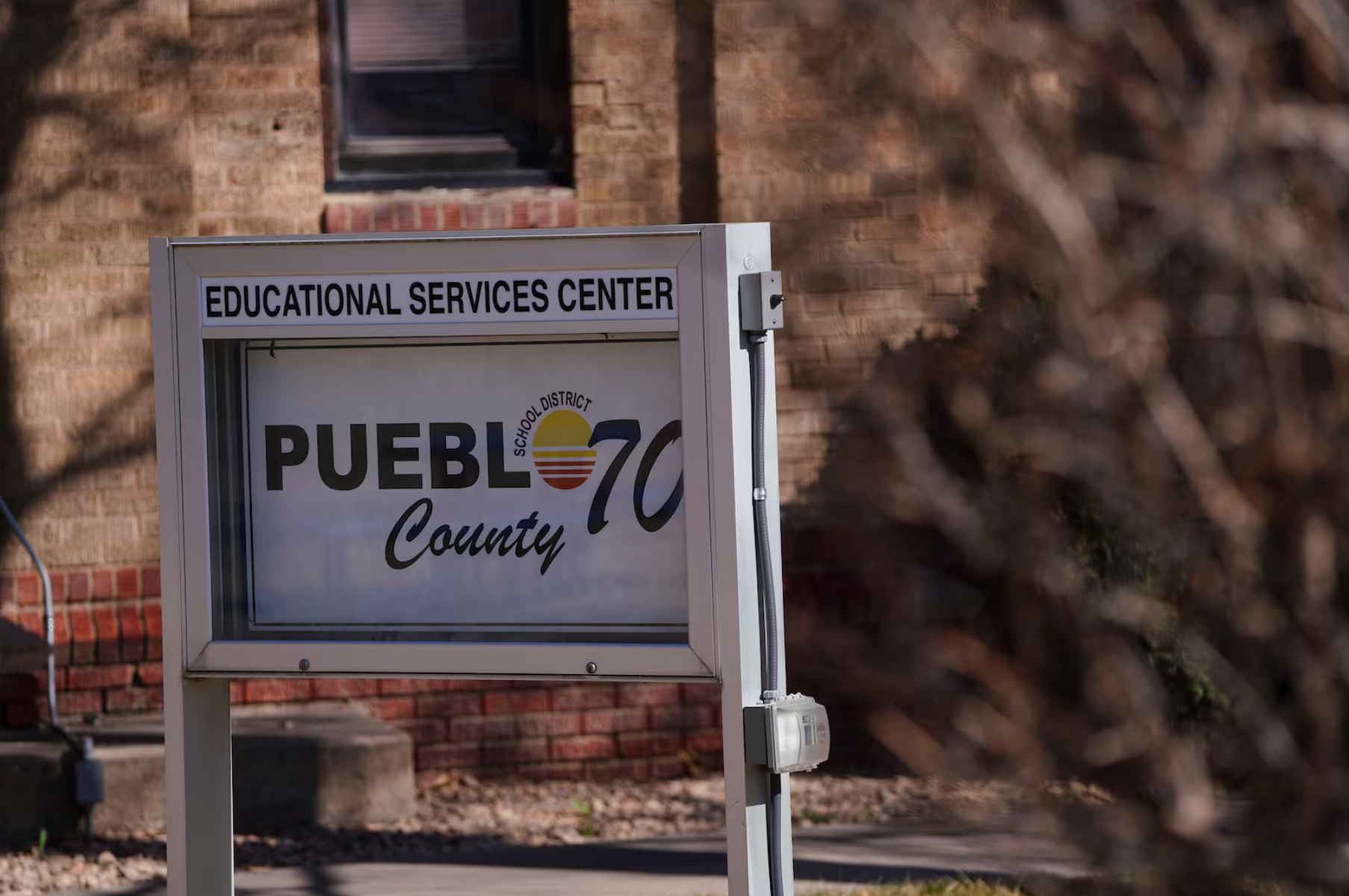
Rebecca Slezak for Chalkbeat

Audio By Carbonatix
This story was originally published by Chalkbeat Colorado.
A Colorado school board violated the state’s open meetings law by concealing the true nature of a “public Christian school” the board allowed to open last year, a state judge ruled Tuesday.
In addition, the decision by Pueblo District Court Judge Michelle Chostner found an open meetings violation related to an appointment the school board made last winter.
Together, these findings represent a major — and potentially expensive — defeat for the Pueblo County School District 70 school board, the defendant in the lawsuit.
Chostner’s ruling invalidates the February appointment of Susie Carnes to a vacant seat on the Pueblo 70 school board, and requires a new meeting so the four other board members can vote to fill the seat. Tuesday’s ruling also invalidates a June 2025 agreement approved by the Pueblo 70 school board that allowed the launch of the “public Christian school.”
That school, Riverstone Academy, closed permanently in May, but the court ruling could open the way for the state to claw back around $300,000 in public funding given to the school
The Pueblo 70 school board must also pay the plaintiffs’ attorney fees, the judge said.
The ruling is a win for Jonathan Lewis, Tara Stroesenreuther, and Adolph Vigil, the three school board candidates who brought the lawsuit in March after they were passed over for the vacant board seat.
The Pueblo 70 school board voted earlier this summer to authorize an immediate appeal if the ruling ordered the removal of a board member or a meeting to fill a board vacancy. As of mid–day Wednesday, no appeal paperwork had been filed with the court.
A Pueblo 70 spokesperson said by email Wednesday the district doesn’t comment on active litigation.
Although in their lawsuit the plaintiffs sought a vote to fill the vacant seat that Carnes filled, they wanted it to happen under slightly different conditions than what the ruling prescribed. That is, with voting only by the three board members who remained at a Feb. 10 meeting after one member had a seizure and departed. That scenario, which the judge did not require, would potentially yield a vote for one of the plaintiffs, not Carnes.
Asked about whether the state would seek to recover public dollars it previously gave to Riverstone Academy, a Colorado Department of Education spokesman said by email Wednesday that, “We are reviewing the decision to determine whether it will impact funding.”
Last fall, department officials suggested they could claw back Riverstone’s funding following an audit, but subsequently backpedaled on that.
The 30-student school, which used Christian curriculum and offered students a “Christian foundation,” was intended to spark a lawsuit over the question of public funding for religious schools that would go to the U.S. Supreme Court. That lawsuit was filed last winter, but fizzled when the school closed.
Chostner invalidated the Riverstone agreement approved by the Pueblo 70 board because the board did not reveal Riverstone’s religious character or its purpose in two meeting agendas or meetings. The district’s lawyer, who helped launch Riverstone, had shared that information in a private letter to the board.
“Riverstone’s true nature should have been made clear both to the public, and to the voting board members, by way of the agendas,” Chostner wrote.
Chostner noted that some board members seemed to be in the dark about Riverstone, even as they voted to approve the agreement in June 2025. Two board members testified in court that they hadn’t read the email from the lawyer, Brad Miller, prior to either meeting where the board considered the Riverstone agreement.
Two others “did read the email but nonetheless during their testimony questioned whether they fully understood the import of the email,” she wrote.
A.J. Wilson, the board’s vice president, said during the June trial that he’d read the email and thought the idea of pursuing a test case was “kind of stupid” because “you should never go looking for a lawsuit.”
But that belief didn’t play into his vote to approve the Riverstone agreement, he said, “because that was kind of their prerogative, and if they wanted to pursue that, then it shouldn’t have affected the district at all.”
Riverstone’s opening led to a tumultuous year in the 12,000-student district, contributing to the sudden resignation of a board member, numerous tense public meetings, and the lawsuit against the school board.
Board president’s secret appointment violated Colorado law
Tuesday’s ruling said Susie Carnes’ selection to the Pueblo 70 board was a violation of Colorado’s open meetings law because the school board president, Ann Bennett, made the appointment over email without providing public notice.
“The appointment was done in secret: precisely the type of formal action the (Colorado Open Meetings Law) prohibits,” Chostner wrote.
Although the plaintiffs had argued that two February school board meetings around the time of Carnes’ appointment violated the open meetings law, the judge didn’t agree. She said both meetings were properly noticed.
Even so, Chostner found fault with Bennett’s decision at one meeting to break quorum and leave unannounced. That happened on Feb. 10, when the board deadlocked on picking a board member with repeated 2-2 ties. Then Wilson had a seizure and left the meeting. Bennett, who had sided with Wilson in the vacancy votes, never returned from the 10-minute recess she’d called or adjourned the meeting.
Chostner said there’s no evidence Bennett needed to end the meeting, because “the other board members were present and were ready to continue voting,” she wrote.
Six days after the unadjourned meeting, Bennett announced that she’d appointed Carnes to the vacant seat. Under Colorado law, school board presidents can appoint a new member if the board can’t agree on a candidate after 60 days.
Chalkbeat is a nonprofit news organization covering public education.