
Illustration by Elaine Cromie / Chalkbeat | Screen grabs of Bluebonnet Learning | Photos by Getty Images

Audio By Carbonatix
This story was originally published by Chalkbeat Colorado.
Officials in Montezuma-Cortez, a small school district in southwestern Colorado, could have chosen a new elementary reading curriculum from more than 20 state-approved options.
Instead, with little public discussion this summer, they picked one called Bluebonnet. It’s described as being “built for Texas students” and has drawn fierce criticism from some Texans for containing Biblically infused lessons.
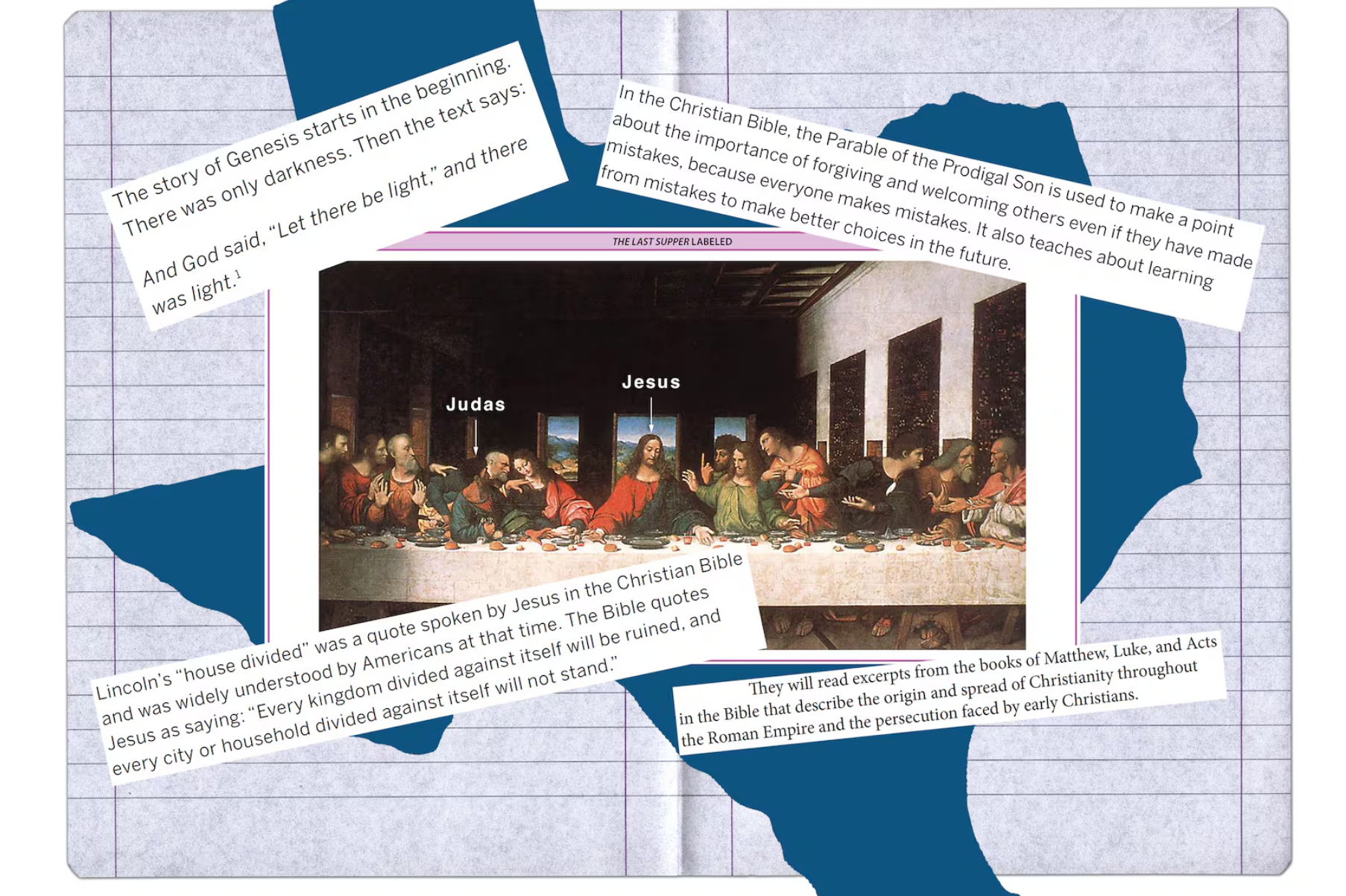
Kindergartners learn about the days of Creation in the Book of Genesis. First graders learn about the Parable of the Prodigal Son and fifth graders learn about Biblical allegories in “The Lion, the Witch, and the Wardrobe,” by C.S. Lewis.
The curriculum adoption in Montezuma-Cortez is the latest chapter in an ongoing debate about what kind of religious content belongs in American public schools. It also raises questions about why a low-performing district is using a controversial reading curriculum that wasn’t vetted by state evaluators and didn’t go through a public review process or school board vote.
Montezuma-Cortez leaders picked Bluebonnet because the district recently adopted a school reform model from the Houston school district, which approved Bluebonnet this summer.
Houston Superintendent Mike Miles, a former Colorado charter school founder, created the school improvement model Montezuma-Cortez is using. Called “New Education System,” it emphasizes explicit teacher-led instruction, keeping students engaged, and training for teachers and principals. With the help of consultants, Montezuma-Cortez will use the reform strategy at its three elementary schools starting this fall.
Colorado is a local control state and school districts don’t have to use state-approved reading programs, but most do. A spokesperson for the Colorado Department of Education said districts that don’t use state-approved curriculum must ensure the programs are evidence-based and meet state academic standards.
Superintendent Eddie Ramirez and six of seven Montezuma-Cortez school board members didn’t respond to requests for comment about Bluebonnet. Justin Schmitt, the district’s executive director of academic success, offered to talk by phone on Tuesday, but didn’t respond to follow-up emails to schedule the interview.
Board member Mike Lynch said by email Tuesday that the district is following Houston’s lead on curriculum because of that district’s “rapid and phenomenal turnaround history.”
“I want that outcome for my district,” he said.
Students in Houston schools that are part of the New Education System made significant gains on state tests in the last few years.
Lynch said he doesn’t know if Bluebonnet is evidence-based or how well it matches Colorado standards.
“In my opinion, we need to concentrate on teaching our kids how to read and do math,” he said. “Then we can worry more about matching the Colorado standards.”
Lynch also said he didn’t have enough information to form an opinion about Bluebonnet’s Biblically infused lessons.
“There is a difference between containing references from the Bible and teaching the Bible. There is also … number of occurrences, or degree of infusion,” he said. “I don’t know about those facts yet.”
Controversial from the beginning
The State of Texas developed Bluebonnet a few years ago by adapting an existing reading curriculum from the company Amplify. Despite criticism from religious scholars and advocates for church-state separation, Bluebonnet was narrowly approved by the Texas State Board of Education in 2024.
Texas districts aren’t required to adopt it, but they get financial incentives from the state if they do.
Mark Chancey, a religious studies professor at Southern Methodist University, said the problem with Bluebonnet is not that it includes religion but that its treatment of religion is not well done. It mischaracterizes some Bible stories, presents some too literalistically, and gives scant attention to religious traditions outside of Christianity, he said.
A second grade lesson on Esther, a Persian queen from the Bible, suggests she acted based on her faith in God and portrays her as a champion of non-violence for helping save the Jews. But Chancey said the Book of Esther famously doesn’t mention God and that Bluebonnet fails to mention that Esther promotes killing enemies of the Jews at the end of the Bible story.
Chancey said some Biblical content in Bluebonnet is not appropriate for the grade where it’s introduced.
“Is a 5-year-old going to say, ‘I’m so thankful that we’re learning about a creation story from Genesis for the sake of cultural literacy, but I understand that people interpret this differently, and not everybody accepts that it’s scientifically and historically accurate,’” he said.
“I don’t think many 5-year-olds are going to think that way,” he said.
Brent Strawn, a religion and law professor at Duke University, said knowing Bible stories and passages can give students a more nuanced understanding of everything from Shakespeare’s plays to pop music to common idioms, like “the apple of my eye.”
“You could make a case that reading the Bible, having some familiarity with the Bible, could help you as a kind of interpreter of cultural references,” said Strawn.
But he also worries that this rationale can be used to bring Biblical content into public schools when the real goal is to instill children with Christian values and beliefs.
“I’m … in favor of all Christian values. I’m an ordained minister,” he said, “But the question is whether that’s legal, and most people would say that’s not legal according to the establishment clause of the Constitution.”
That clause bars the government from promoting or prescribing one religion over others.
Strawn has not reviewed the Bluebonnet curriculum.
A sudden pivot, little public discussion
When officials in the 2,200-student Montezuma-Cortez district adopted Houston’s school improvement model last spring, the goal was to improve elementary students’ academic performance. One of three district-run elementary schools performs well above the state average on state literacy and math tests, but the other two perform far below.
District leaders originally planned to use a Colorado-approved reading curriculum as part of the improvement effort: Core Knowledge Language Arts. The school board approved a curriculum-use agreement with the Houston district in May that referenced that program.
But when Houston opted, despite opposition from some parents and faith leaders, to switch to Bluebonnet in June, Montezuma-Cortez officials quickly followed suit with no school board vote.
The two curriculums are related but not the same.
Bluebonnet was developed from Core Knowledge Language Arts as its foundation but has been adapted over time, said Kristine Frech-Barstow, senior vice president of corporate communications at Amplify, by email.
As a result, the curriculums are different and Colorado’s approval of Core Knowledge Language Arts doesn’t ensure Bluebonnet would also be approved, she said.
Ericka Burns, a consultant from the Colorado Springs-based firm Education Partners, said during a July 21 Montezuma-Cortez school board meeting that using the same curriculum as Houston makes it easier to use Houston’s school improvement model, but that it’s not necessary.
“We implement the instructional model regardless of curriculum,” she said.
Education Partners will receive $300,000 to help Montezuma-Cortez with the school improvement effort.
Bluebonnet materials include numerous mentions of Texas history and civics. For example, kindergarten lessons talk about the Texas flag, the Texas state capital building, the Texas Pledge of Allegiance, and famous Texans like Sam Houston.
In June, the Texas Education Agency announced it’s spending $8 million to fix thousands of errors in the curriculum, including typos, formatting problems, and copyright violations.
Chalkbeat is a nonprofit news organization covering public education.