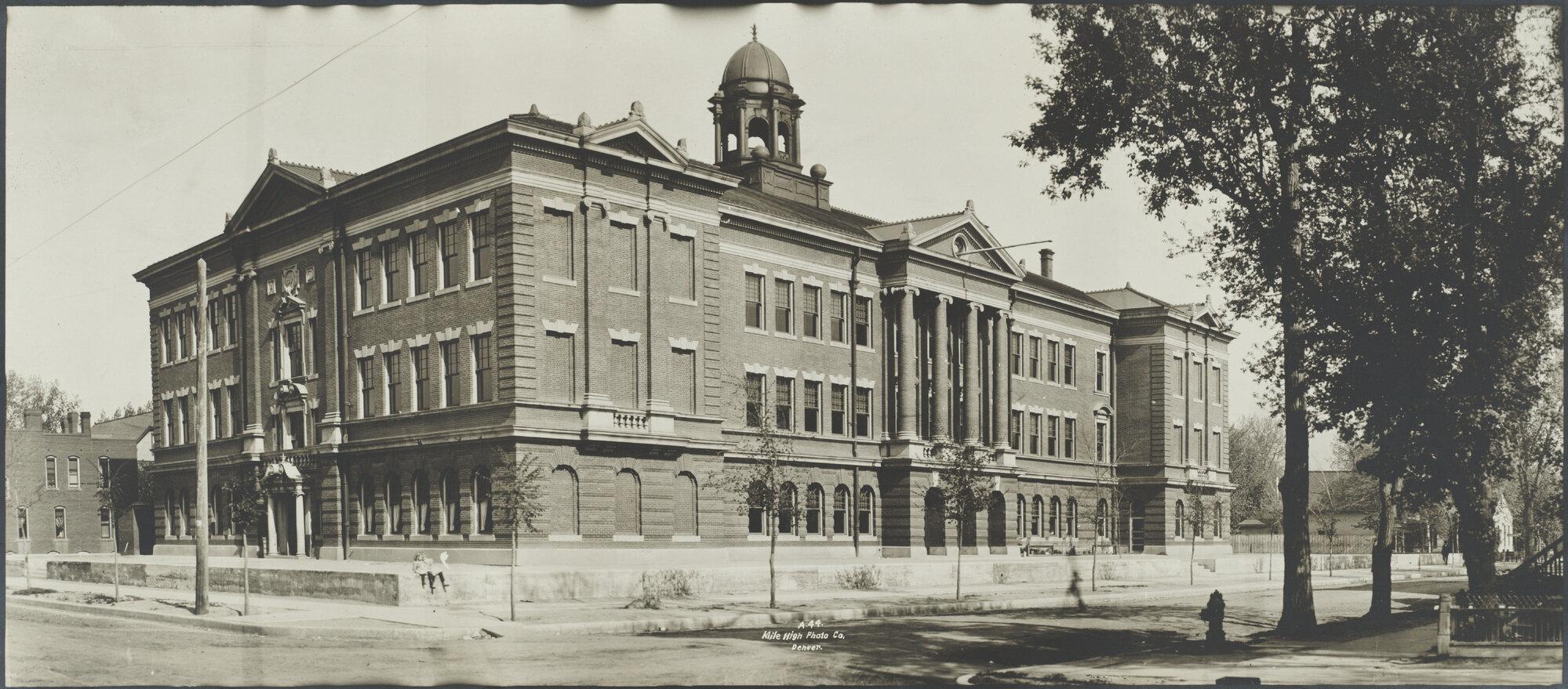
Provided by Denver Public Library Special Collections.

Audio By Carbonatix
Deaf children were once punished at the Evans School for using their hands to speak. Now, patrons raise pints where silence was once enforced.
That troubling history could soon change the school’s designation on the National Register.
Built in 1904, the old school at 1115 N. Acoma St. is now occupied by Schoolyard Beer Garden, but its longstanding history with serving the deaf, blind and others with physical disabilities has led to History Colorado and Colorado School for the Deaf and the Blind proposing a National Register of Historic Places nomination amendment.
While the school is already on the National Register, the amendment would change its significance from just being an old building. If passed by the Landmark Preservation Commission on Sept. 1, the recommendation will be forwarded to the Keeper of the National Register to be listed as a historic building under Education, in association with Social History: Deaf Community History and other similar areas of significance.
But the school’s path to becoming a historic site is steeped in both positivity and negativity.
“This National Register nomination is an excellent example of a nomination that grapples with difficult history, addressing history without minimizing the harms of the past,” Becca Dierschow, senior city planner for the Landmark Preservation and Community Planning and Development of the City and County of Denver, said in the ammendment request.
Dierschow went on to note that the school’s deep connection with oralism — the forbidding of sign language and the requirement of lip reading — supports the importance of placing it on the National Register.
What is oralism?
Before the three-story, brick building became a beer garden, it was the only school in the city that taught people with physical disabilities, like deafness. But it didn’t teach sign language.
After the Civil War, education reformers pushed schools to drop “manualism,” or the use of sign language, and replace it with “oralism,” the exclusive use of speech and lipreading. Around 1860, lipreading and speech were added to curricula all over the country, including at the Colorado School for the Deaf and Blind in Colorado Springs when it was established in 1874.
In 1880, the International Congress on Education of the Deaf (ICED) in Milan even declared that oralist education was superior to sign language education, leading to a resolution that banned sign language in Deaf schools.
The idea was that using sign language would slow down student learning. Even famous figures like Alexander Graham Bell (ironically, the creator of the telephone) proclaimed that speech was essential, according to the Disability History Museum.
“This pedagogy was focused on integrating Deaf students into ‘mainstream’ society rather than understanding their needs and primary form of communication,” Dierschow reported.
A 2018 article in the Maternal and Child Health Journal by researcher Wyatte C Hall claimed that not teaching Deaf children sign language can lead to cognitive delays and mental health difficulties. “Altogether, a fundamental and irreversible biological impact — on the brain and on healthy development — appears to occur when an accessible language is not provided by a certain early time period in brain development,” he wrote.
The ICED even apologized for the historical harms of oralism during a conference in Vancouver in 2010.
Past and future
The Evans School was named after territorial governor John Evans, who lost that job after the Sand Creek Massacre but made a comeback as a city booster. The first class for Deaf students began in 1925, which followed oralism. Oralism continued in the school until it closed in 1974, after white flight to the suburbs crushed the school’s enrollment.
“Deaf Denverites were not consulted about how their own children would be taught, and that was not acknowledged until the 1990s,” Denver City Councilman Chris Hinds, whose district includes the school, tells Westword.
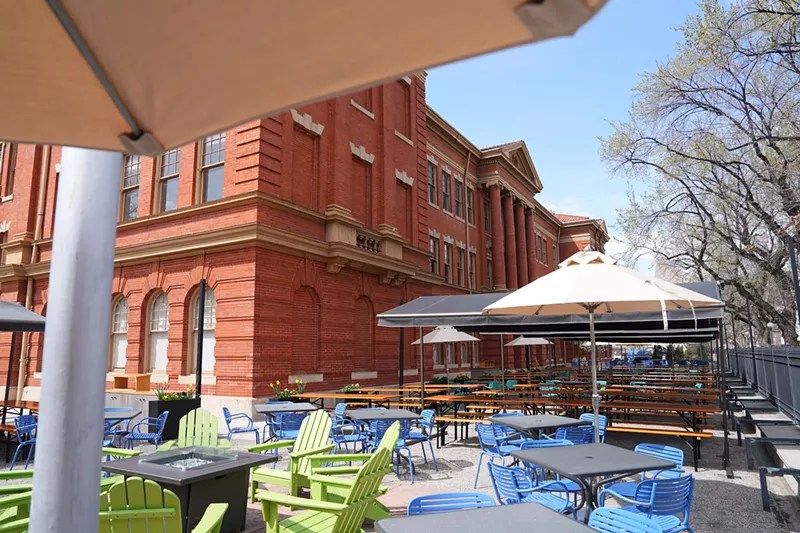
Marc Piscotty
History Colorado also doesn’t refer to the school by its Evans name because of the negative legacy around John Evans, instead opting for the address. The state agency said in the amendment application that it is in communication with the indigenous, deaf and blind communities about potentially renaming the school.
The school was set to be destroyed over 50 years ago, but residents Richard and Alan Eber purchased the property at an auction for $620,000 in 1974. The two man didn’t have plans for the building, though, and it sat dormant until the land was sold to Lennar Multifamily Communities for $18 million in 2019. That same year, the investment firm sold the school building to City Street Investors, the team behind the redevelopment of Denver’s Union Station, Hangar 2 Lowry and Edgewater Beer Garden, for $11 million.
The original idea was to restructure the building into co-working and office spaces, but COVID changed the plan. The downstairs bar and cafe opened in 2025.
The building was listed on the National Register of Historic Places in 1980 and was later designated as a Denver local landmark in 2001.
Hinds says that the history of the school being Denver’s place for Deaf and Blind students is worth preserving on its own, but the documentation of oralism makes it even more crucial.
“What makes this nomination unusual is that it does not stop with the institution’s accomplishments,” he says. “Preservation is at its best when it tells the whole story, and I am glad History Colorado and the Colorado School for the Deaf and the Blind chose to tell this one honestly.”