Photo by Michael Chavez

Audio By Carbonatix
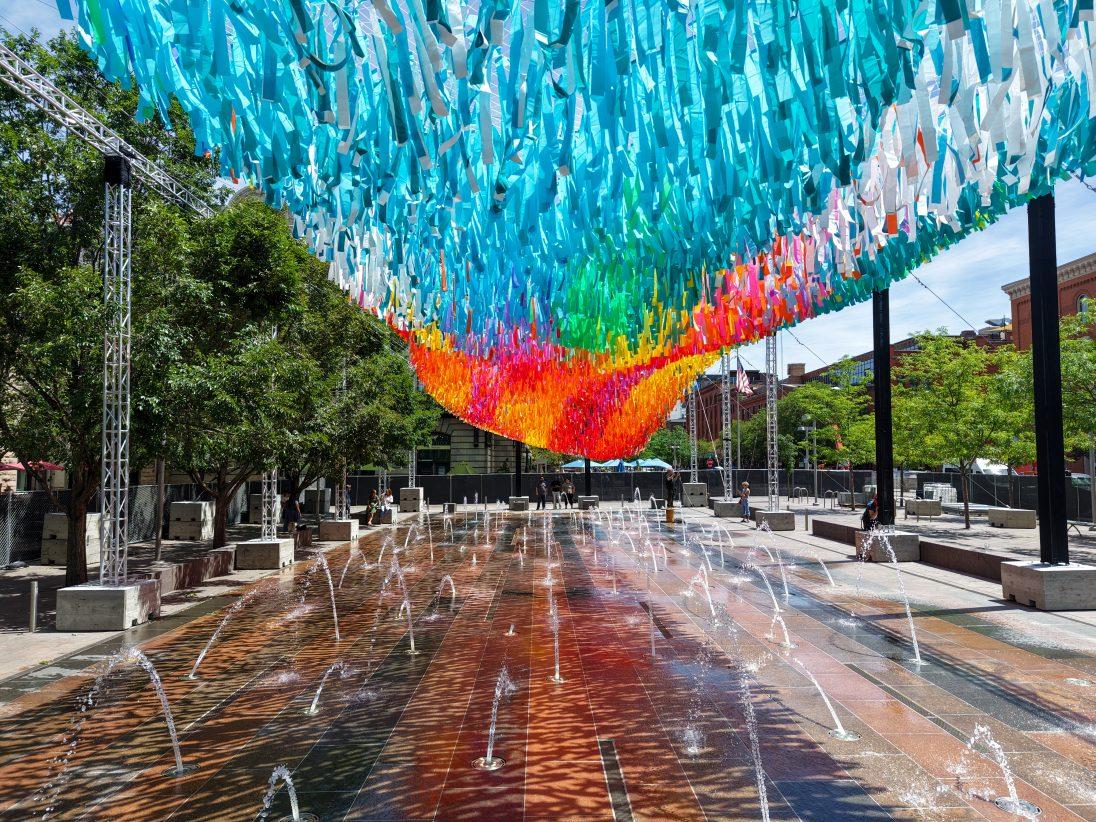
The colors of “Sun Splash,” the new aerial art installation hanging over the splash pad outside Union Station, blew in the wind with a sound like crashing waves. Below, children screamed with glee as they ran through sprinklers. Adults paused to take photos of the 2,750-square-foot structure made of 16,249 pieces of kite fabric that reflects its colors in the fractured light of the puddles beneath it.
Birds sang. Music could be heard from a nearby restaurant. But suddenly, a new sound entered the scene.
“Fuck you, bitch!” The repeated exclamation was yelled by one man to another, both standing in the splash pad with water spraying at their ankles as they cursed at each other. A mom quickly wrapped her daughter in a towel, and they scurried away.
A third man interjected from across the pond: “Shut the fuck up! There are children here!”
A boy ran in circles around the two men fighting in the splash pad, either oblivious or beyond caring.
A perfectly idyllic day in downtown Denver.
Loud quarrels aside, these idyllic days are the goal of the Denver Downtown Development Authority, which collects a portion of taxes generated in the city’s Central Business District and then reinvests those funds into economic development in the area.
The DDA began accepting applications last year for “major projects that will redefine the downtown experience and attract new residents, businesses and visitors.” It’s one of the city’s latest efforts in revitalizing downtown Denver. A revamped 16th Street was unveiled in October after a three-and-a-half-year $175 million renovation project that beautified the area with public art and dropped the “Mall” from its name. Days earlier, the DDA acquired the Denver Pavilions mall on 16th Street for $37 million.
“Downtown Denver is a hub for community gathering, helping to shape Denver’s identity and cultural fabric,” says Nick Marion, Denver Department of Finance marketing & communications specialist. “A vibrant arts and culture scene attracts citywide residents, tourists, boosts local businesses and creates jobs in key downtown employment sectors. Cultural amenities enrich the urban experience, making downtown a more attractive place to live, work and visit. Furthermore, arts and cultural investments provide valuable educational opportunities, fostering lifelong learning and youth engagement. By investing in arts and culture, downtown Denver will position itself as a neighborhood where innovation and creativity thrive.”
Hoping to bring more people into downtown, the DDA awarded $166 million in investments across 13 different projects pertaining to restaurants, parks, art and other attractions in 2025. On June 24, it approved another package of such investments, setting aside around $50 million for efforts including a job creation fund, money to go toward establishing a regional innovation and entrepreneurship hub at Independence Plaza, a new mural at the Denver Pavilions and support for the Community Arts Stabilization Trust (CAST), which works to create affordable living and working spaces for artists.
Last month, the first two installations of “Skynets,” a summer aerial art series “designed to drive immediate foot traffic, visitation and joy into the city’s urban core” at three public locations created by Colorado-based artist Patrick Shearn and his studio Poetic Kinetics, were unveiled.
“Sun Splash” at Union Station and “Quaking Gold” at Glenarm Plaza are up now, while the third, “Skyline Drift,” is set to open at Skyline Park sometime this month.
Shearn maps out each piece of kite fabric with pixels in a computer program for his Skynets installations, enabling him to create massive gradients while being very specific about where colors land in the overall shape. He says the art is inspired by the murmuration of birds, particularly the mesmerizing way that hundreds of starlings move together in the sky.
“It’s beautiful and magical, and something happens to me, like taking a breath that’s too big for my lungs to hold,” Shearn says. “It’s a distinctive awareness of awe. And I was thinking, ‘How could I create that same sensation in somebody viewing my work?’ So I started experimenting with this concept in a desire to mimic and recreate murmuration.”
The result is a hypnotic flow of colors in the sky that move and reflect differently depending on the lighting and weather.
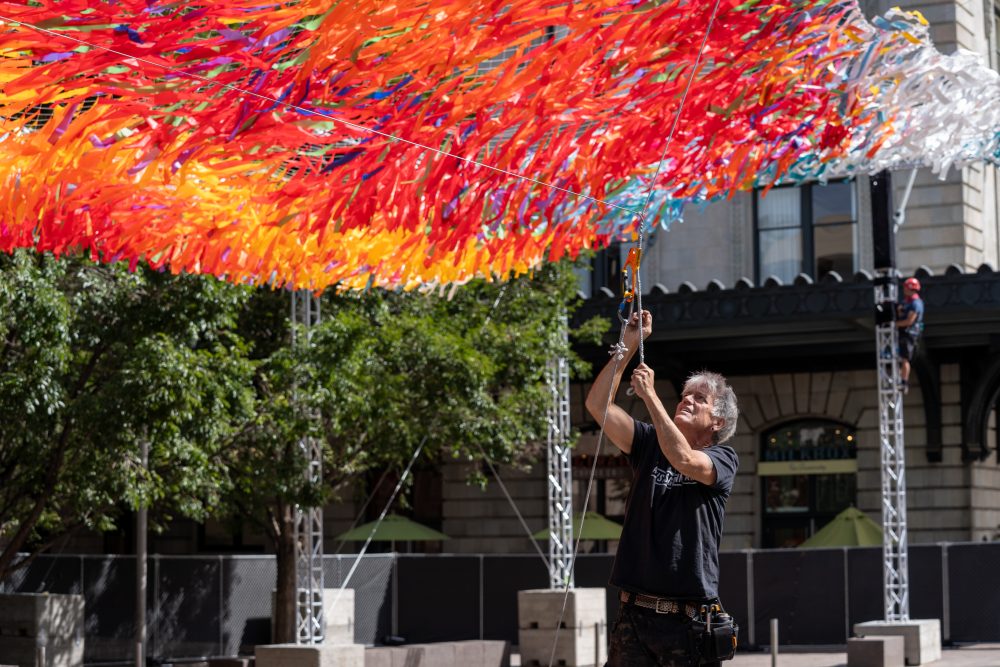
Photo by Michael Chavez
Shearn invites people to take pictures and videos of his installations, but also wants you to “spend some time not looking through your screen.”
“It is immersive, they are large. You can look into them and see color play, see the dramatic motion of the wind,” he says. “They’re meant to be experienced and explored. Come when it’s windy, when it’s breezy and when it’s still, because they’re all really different in different weather conditions.”
Shearn, whose studio is based in Black Forest, got his start in the film industry working on films like “Jurassic Park” and creating installations featured at outdoor festivals, like Coachella and Burning Man. Last summer, his “Off the Beaten Path” installation above Gazebo Lake in Green Mountain Falls went viral, drawing a high of 1,000 visitors per day to a town of 700 residents.
Over the lifecycle of the installation, the small town just north of Colorado Springs saw a total of 100,000 visitors, Marion says.
“The installation also contributed to a 36% year-over-year increase in sales tax revenue [in Green Mountain Falls],” Marion adds. “The city has seen a lot of momentum and positive reactions to the aerial art installations in our downtown, and we look forward to future applications from artists and creatives that demonstrate potential to drive foot traffic, visitation and joy into our urban core.”
Poetic Kinetics was paid $635,500 for the installations, according to Marion.
The sky’s the limit for some of Denver’s city-funded arts projects, like “Skynets.” CAST, a San Francisco-based arts nonprofit that expanded to Colorado last year, has also been a rising star in Denver’s cultural landscape, thanks in part to a DDA grant.
But other arts efforts funded by downtown tax revenue have already come crashing down.
The Dirt on DIRT
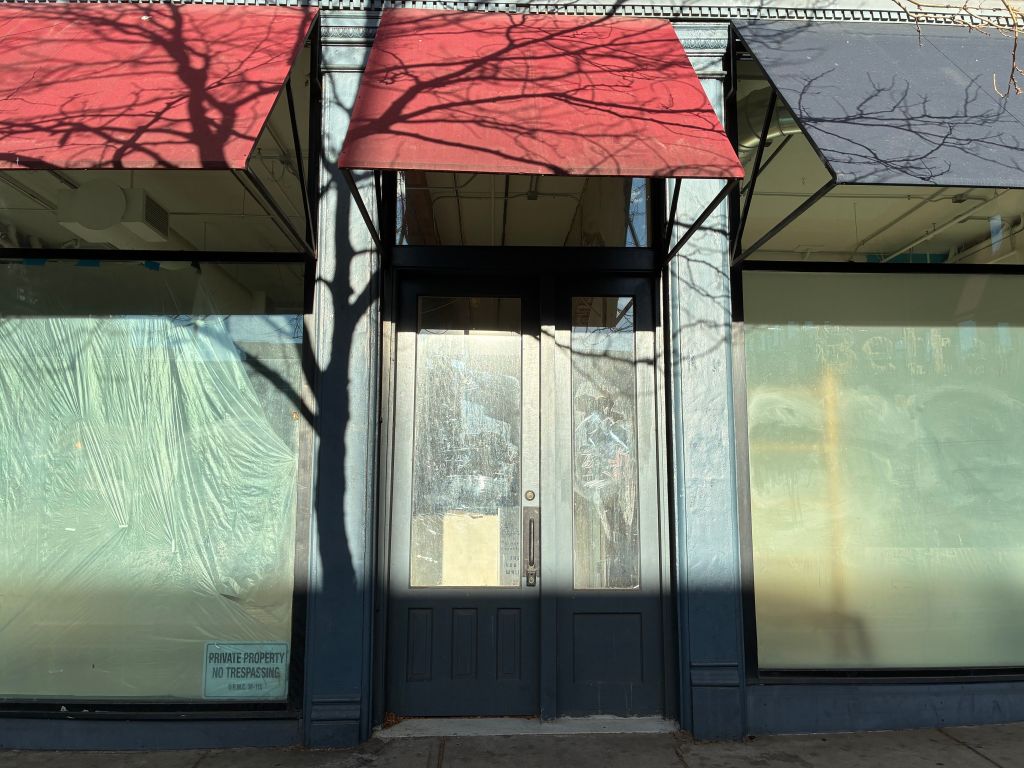
In February 2025, Westword reported that two theater veterans, Steve Wargo and Blair Russell, were converting the former Patagonia store at 15th and Blake streets into Denver’s very own immersive theater hub, Denver Immersive Repertory Theater (DIRT). A few months later, the DDA announced that it would award DIRT a $400,000 small business loan as part of its pilot business incentive program; at the end of 2025, Wargo and Russell said they were preparing to open the venue’s first show, “Midnight’s Dream,” a reimagining of Shakespeare’s “A Midsummer Night’s Dream” using Celtic folklore and faerie mythology.
In December, Russell told Westword the DDA money was earmarked for renovating the building, part of a broader build-out he estimated at just under $1 million to create the “warm gray shell” that would bring the space up to code and “be our home for a good long while.” From there, Wargo estimated it would take roughly $600,000 to put on “Midnight’s Dream,” which was supposed to open in April.
But by June, there had not been a single production of “Midnight’s Dream” at DIRT, because the theater still hadn’t opened. On June 15, the DIRT Facebook page said in a post that Russell and Wargo had decided to “release our performing company from their contracts rather than keep them waiting indefinitely while we finish the build.”
Toni Tresca for Westword
“In the last twelve months, DIRT has endured some unforeseen challenges that have caused significant operational delays and financial impacts towards completing construction on our building as originally envisioned,” Russell and Wargo told Westword in a July 1 statement.
By July 2, DIRT was issued an eviction notice on 15th and Blake by landlord Fred Glick, who says the theater owes $51,000 in unpaid rent for May and June, BusinessDen reported. The eviction came on the heels of a lawsuit against DIRT by Littleton-based Beaver Construction Consulting, which alleges that the theater company owes $268,707 for unpaid work.
A copy of DIRT’s DDA loan agreement, obtained by Westword, specified that if the city deems the loan insecure, the full amount of the loan will immediately become due.
Russell and Wargo did not respond to a request for comment about the lawsuit or eviction notice, and Marion says that the city does not have any additional information about DIRT to share at this time.
As the idea of a downtown Denver hub for immersive theater exits stage left, a Mile High hub for film artists is emerging — where drama only shows up in scripts and on screens, hopefully.
Downtown Hub for Film Artists
CAST’s building at 444 17th St. is set to become home to six artist studios, a micro cinema, affordable artist storage and a gallery. According to Louise Martorano, Managing Director of National Programs for CAST Colorado, the building could open as soon as spring of next year.
On June 24, the DDA approved a $1.35 million grant to support the acquisition and conversion of the vacant 6,300-square-foot, ground-floor space. CAST settled on an acquisition price of $500,000 for the building, using the remaining $850,000 for renovations for the microcinema, studios, gallery and storage, Martorano says. The nonprofit hopes to close on the building by early fall.
Martorano, who spent 15 years at RedLine Contemporary Art Center — most of it as executive director — before taking on the job with CAST, says the downtown location “was envisioned in response to the lack of infrastructure for film and video-based artists in the Denver area.”
Over the last 18 years of working with artists across various media and mediums, there was a consistent request for affordable and secure screening space, performance space with non-concrete floors, and more opportunities and spaces to share contemporary film and video work,” she continues. “There is already an expansive community of independent video, performance and filmmakers in Colorado, so this resource is with them in mind and the communities that surround their practices and ideas.”
Martorano aims to provide a locally-driven, centrally located creative hub for arts and culture organizations to offer creative programming and events to locals and visitors alike. “This new space comes without pretense or expectations, but rather a sincere offering to share in an affordable resource and creative infrastructure for artists that our city and state art agencies believe in and want to support,” she says.
Founded in San Francisco in 2013, CAST’s expansion into Colorado marked the agency’s first extension to another state. Earlier this year, CAST secured the East Street School in Trinidad as an affordable housing project and studio space for artists; Colorado Creative Industries hosted its annual summit there last month.
Looking forward, Martorano is excited to facilitate 444 17th St.’s transformation into a community-driven resource for film, media and video as well as a space for affordable artist studios and fine arts storage space. If all goes well, it should be open before next summer.
“Both are critical to continue supporting artists who choose Denver as their home, and this funding approval is a validation that artists need permanently affordable space to thrive, that culture matters, and it’s worth every effort and process to protect,” Martorano says.
How Do Artists Get DDA Funds, Anyway?
The DDA wants to continue funding arts and cultural projects. According to Marion, applications for artistic installations will reopen later this year, and the event infrastructure category is currently open, Marion says. Entities can apply through a formal application process on the city’s Downtown Development Authority webpage.
“The city then completes an evaluation process, which includes working with applicants to better understand and refine their proposals,” Marion says. “Art displays involving public right-of-way have additional review for assessment of traffic and public access impacts. Projects are then sent to the [DDA] Board of Directors for consideration of funding.”
He adds that most reviews are expected to be complete within 30-90 days, with an additional 30-90 days for the approval process.
It took nearly six months for DIRT to receive its DDA funding after being picked as a loan recipient. Marion says the length of time to receive DDA funding “varies largely by project and is based on a number of factors specific to each project/proposal, including the applicant’s ability to successfully execute a contract with the [DDA].”
Not every project has been an immediate success, but the positive effects are already noticeable in downtown Denver.
“Skynets” waved its colors over Denver PrideFest, which was held for the first time on 16th Street on June 28, bringing thousands of people downtown. Meanwhile, as visitors step out of Union Station this summer, they’ll be immediately greeted by even more cool art.
And, if they’re lucky enough, two guys fighting in a splash pond.