Courtesy of Andrew Bray

Audio By Carbonatix
A guy stopped me on my way out of the rec center the other day and thanked me for the High Plains Comedy Festival. We were leaving at the same time, and he noticed my High Plains hoodie. He told me that his brothers fly out to join him for the festival every year, and it has become a cherished tradition. Then he thanked me for it. I said, “You’re welcome,” and told him how much I loved that tradition. I didn’t have the heart to tell him we’re hanging it up.
Because I knew how he would feel. He’d feel the same way I do every time something I love folds in this city: Like a page has turned. Like, maybe it’s even a new book now. And you know eventually you’ll get into this new book just fine, but goddamn, you were really enjoying what you were reading.
So, it goes.
RIP High Plains.
Long live High Plains!
Since we announced that we were ending Denver’s little indie comedy festival that could, I’ve fielded a handful of media requests. They want to know what it all meant; they want to fold it into a broader narrative: The arts culture of the city, the financial feasibility of indie festivals in general, the health of the Denver comedy scene. I’ve held my tongue. I don’t know about any of that. All I know is that for thirteen years we did something really cool. And I’m proud.
Origin story time!
I was lucky enough to attend the seminal Bridgetown Comedy Festival in Portland, Oregon, in the mid-to-late-2000’s. There’s no overstating how influential that festival was for comics of my generation. How would I define that generation? Loosely: left-of-center people who admired the fearlessness of NYC/LA-adjacent alternative comedy and did their best to put their own spin on it.
Bridgetown was indie rock, versus arena, more Maria Bamford than Seinfeld. It was silly, and fun, and free, summer camp for comics. There were no stakes, and that made the performances feel pure, and thrilling; a place where it was safe to experiment.
It was impossible to perform on a festival like that and not feel inspired. I remember flying home thinking one, I want to try to feel this carefree in comedy forever; and two, why the fuck doesn’t Denver have this?
So, I set about changing that.
My first stop was Illegal Pete’s.
Many people have asked me how to start a comedy festival. I say, get yourself someone who looks at you like Illegal Pete’s looks at you. I met with Pete Turner, whom I casually knew at the time, and he asked me what I would need.
“$5,000?” I bullshitted.
I had no idea.
Pete wrote me a check. That was that. Thirteen years later, Illegal Pete’s remains our title sponsor, and Pete is a dear friend. Amazing what can be accomplished when someone supports the arts scene in their community, the way Illegal Pete’s continues to do all the time.
That first year was scrappy, and messy, a bit of a carnival on drugs, which it was; somehow it worked. People loved it, comics loved it, and we didn’t have our hat handed to us.
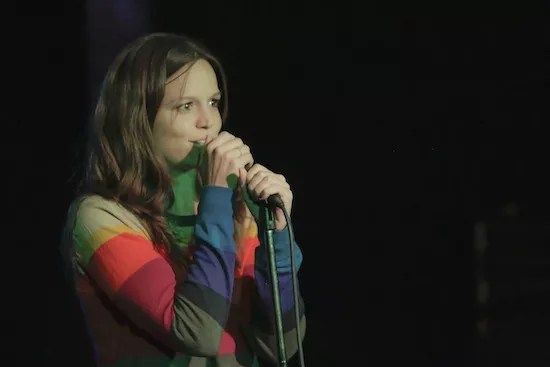
Ryan Brackin
A DIY effort like that is only possible through the goodwill of others, and right away, so many people volunteered — to pick up comics at the airport, to load in chairs, to stock greenrooms, hang banners, stuff gift bags, run tech. The comedy supporters of this city rolled up their sleeves.
The afterparties were immediately legendary, and probably very illegal: People dancing in the back of Mutiny Information Cafe till the sun came up. We held one after-party in the basement of the now-defunct Buffalo Exchange, and through the haze of memory and alcohol, I just barely remember comic after comic riding down this industrial conveyor belt, the way luggage enters a baggage carousel, and laughing till my sides hurt.
We experimented with venues — the Gothic Theatre, the McNichols Building in Civic Center Park — but it was a Baker festival through and through. I lived nearby at the time, and I wanted the festival in my neighborhood. Hi-Dive immediately opened its doors because it rules and always has. 3 Kings, now HQ, hosted us as well, ditto the aforementioned Mutiny. They all welcomed in our shit-show. It made for an easygoing, walkable fest, one where you could bounce across the street to catch a certain comic’s set, then dash off to the next venue if you were so inclined, like a music fest, but with jokes.
But High Plains really leveled up when Comedy Works Entertainment came on board.
CWE agreed to partner with us on marquee, headlining shows at Denver’s iconic Paramount Theater, an 1800-seater where they regularly put on shows too big for Comedy Works club space. Now we could pull in the big names and include a ticket to their show with the festival pass. Still, we kept our aesthetic: Anthony Jeselnik, Maria Bamford, Nikki Glaser, Matteo Lane, David Cross, Bob the Drag Queen, “My Favorite Murder,” “How Did This Get Made?” on and on. Then those comics would finish their sets and come hang with the rest of the comics on South Broadway, even dropping in unannounced on late shows.
High Plains was taking shape, but it was kind of sloppy. That all changed when my co-producer Karen Wachtel came on board. Karen had been volunteering for the festival for years, so she knew it backward and forward. She was one of those super-volunteers, the type who gets it, so you keep assigning them more responsibility, until eventually you’re forced to realize they should probably just be running the damn thing. Like, spreadsheets?!
What the fuck?!
After some shuffling of deck chairs, Karen came on board as co-producer, and that’s when High Plains really hit its stride. Having Karen handle so many of the organizational components allowed me to focus on booking the thing and performing, which allowed me to enjoy the fest more. I still had to work my ass off every year, but once the festival train was out of the station, I didn’t have to run around putting out fires. Karen and the cracker-jack staff she assembled could handle that. I could just be a comic. As much as my neurotic self could allow, anyway. That’s all because of Karen Wachtel. Simply put: she made the festival exponentially better.
And, the rest, as they say, is history. Just like the High Plains Comedy Festival.
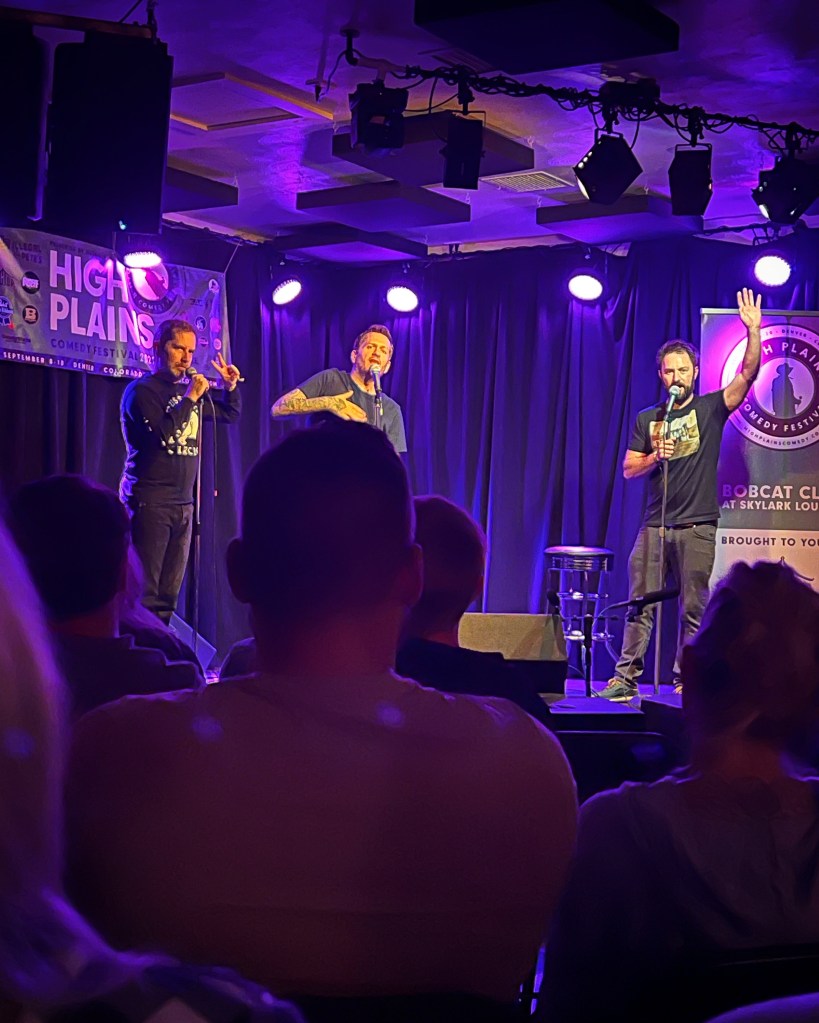
Adam Cayton-Holland
Some favorite memories? Sure. Let’s indulge.
An impromptu baseball game in a conference room of the McNichols building, with a wiffle ball and the top of a pizza box as a bat. Comic field trips to Eldorado Springs and the OG Casa Bonita, where I had to demand people only eat chips, lest explosive diarrhea keep them from the stage. Dave Hill absolutely shredding on guitar. Reggie Watts entering a new dimension on stage. Eddie Pepitone, always Eddie Pepitone. Kate Berlant let loose on multiple stages in one night. Getting to have Marc Maron on my podcast. A “Those Who Can’t” table-read where Bobcat Goldthwait did the voice. All those Fine Gents opening sketches. Me and the Grawlix boys playing flutes to simulate the DIA train music. The barbecues we held every year in Wash Park, where David Gborie and Steven Agyei made every comic footrace, and refused to stop calling it “Race Wars.” They even made merch.
Man, just writing all those down made me sad as hell.
I’m going to miss having an annual reason to invite so many people I respect and admire to come play in my backyard. Because it really was an act born of fandom: For comics, for comedy, for Denver. Sure, I’m part of all of that, but I truly enjoyed watching the festival as much as participating in it. It was the type of festival that I wished to see in the world. That’s why I never accepted submissions. I didn’t want to watch said five-minute clips. I just asked people I found great to come perform. Then I asked those people whom I should know about. Duh.
Every year, as the final after-party was winding down, I’d take the mic and say a few words. These last few years, I’ve given that speech earlier and earlier. I started the festival because I wanted to party with all my favorite comics. Now I’ve got two young boys. The party isn’t for me anymore.
I can’t tell you what all I said in all those many speeches over the years, twelve in all. But I think essentially it boiled down to thank you. Thank you so much to the volunteers and staff. Karen, thank you so much for helping run this thing. This festival would never have lasted this long if you didn’t come on board, and I can’t thank you enough for all your hard work. We did something great here. Thanks to later-addition venues Chaos Bloom and the Skylark Lounge, instant staples. Thank you so much to all my comedian friends for letting me grossly underpay you, sure, but mostly for inspiring me, being brilliant and fearless and never punching down, never succumbing to toxic inanity, the kind that enables literal fascism because you’re frustrated you shouldn’t say the R word anymore. Thanks for not being that. Thanks for being the opposite of that.
Thank you so much Denver, for showing up and making a festival like this possible.
I was at a bar in San Francisco with my wife once. We were admiring all the cluttered ephemera on the wall behind the bar. All the Giants championship banners. Mostly we were lamenting the ineptitude of Dick Monfort, wishing he would sell the entirety of the Colorado Rockies to the Penners and go the fuck back to Greeley. But I digress. My wife and I were remarking how each of those pennants constitutes an entire season, an era in time, and how that contributes to the fabric of a city, the culture of a place. Back behind the bar, gathering dust, something extraordinary is commemorated. You process it almost unconsciously, but I believe it does seep into you: The fact that something amazing happened in this city.
Occasionally, I’ll see someone wearing High Plains merch out in the wild, the same way that guy at the rec center took note of my hoodie. It always has Geoff Tice’s killer artwork on it — thanks, Geoff! — and I always smile when I see it. It makes me feel like High Plains contributed to the story of Denver, like we’re part of the wallpaper now, cluttered ephemera behind a bar that help tell the story of a place. Through this festival, I’m happy to have contributed a little bit to the story of Denver. But now High Plains must die the DIY death of all DIY things, for that is the nature of DIY.
This book is over. Time for someone else to write the next one.