
Kristen Fiore

Audio By Carbonatix
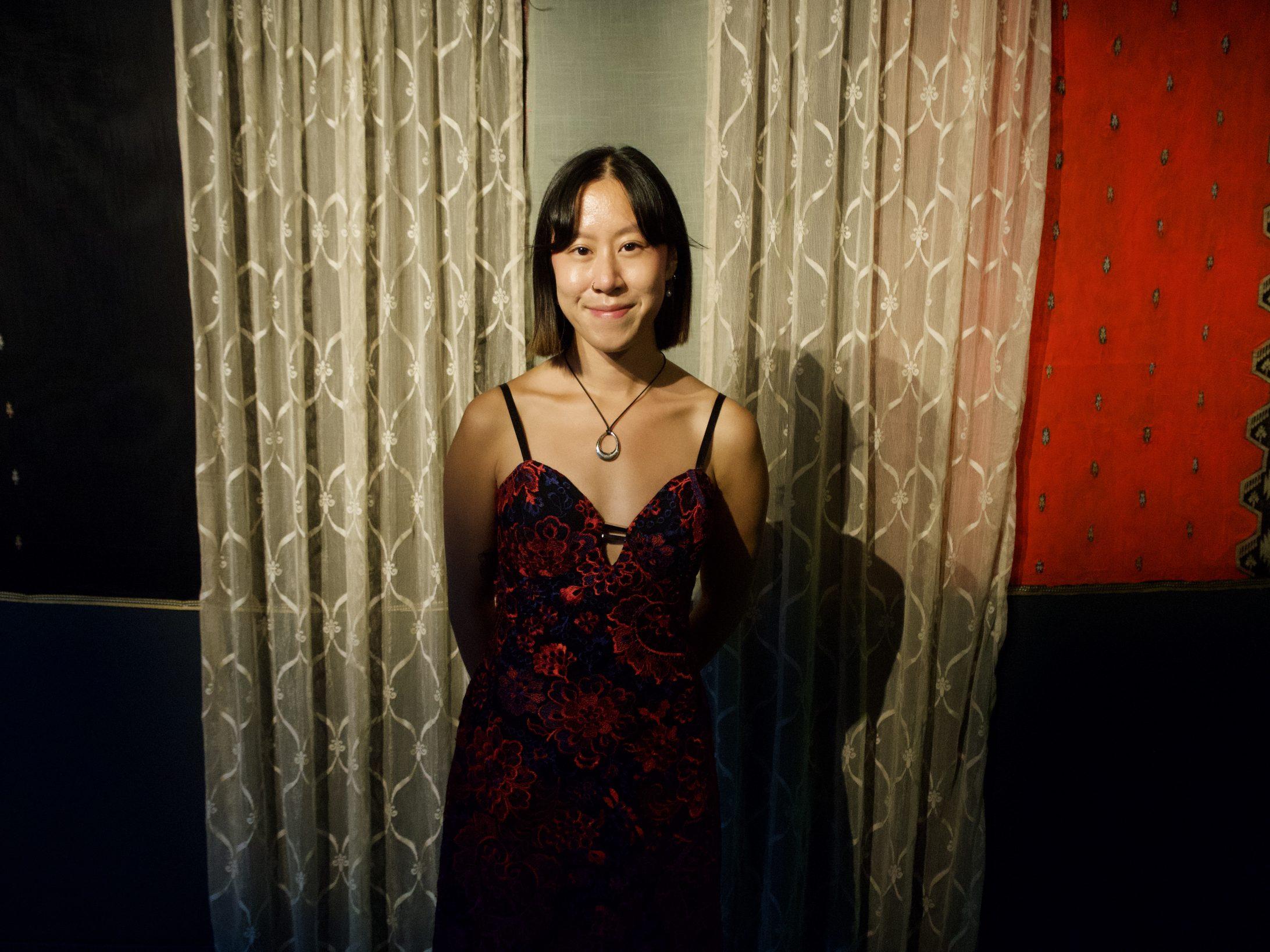
Felicity Wong wants people to think about their clothes more.
She’s certainly done a lot of thinking about them herself — enough to fill up a whole master’s thesis and an exhibition at Union Hall Art Space.
“Wearing, Wearing,” which opened in late June and runs until Aug. 8, investigates the relationships between clothing and decay through the lens of racial and colonial capitalism, with installations by artists Sarah Darlene, Allegra Giddings, Elle Hong, Paloma Jimenez, Allison Sheldon and Flora Wilds. Wong curated the show as part of Union Hall’s Rough Gems curatorial training program, designed in 2019 to cultivate curatorial leadership and create real-world experience for emerging creatives.
Wong, who recently graduated with a master’s degree in art history from the University of Colorado Boulder, found out about Rough Gems as she was starting her master’s program and knew she wanted to apply once she had a concrete idea for an exhibition.
She’s always loved clothing, but says that as a child of immigrants from Hong Kong, she grew up with the mentality that fashion was frivolous. “There was the joy that it brought me, but it wasn’t something that felt serious or important,” Wong says. “I felt that tension growing up.”
Then she went to college. As an undergraduate English major at the University of Notre Dame, Wong remembers looking at microfiche copies of British Vogue and “thinking about how clothing was negotiated as this cultural, political act in ways that could be quite subversive,” she says. “It was so intellectually amazing for me to delve into all of that. … I was like, ‘Wow, I can think about clothing in an academic context.'”
It was liberating. As she continued her studies in graduate school, her readings provided tools to think about clothing through other lenses, like gender, colonialism, colonization and capitalism. But she started to think about it in a more personal context, too: “The Pearl River Delta [in southern China] has historically been a port and site of a lot of production, trade and garments,” Wong says. “I found out quite recently that my maternal grandmother was a seamstress and worked in a lot of the garment manufacturing centers that were popping up in southern China in the late 20th century. I don’t know the exact political-socioeconomic context from which she was working, but I find those connections all the time now.”
The framework for “Wearing, Wearing” started to form. Wong reached out to artists whom she thought could be a good fit to challenge or inform the idea, and her proposal was accepted by Union Hall.
“A lot of this exhibition is, for me, a response to a lot of fashion exhibitions at neighboring institutions that have spotlighted couture collections,” Wong says. “I think I wanted to produce something different, and think about clothing that wasn’t necessarily couture, nice and pristine.”
While she’s not against slow fashion or pro-fast fashion, she says that in fashion communities, there is a tendency to demonize fast fashion, to see clothing with “made in China” labels as shoddy and disposable, whereas garments with “made in Italy” labels are seen as couture and luxurious.
Wong wanted to dive into the dichotomies in the fashion industry: The high and the low, the fast and the slow, the couture and the mass-produced. “I see a strong connection between the way these dichotomies have been drawn, and going back to what I’ve spent a lot of time researching — how racialized labor has perpetuated those distinctions.”
The artwork that came together for “Wearing, Wearing” explores these themes in a variety of different ways. Sheldon’s piece, which includes a jacket made from Sheldon’s grandmother’s quilts, deer bones, salt and chamomile, is a meditation on grief and death.
Kristen Fiore
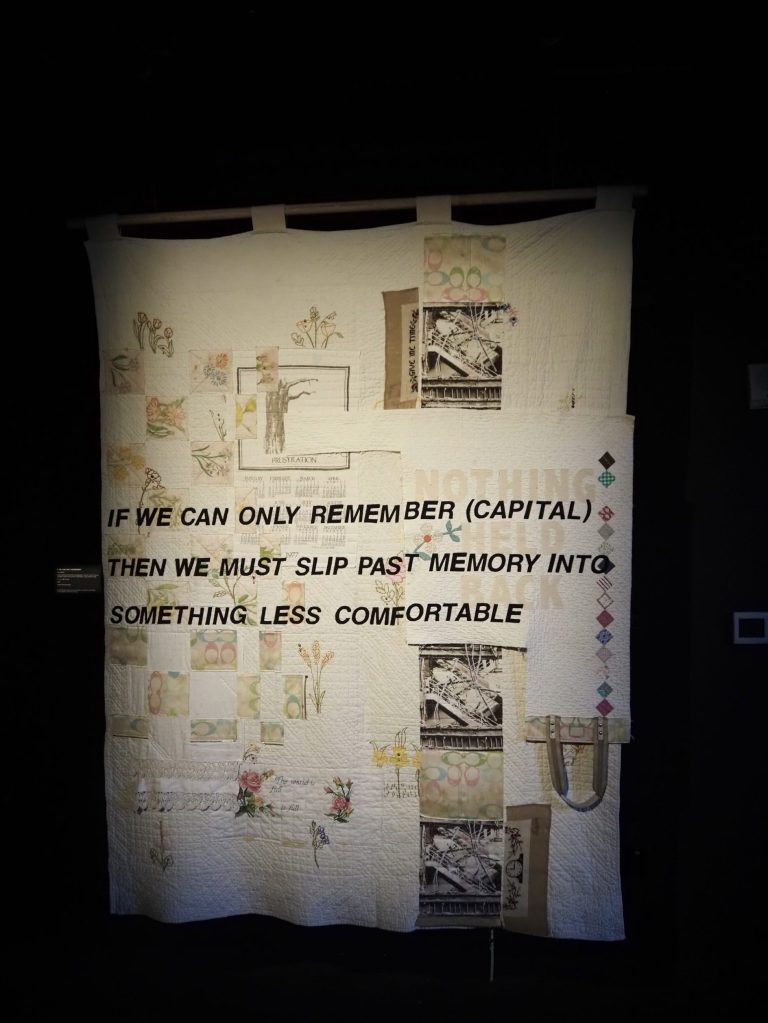
L.A. artist Wilds — the only artist in the exhibition who is not based in Colorado — created an installation of quilts, Coach purses and a video element, juxtaposing the handmade and the mass-produced. It critiques consumption, but also embraces it.
“For her, growing up in the early 2000s, Coach purses were such an aspirational symbol, a commodity icon of femininity for her,” Wong says. “We’ve had a lot of conversations about how Coach purses today are seen as middle ground. It’s an affordable middle-class symbol. But for her growing up, it was aspirational, and she saved up all her money in middle school to afford a purse.”
Meanwhile, Hong created a lo-fi, digital waste video projected onto two mannequins like clothing that speaks on surveillance technology and transness. Darlene created collages with fabric and paper, using her own clothing as well as the clothing of family members, friends and lovers, resulting in works that Wong describes as “regurgitated energy.” Jimenez created sculptures of socks and underwear with email sign-offs around the bands, and Giddings, a fashion designer, displayed handmade clothes made out of recycled materials and a wall of photos of those clothes being worn.
-
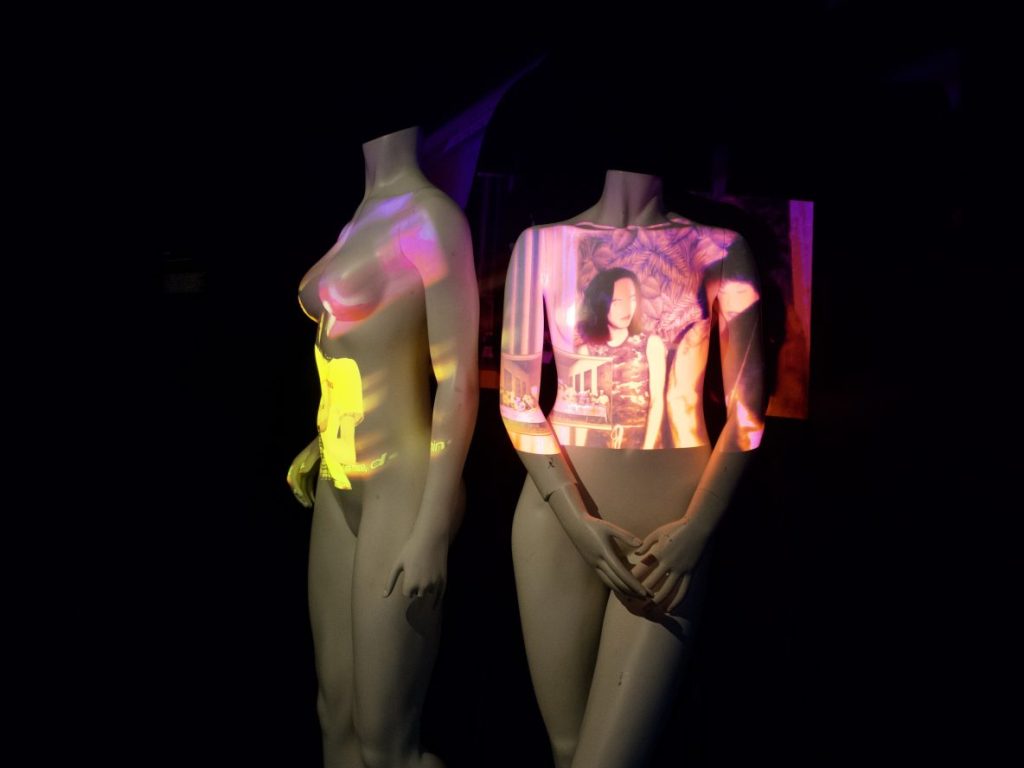
Elle Hong’s installation in “Wearing, Wearing.” -
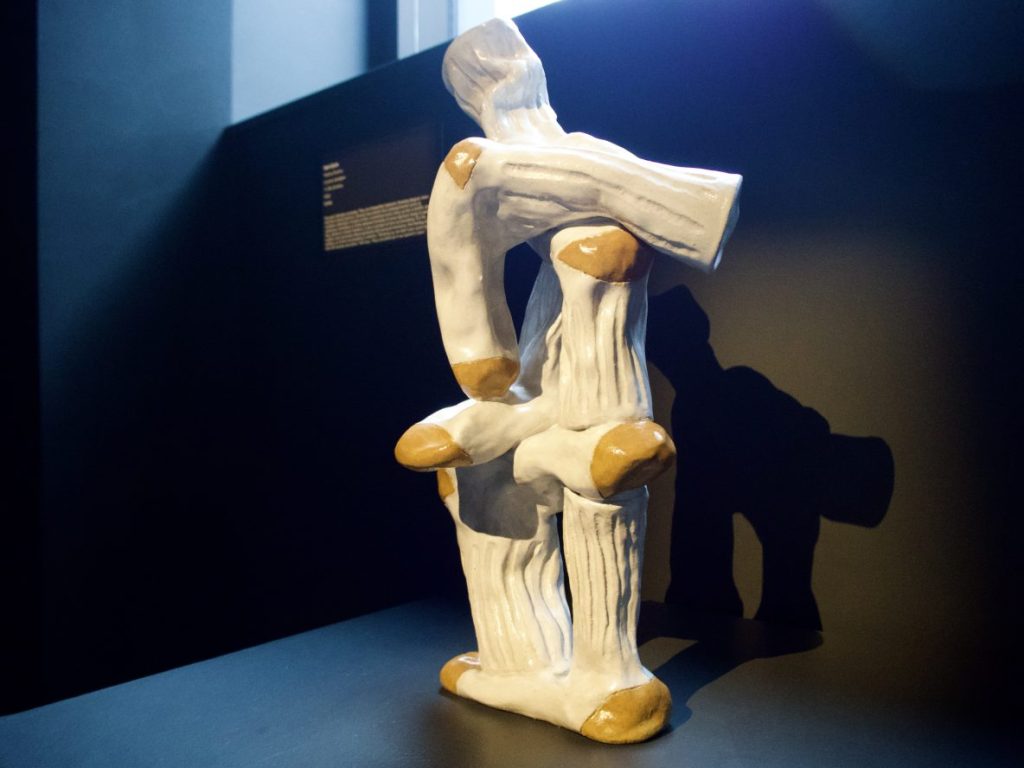
A sculpture created by Paloma Jimenez in “Wearing, Wearing.” -
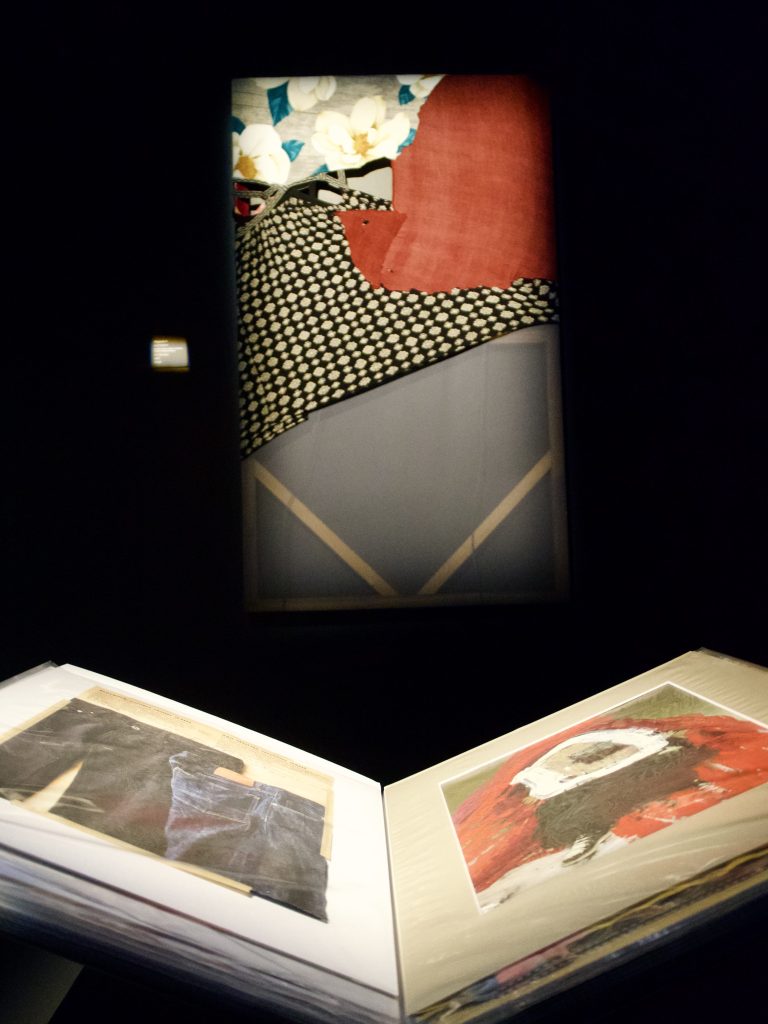
Paper and fabric collages by Sarah Darlene in “Wearing, Wearing.” -
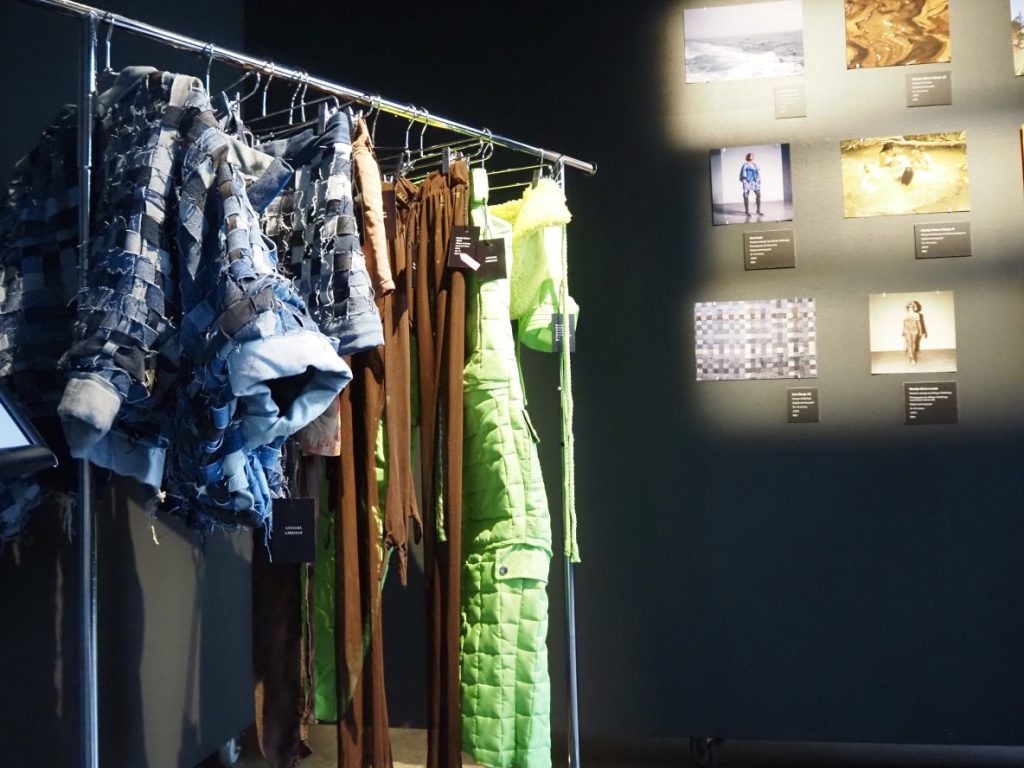
Clothes created by fashion designer Allegra Giddings in “Wearing, Wearing.” -
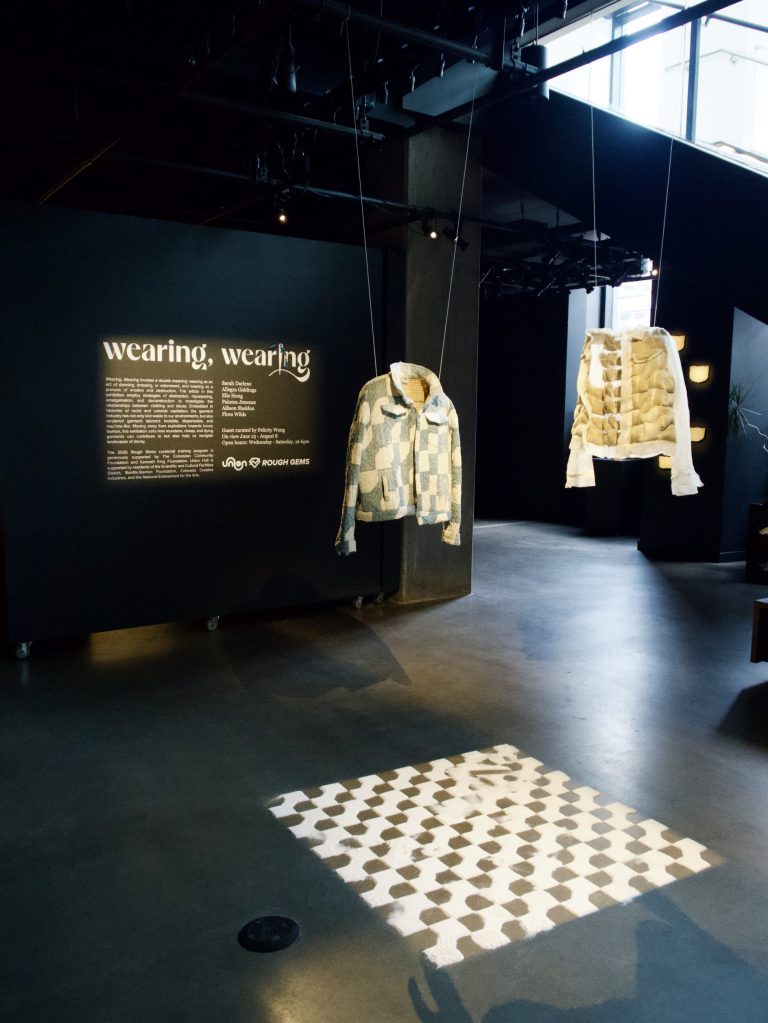
Allison Sheldon’s installation in “Wearing, Wearing.”
“It’s been a pleasure working with these artists in not only a purely professional sense, but also getting to know their background, their stories and hearing their opinions and how they arrived to the practice that they are working on and displaying today,” Wong says.
Her favorite part of the experience was the install, which she says taught her a lot. “I didn’t know what an L pin is … I had no idea how a drill worked and how you drill something into a wall and display it,” Wong says.
While Coloradans, who are so entrenched in their “Colorado casual” and no-frills thinking when it comes to personal style, can be dismissive of clothing and fashion, Wong says she’s been warmed and excited by people’s response to the exhibition.
“I didn’t want to redeem fashion as an art,” she says. “A lot of exhibitions at arts institutions try to do that, and I’m less interested in this question of whether something is art or not because it’s commodified. I’m trying to meet it where it’s at.”
Wong believes that fashion exhibitions at other museums can sometimes create a distance between the tiny couture clothing pristinely displayed on a mannequin and the person looking at it while wearing $15 Old Navy jeans.
She hopes that “Wearing, Wearing” closes that gap a bit.
Applications for the Rough Gems curatorial training program typically open in the fall and are open for an eight-week period. New and emerging curators based in the Denver metro area can learn more and apply for the program at unionhalldenver.org. “Wearing, Wearing” runs through Aug. 8 at Union Hall Art Space, 1750 Wewatta St., Suite 144.