

Melinda Sue Gordon/Universal Pictures

Audio By Carbonatix
“The Odyssey,” which opened on July 17, is a unicorn of a movie — a mega-hyped version of Homer’s epic poem that is proving to be both enormously popular (the nearly three-hour saga earned an estimated $263 million worldwide in its first weekend) and critically cherished (its Rotten Tomatoes score at this writing is 94%).
I caught the flick this weekend on IMAX along with a packed house — fortunately, not at an area theater that’s spent recent days bedeviled by technical breakdowns — and although I enjoy being a contrarian at times (make that “at most times”), I can safely say it’s an impressive achievement well worth seeing. But that doesn’t mean it’s a flawless masterpiece.
Indeed, “The Odyssey” has some notable issues that most reviewers have been too busy searching their online thesaurus for fresh superlatives to mention — and other significant elements have been given short shrift amid the rush to chisel director-writer Christopher Nolan’s bust on the filmmaking Mount Rushmore. Since the arrival of “Following,” his debut feature, in 1998, Nolan has delivered consistently interesting offerings, but some of them don’t work particularly well (see — or perhaps don’t see — 2020’s “Tenet“), and others are significantly overrated.
The night before catching “The Odyssey,” I decided to revisit 2014’s “Interstellar,” which I hadn’t much enjoyed upon its initial release, after hearing Katey Rich lavish it with praise on the Prestige Junkie podcast. The second time around, I found it to be just like watching “Project Hail Mary” if the latter had been overlong, ponderous, pretentious, brimming with the most painful exposition imaginable and no fun, as well as (biggest demerit) starring Matthew McConaughey instead of Ryan Gosling. Only amusing part: The viewer is asked to believe that a young Timothée Chalamet, playing McConaughey’s son, grew up to be a farmer.
Told you I enjoy being a contrarian.
Here are five key aspects of “The Odyssey” that have been virtually ignored thus far. Ancient (and not-so ancient) spoilers ahead.
1. The first section is kinda boring
Nolan isn’t entirely to blame for this issue, since it’s embedded in the source material. The story essentially opens with the queen of Ithaca, Penelope (Anne Hathaway), trying to figure out what to do about the lingering presence of suitors such as Antinous (Robert Pattinson), who want to take advantage of the fact that her kingly husband, Odysseus (Matt Damon), has been missing for twenty years. Her main delaying tactic? She says she won’t mate anew until after she finishes a weaving project — and as everyone knows, there’s nothing more scintillating from a cinematic point of view than watching someone thread a loom.
To mitigate this issue, Nolan, who loves to toy with time, offers an early flashback of a soldier named Sinon (Elliot Page) getting speared to death outside the fabled Trojan horse — the stickiest image from “The Odyssey” for people who were assigned to read it in school but never actually did. Sinon isn’t actually in “The Odyssey;” the character is pulled from “The Aeneid,” the Roman variation on the Greek original. This tweak lets Nolan deliver some early action amid the necessarily stagey Penelope-and-the-suitors scenes, dodging a pitfall that wasn’t avoided by 1954’s “Ulysses,” the most prominent big-screen Hollywood adaptation of “The Odyssey” up until now. (I’m not counting 2000’s “O Brother, Where Art Thou?,” the Coen brothers’ satirical riff.) In “Ulysses,” which I eyeballed this weekend, too, Kirk Douglas, as the namesake hero, doesn’t even show up for fifteen or twenty minutes — one reason why so few filmmakers have taken on this tale.
Still, Nolan’s efforts can’t quite mitigate the static nature of the introductory section. As a result, “The Odyssey” 2026 doesn’t truly wake up until the arrival of Cyclops, who’s worth the wait.
2. Some of the set pieces are creepy and weird — in a good way
Cyclops is usually depicted as a simple, brutish monster with a taste for humans. But Nolan’s team takes a different tack, designing a giant with a visage so misshapen that he instantly becomes both a fearful presence and an object of pity. Likewise, this Cyclops doesn’t engage in conversation with Odysseus and his men, unlike the one in “Ulysses,” who comes across as a mere dope, albeit one who resembles a supersized lumberjack. The decision adds an extra layer of pathos to a sequence that is generally presented as evidence of Odysseus’ cleverness and gift for trickery — characteristics Nolan chooses to deemphasize.
The same goes for the section in which Circe (Samantha Morton) turns Odysseus’ troops into swine. Instead of deploying CGI to visualize the transformation, Nolan shows Circe physically reshaping the men’s skulls, pulling and tugging and wrenching snouts right out of them via practical effects instead of the digital kind. The choice to eschew modern technology in favor of pre-computer approaches could have come across as cheesy. But instead, it’s genuinely unsettling and disturbing — a throwback that works.
Melinda Sue Gordon/Universal Pictures
3. Many of the female actors don’t have much to do
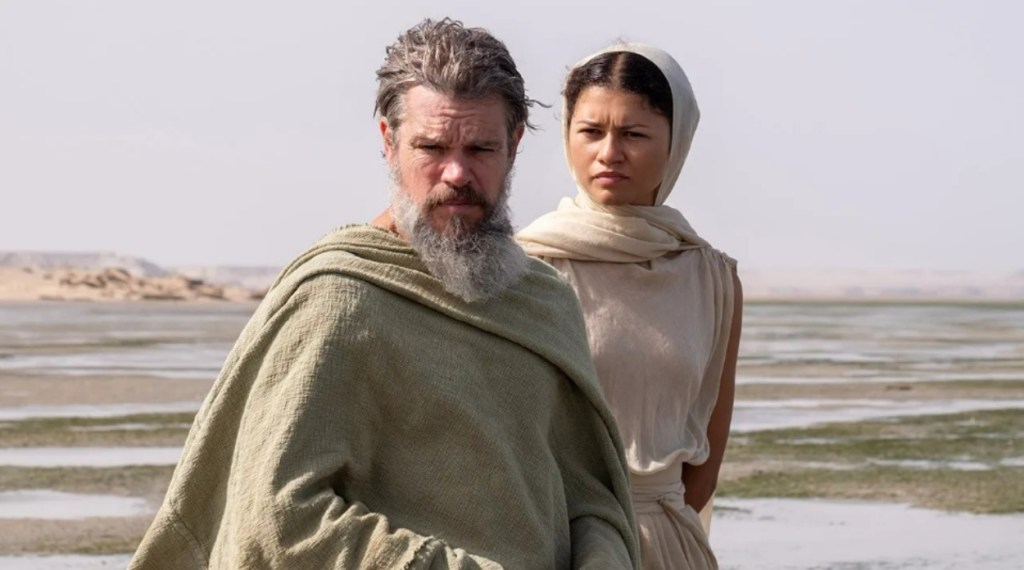
“The Odyssey,” like many classical works, is mostly about dudes, and while Nolan tries to beef up women’s roles, he isn’t particularly successful beyond the aforementioned Morton move. Zendaya, as Athena, mostly stands near Odysseus (only he can see her), looking alternately concerned and disappointed, Hathaway gives good anxiety but not much more, and Lupita Nyong’o, as Helen of Troy, is consistently upstaged in her few appearances by Jon Bernthal, who chews so much scenery as Menelaus that he’s probably still picking wood out of his teeth. (That’s a compliment, by the way.) As for Charlize Theron as the nymph Calypso, she wisely underplays a part that could have tilted toward misogyny, since she delays Odysseus’ return to Ithaca by seven years for purposes that could be considered selfish. But Nolan utilizes her more as a way to reflect Odysseus’ pain than as a compelling personage in her own right.
4. The soundtrack is assaultive
Composer Ludwig Göransson, who is responsible for the original music in “The Odyssey,” is an Academy Award magnet; he’s won three Oscars, for 2018’s “Black Panther,” the 2023 Nolan blockbuster “Oppenheimer,” and 2025’s “Sinners.” This time around, though, he seems to be aping Hans Zimmer, whose scores for director Denis Villeneuve’s “Dune” trilogy essentially consist of single tones blared at extreme volume. Hence, describing Göransson’s contributions to “The Odyssey” practically demands capital letters and exclamation points. BWWAAAWWAA! NUNUNUNUNUNU! GRGRGRGRGREEEEE!
Yes, the results are effective. But Nolan leans on the score so energetically that some of the dialogue is swallowed up in the sonic maelstrom. What did you say, Matt? All I heard was VVVOOOLLLOOOOVOOO!
5. The Oscar watch may be tricky
Plenty of golden statuettes will be bestowed on “The Odyssey,” but the folks with the best chances are those who never had to don togas and pack shields: cinematographer Hoyte Van Hoytema, whose work is legitimately jaw-slackening, film editor Jennifer Lame, sound editor Richard King and, of course, Nolan himself. At its core, this is a director’s movie, and that means the performances are part of Nolan’s overall vision as opposed to portrayals that qualify as independently astonishing. Damon is fine as the agonized, guilt-ridden Odysseus, but it’s a workmanlike turn. Pattinson is certainly showier, but he overdoes the leering villainy bit; if he had a mustache, he would have spent the movie twirling it. Both will be nominated for Oscars, as will Hathaway, but if they win, momentum will deserve the credit.
My preferred picks for Academy consideration are Morton, who could rise to the top in the same way that Amy Madigan did for “Weapons,” and Page, who does wonders with a small part; his post-death confrontation with Odysseus is absolutely searing. As a bonus, a Best Supporting Actor victory for a trans-performer would make the heads of bigots explode.
That really would be epic.