Kristen Fiore

Audio By Carbonatix
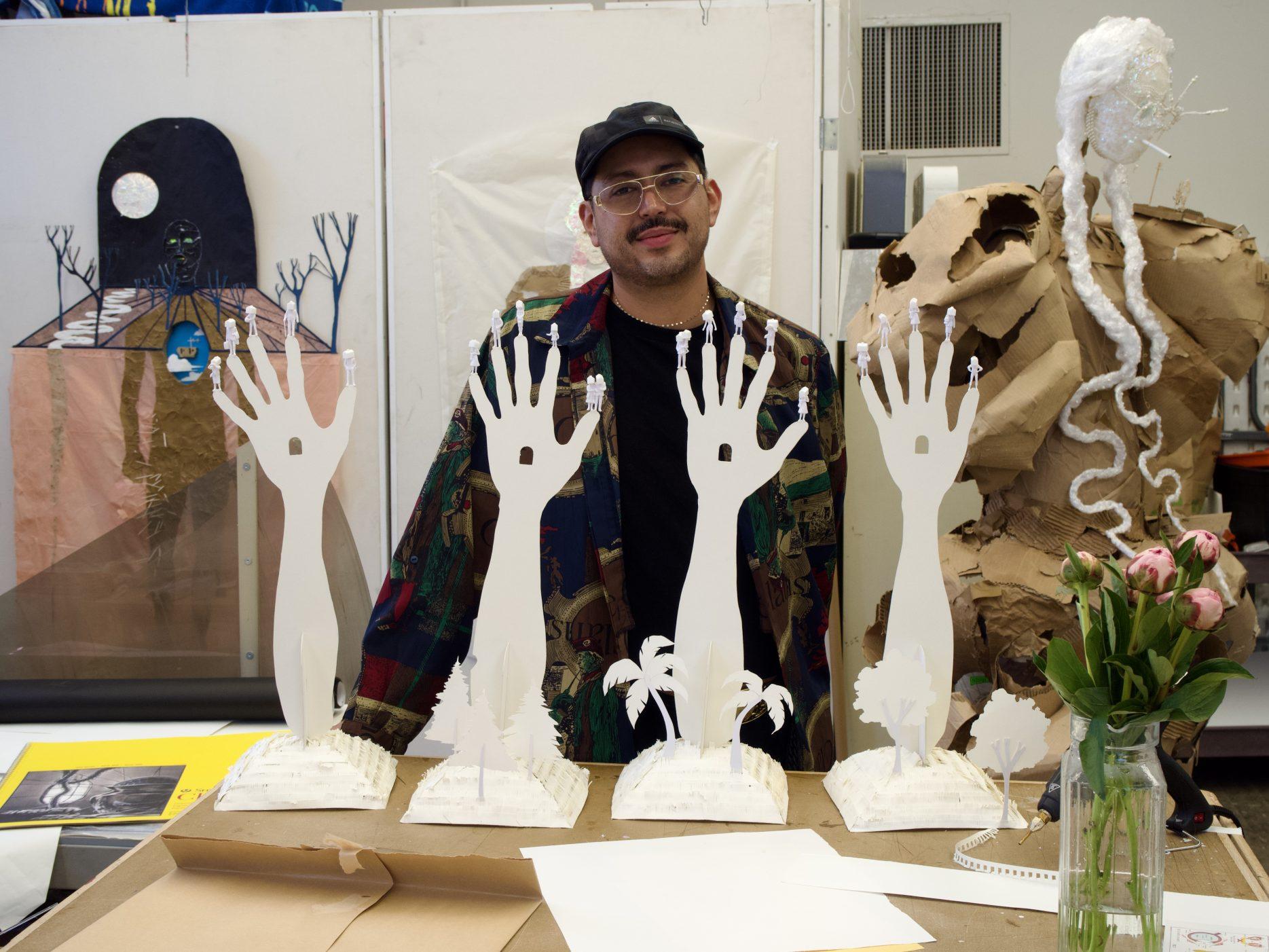
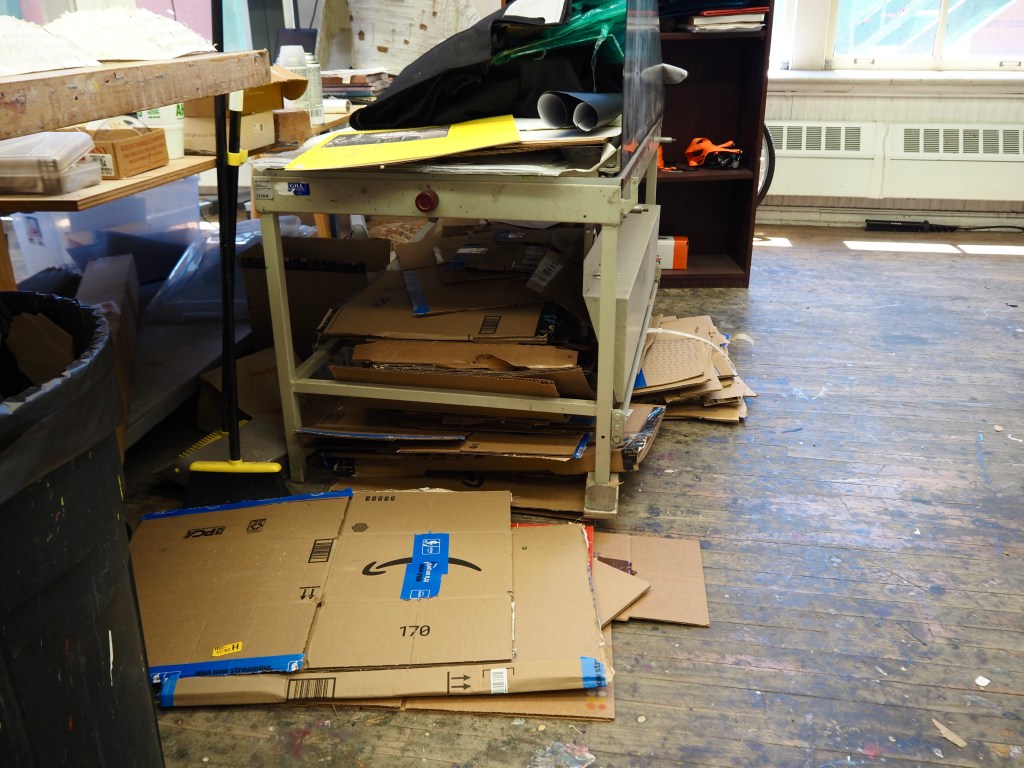
Juan Carlos Escobedo’s studio at the Art Students League of Denver is lined with cardboard. Empty boxes, folded and flattened, are shoved under tables, while Escobedo’s cardboard creations — hands, clothing, houses and more — rise from every surface in the room.
These pieces are for “Curas: Males de Corazón” or “Remedies: Ailments of the Heart,” Escobedo’s exhibition at ASLD, which will run June 12 through July 26. The show explores inherited familial and cultural knowledge by reflecting on different “curas,” or remedies, through a series of works that highlight how many non-Western traditions understand emotional, physical and spiritual pain as being deeply interconnected.
Escobedo, this year’s ASLD Color Scheme resident (a re-envisioning of the organization’s Visiting Artist of Color Residency), is the child of two parents from Mexico. He grew up in a trailer home near El Paso and has created art for as long as he can remember. “My mom encouraged me to make art,” he recalls. “And I think since I was a kid, she understood or realized that I was gay. I think this was her way of allowing me to round myself into something that I could be free in.”
Escobedo went on to study painting at New Mexico State University before earning a master’s degree at Massachusetts College of Art and Design. “I entered in a 2D program, but I ended up doing all these three-dimensional works, stuff out of cardboard, mostly, and paper and found materials,” he says.


His time in Boston was weird. Escobedo was used to a certain level of diversity in El Paso; now, he’d be sitting in a restaurant and realize he was the only person of color in the establishment. People would come up to him and ask him how he spoke English so well. “Someone even asked me where my ‘motherland’ was,” Escobedo remembers. “I was like, ‘Texas.'”
Things weren’t much better in art school, where Escobedo received a lot of pushback for his use of cardboard. “Eventually, I found the parallel between the resistance to the cardboard and my own identity,” Escobedo says.
If only his critics could see him now.
The residency at ASLD, a seven-month program, is kind of like living the dream for an artist. “We do offer a stipend that covers living expenses and materials so that folks don’t have to be looking for a job while they’re here,” says Tessa Crisman, director of communications and development at ASLD. Residents aren’t pressured to meet quotas. Whether they make three pieces or fifty during their residency, they will all go on display at the end of the program.
“In art school, there’s this mindset that artists need to produce work nonstop, constantly, and if they don’t, then they’re not artists,” Escobedo says. “When I did a residency in Berlin, I was thinking a lot about how these European artists approached making art. A lot of them see art as an inherent part of everybody’s lived experience, whereas in the United States, making art is more of a capitalist venture. If you’re not selling it, then you’re not visible or relevant.”
Working through the ASLD residency has relaxed some of that pressure, he says.
Like most arts organizations, ASLD has been struggling with funding, but according to Crisman, the nonprofit — which occupies an 1893 building that was once a school and now holds classrooms and studios for art students of all ages and levels — has received a heartwarming amount of community support.
“It’s been a pretty wild ride since January 2025,” Crisman says. “We have lost out on significant funding over the past couple of years, but I also want to highlight that our individual supporters, just the members of our community, have really stepped up and tried to close that gap, which has been a pretty significant source of warm fuzzies during this time and a reminder that there are so many people throughout Colorado who really feel like ASLD is their place and are willing to do anything to keep it alive.”
Escobedo applied at the suggestion of a former ASLD resident, Guadalupe Hernandez, whom he met during another residency in Houston. Escobedo, who teaches intro art classes at Texas A&M University when he’s not doing residencies, says that Color Scheme has been his longest residency, which has allowed him to continue zooming out from his earlier works of paper and cardboard homes, landscapes and clothes to something much more metaphysical.
“A few years ago, I was in this collective where we were trying to do magic. We were trying to conjure up some dick or whatever,” Escobedo jokes. “But we were also thinking about the rituals we grew up with.” He lists rituals like putting a red string on the forehead of a baby who has hiccups or an egg cleanse for spiritual cleansing.
In “Curas,” Escobedo dives deeper into his own family’s rituals.
“My mom told me once that when she used to be really sad, her grandmother would go out and hug a tree barefoot, and supposedly that helped,” Escobedo says.
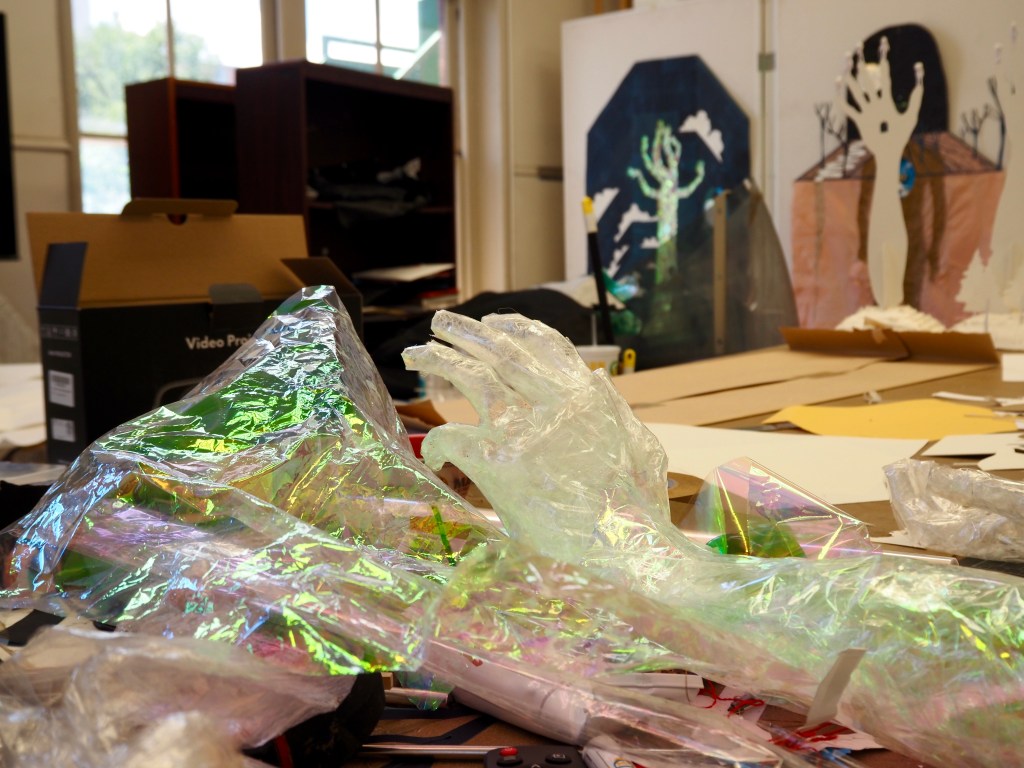
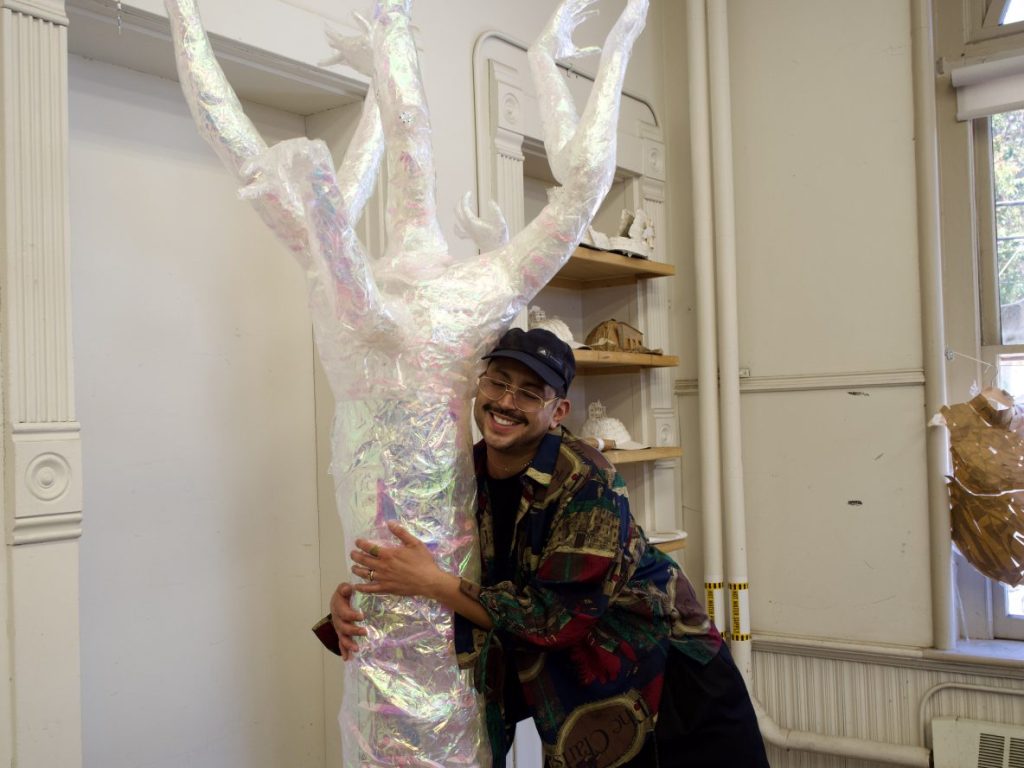
Escobedo’s great-grandmother features heavily in the exhibition, from a larger-than-life cardboard sculpture with long braids to collage work and even a ten-foot-tall cellophane tree with hands and feet.


“I was thinking about the work these women did,” he says. “They were cleaners, cooks, they took care of white children. They were individuals who people consider doing menial tasks, but then they go back to their communities, and they’re healers through rituals.”
Escobedo thinks maybe that’s why hands are so prominent in his work: “Hands are a bridge for people to heal. When somebody’s trying to heal and they go to a curandera and the curandera tells them what to do, the person who’s doing it has to actually physically do things with their hands for that energy to manifest.”
Beyond the rituals, Escobedo examines his family’s physical and spiritual pains, many of which he believes have been passed down.
“My mom was sexually assaulted, and I’ve always had this thought that her trauma passed from her body into mine,” Escobedo says. “The egg that created me was within my mom when she was assaulted. A lot of the physical ailments that my mom has had have happened to me. She broke her back, and I have a fucked-up back. She was always complaining about her right leg, and I have the exact same pain.
“I was thinking about when creating these images,” he continues. “Maybe in my own weird way or superstition, they’ll heal me somehow. Like being aware of them and confronting them.”
Even creating the work has been cathartic. “The tree has been giving me shit for a long time because I’m not a sculptor, so I don’t know how to stand stuff up,” Escobedo says. “So for the longest time, I hated it. But the other day, I hugged it because I finally got it to stand up, and it did feel like hugging an actual tree.”
Kristen Fiore
Overall, he says, this work exposes how much of everyday life is shaped by invisible agreements, things that people treat as natural but are actually constructed. “The next part is what (art) can be made from and who can make it,” he says. “We should be challenging the systemic limitations of art.”
“Curas: Males de Corazón” will have an opening reception from 5:30 to 8:30 p.m. on Friday, June 12, at Art Students League of Denver, 200 Grant St. The exhibition runs through July 26. Learn more about Escobedo at j-esc.com.