Courtesy of Maeve Eichelberger

Audio By Carbonatix
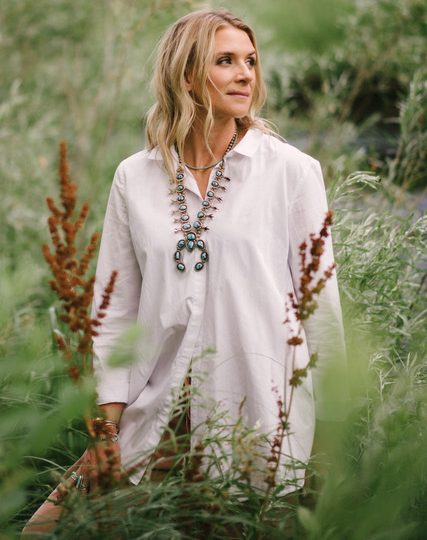
“I think of my work as deconstruction and then reconstruction of something,” Colorado artist Maeve Eichelberger says, standing amid sheets of etched plexiglass and photographic fragments of acrylic in her Denver studio. “For example, I photograph something, like a guitar, and then deconstruct it and reconstruct it into a whole new vision and make it more abstract.”
Courtesy of Maeve Eichelberger
From her earliest paintings to the sculptural, three-dimensional collage pieces she is now renowned for, Eichelberger’s practice has been driven by her impulse to disassemble the familiar and reassemble it with new meaning. That philosophy takes physical form inside Eichelberger’s studio at Blue Silo Studio, an affordable space for artisans located at 4701 National Western Drive.
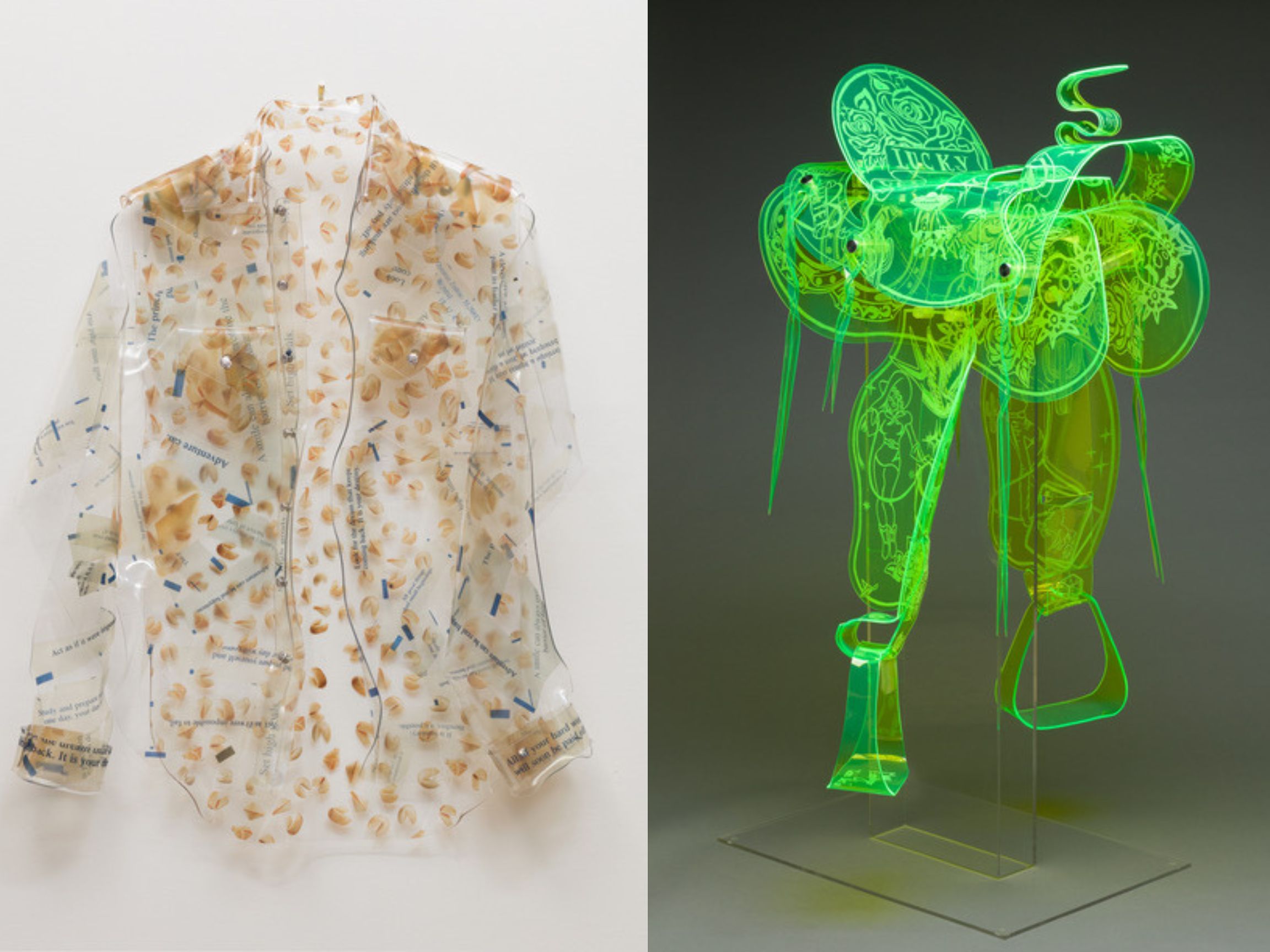
The perimeter of her studio space is lined with colored saddles, shirts with photographs printed on them and layered collages that refract light as you pass by, all made out of acrylic. Sheets of plexiglass, some printed with photographs and others carved with delicate patterns, lean against the walls, while works-in-progress sit on tables like fragments waiting to be assembled.
It’s in this sunny studio that Eichelberger is once again preparing work for the Coors Western Art Exhibit & Sale, part of the National Western Stock Show. Now marking her eleventh year in the exhibition, Eichelberger has become a familiar presence within a show traditionally associated with painting and sculpture rooted in Western realism.
“To me, the stock show is about the appreciation of the American West and how we all contribute to it,” she says. “And the crowds are great. It’s people who aren’t involved in agricultural work alongside people who ride saddle for a living. It’s such a different mix of people that come to the stock show. I’m thrilled to be a part of it so I can showcase what I do. My work’s different. It’s super contemporary and the material is odd, for sure, but I think it’s relatable to a wide range of people.”
Courtesy of Maeve Eichelberger
At the core of her work is collage, even when it doesn’t immediately look like it. “I consider myself primarily a collage artist,” she says. “I started using plexiglass because it was a durable material that I could use that also had transparency. I could stack and layer it, and I wanted more dimension with my collages.”
Before any cutting or assembling begins, Eichelberger draws. Those drawings serve as blueprints at times, but they also serve as prompts, guiding decisions that will change once she has the material in her hands. She sketches patterns, forms, and negative space on paper or tracing material before transferring them to acrylic. Photographs that she takes are printed directly onto the acrylic or layered alongside etched elements that Eichelberger does using a Dremel tool.
Each work is built piece by piece. Shapes are cut, bent, stacked and spaced apart so that light passes through them, creating shadows and shifting perspectives depending on where the viewer stands. Botany appears frequently in these layers: sunflowers, lotus flowers and imagined blooms inspired by leather tooling and decorative arts, all rendered at different scales and levels of abstraction.
“They’re very intricate, and they all range in size and scale,” Eichelberger says. “Each is unique to itself, so I don’t repeat the same one twice.”
Her passion for making art has roots in a childhood spent immersed in creative environments. As the daughter of an architect father, Doug, and a mother, Joan, who taught fashion design and creative writing, Eichelberger was surrounded by creativity.
“The times when I wasn’t in school or daycare or whatever, I was in one of their studios or spaces with colored pencils,” she says. “So I feel like I was always in that realm of creating things.”
By high school, she was painting large-scale canvases and building them herself, encouraged by teachers who recognized her talent and nudged her toward art school. Her early training centered on painting, often focused on flowers and dramatic shifts in scale, with Georgia O’Keeffe serving as a key influence.
Courtesy of Maeve Eichelberger
But collage soon entered the picture. As an undergraduate at Regis University, Eichelberger began cutting paper, magazines and imagery, layering painted elements into her compositions to add texture and complexity.
Graduate school at the Miami International University of Art and Design pushed that experimentation further. She tested resin as a way to separate layers, then began questioning how those materials would hold up over time. Plexiglass ultimately offered the solution she was looking for: durable, transparent and capable of holding real physical depth. As printing technology advanced, she began printing directly onto acrylic, bending and cutting it into increasingly sculptural forms.
“Acrylic gave me the depth I was looking for in my work,” Eichelberger says. “Originally, my work would be more two-dimensional, with me printing directly onto acrylic. I am still doing the same thing, but with a slightly more random composition based on form, structure, texture and color.”
Courtesy of Maeve Eichelberger
Over more than a decade, Eichelberger’s experiments have found a consistent audience at the Coors Western Art Exhibit & Sale, where she has returned year after year. For her eleventh appearance at the event, Eichelberger is presenting four new pieces.
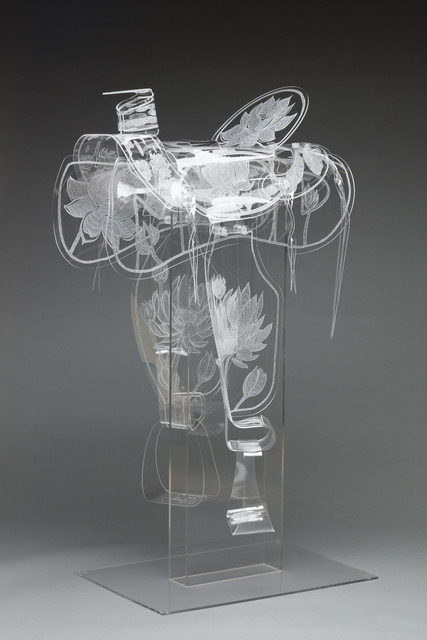
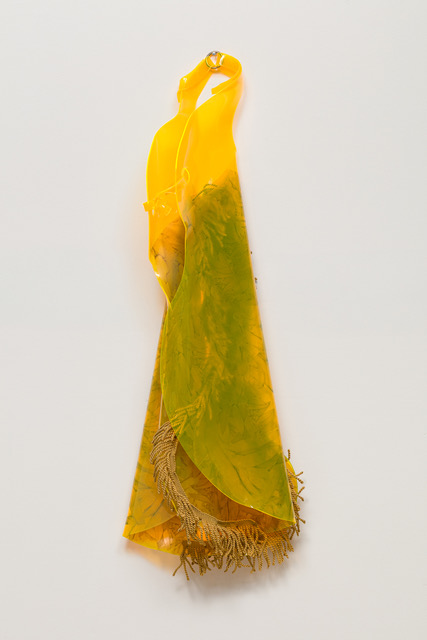
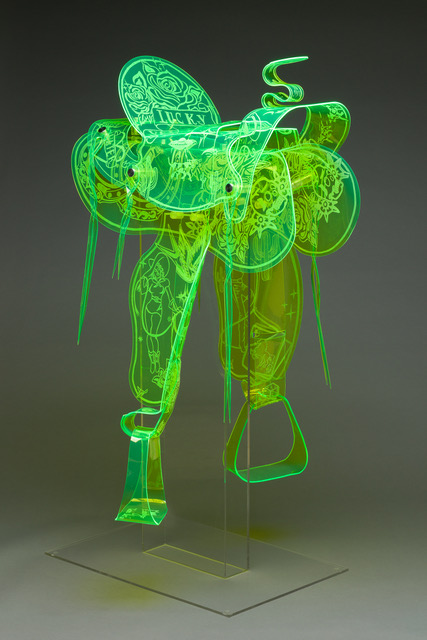
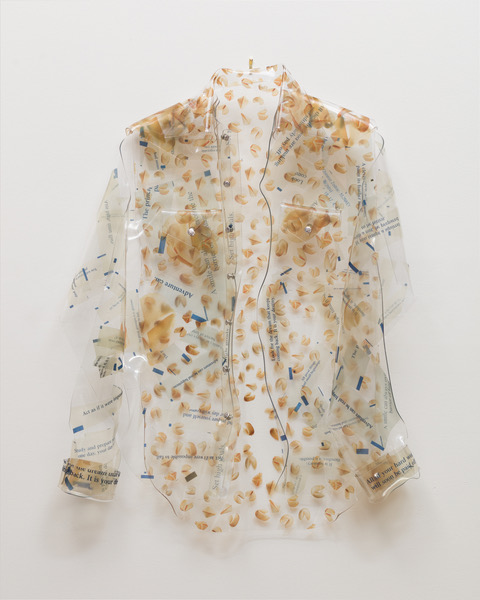
Two large plexiglass saddles anchor the group at the Coors Western Art Exhibit & Sale: one clear and edged with a lotus motif, while the other is fluorescent green and covered in hand-drawn vintage Americana tattoo imagery. Additionally, Eichelberger is showing an acrylic shirt layered with fortune cookie imagery, titled The Fortune Teller, and a pair of bright yellow chaps etched with microscopic white sage, complete the selection.
“It’s a big, beautiful space, so I wanted to do some larger work this year in general,” Eichelberger says of why she chose these pieces for the Coors Western Art Exhibit & Sale. “I keep pushing the limits a little bit every year, so this year my goal was to be a little bit more avant-garde and use bolder colors with different content.”
In recent years, clothing has emerged as an increasingly important site of exploration. While saddles have long served as her canvas, shirts feel more universal.
Courtesy of Maeve Eichelberger
“I used a saddle as my canvas, in many ways, because I can construct on it, but the shirt is a little bit more universal and relatable to everyone because not everyone rides a horse or has been on a horse,” she says. “I still see it as exploring identity through what we wear; it’s how we cover up or surround ourselves or express ourselves and all those different ways that we use everyday clothing.”
Looking ahead, Eichelberger is continuing to develop new shirt-based works that engage directly with questions of environment, waste and stewardship, especially as they relate to Colorado. She teases major upcoming projects in Denver, but she keeps the specifics under wraps for now.
“I want to announce the upcoming show, but I’m not supposed to just yet,” she says. “But, I can say, there are big things coming up in Denver. I can say that, so people will be able to check out my work locally for sure.”
What she can share is that she remains committed to pushing boundaries. “I like a good challenge,” Eichelberger says. “I always just want to see what I can do — everything I do is just pushing myself every time.”
Maeve Eichelberger is participating in the Coors Western Art Exhibit & Sale, Saturday, January 10, through Sunday, January 25, at the National Western Stock Show Legacy Building. National Western Stock Show Grounds Admission Tickets Required. Learn more about the event at coorswesternart.com and the artist at maeveeichelberger.com.