
Courtesy of Tracy Stuckey

Audio By Carbonatix
For more than two decades, Tracy Stuckey has returned to the imagery and mythology of the American West. Even though he grew up in Indiana and didn’t encounter the region until he was a graduate student at the University of New Mexico, the West quickly became an aesthetic and conceptual anchor in his practice.
“I had boyhood fantasies of the West from watching movies,” Stuckey says. “I’m in that generation that grew up with the Marlboro Man advertisements in all magazines and on billboards, so that kind of mythology and that romanticism around the West was sort of around. I grew up with a healthy little bit of that in my life, and then when I went out there to New Mexico, I had kind of the realization that, ‘Oh, this is all a little bit exaggerated.’ After I was there for about five years, the West just sort of started sinking into my work.”
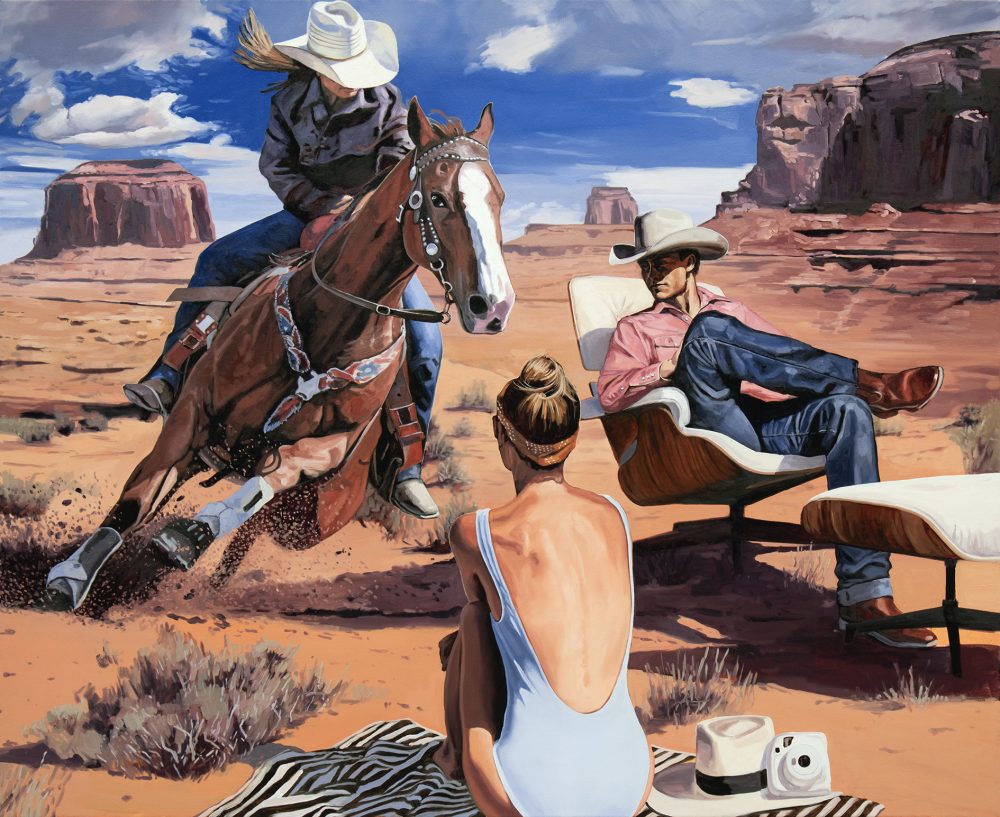
That early realization of how much of the West was a projection serves as the foundation for Stuckey’s seventh solo show at Denver’s Visions West Contemporary, Mid-Century Western. The new exhibition features thirteen works, most of them large-scale paintings, along with a hand-embellished print from a new edition. The pieces deepen Stuckey’s exploration of the Western as both image and idea, but this time he approaches it through a shifting play between domestic interiors and the open landscape.
Courtesy of Tracy Stuckey
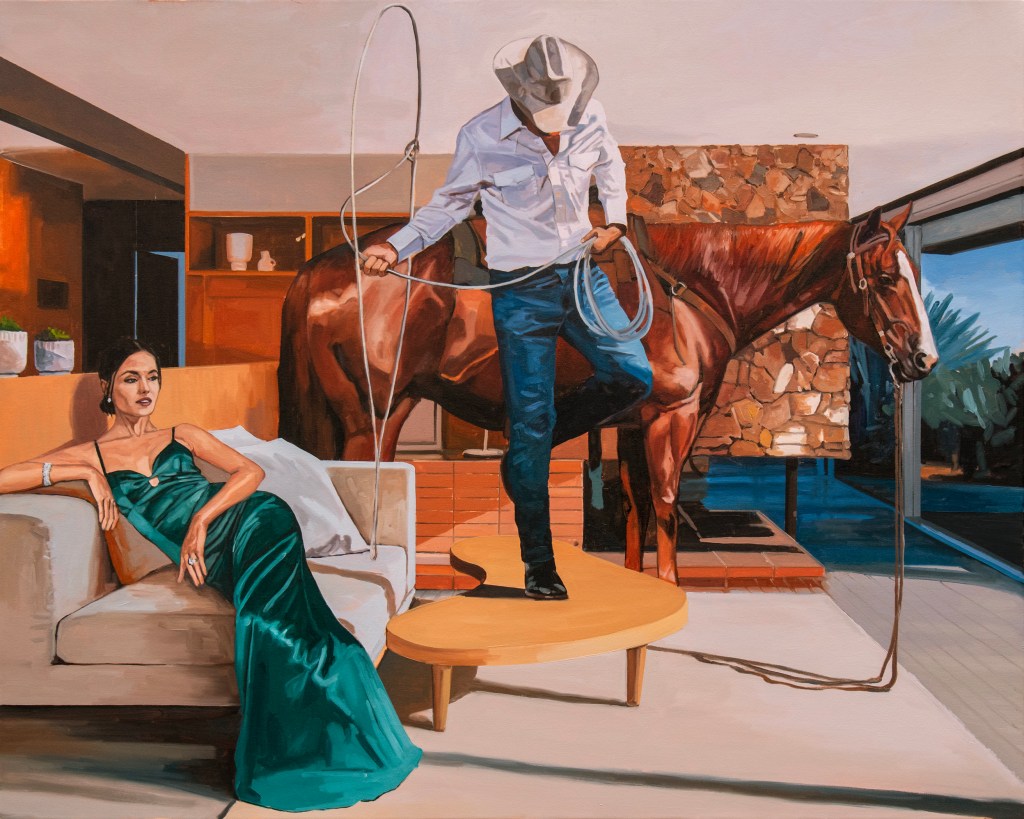
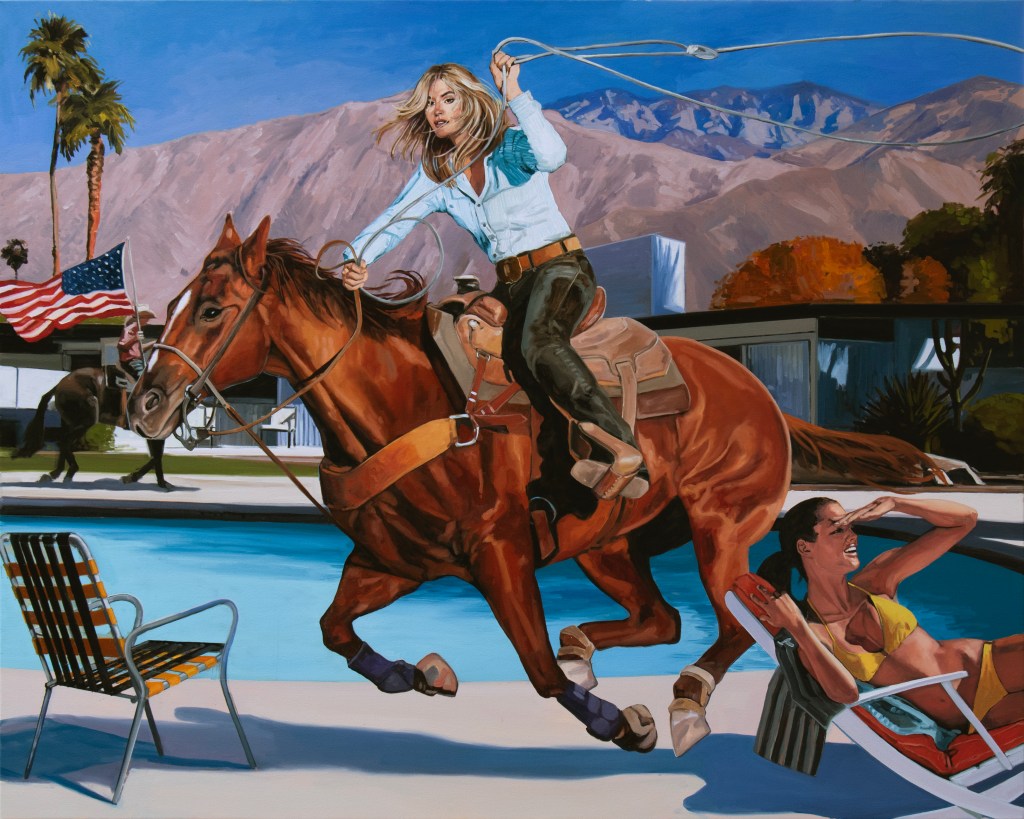
“As I began to make work about the West, one thing that kept coming up in my reading was this idea of the West being characterized by its open space and wildness, in contrast to the East, which is all about order and civilization,” he says. “That’s an interesting dichotomy, and it made for this easy way to start creating tension within the work. I’ve done works similar to some of the pieces in this show before, but this is the first time I’m really trying to focus on that dichotomy in almost all the paintings. It creates this level of tension because what should be inside is now outside, and vice versa, resulting in these bizarre scenes.”
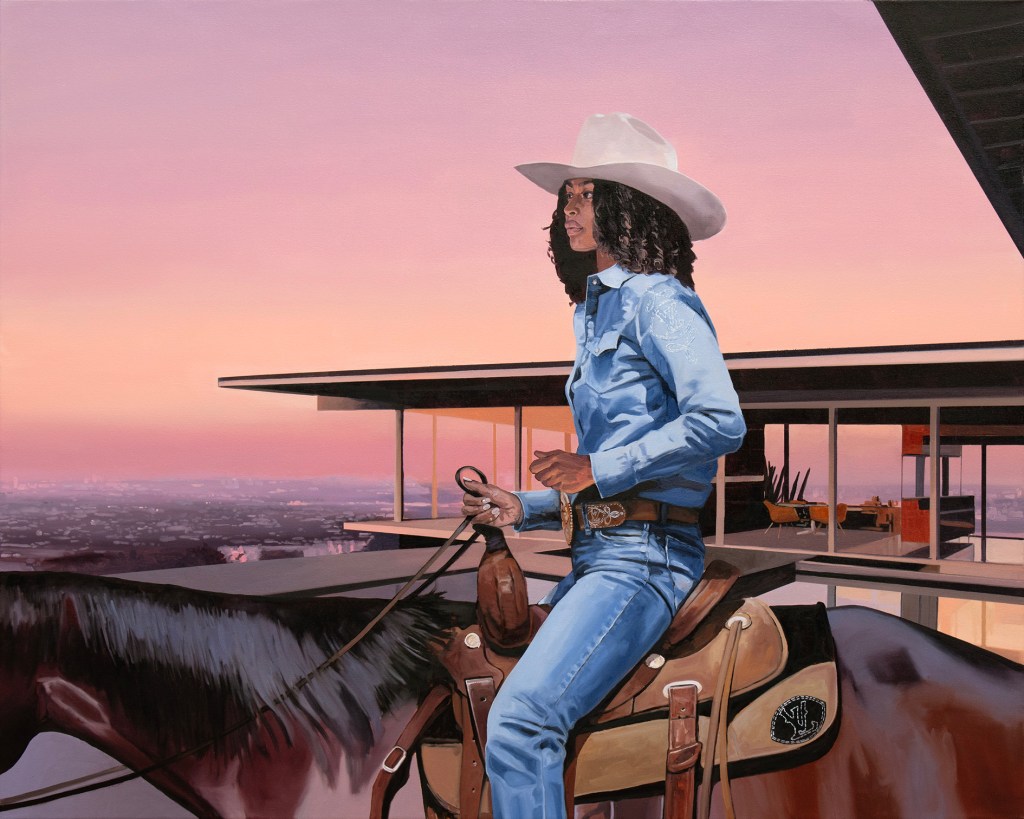
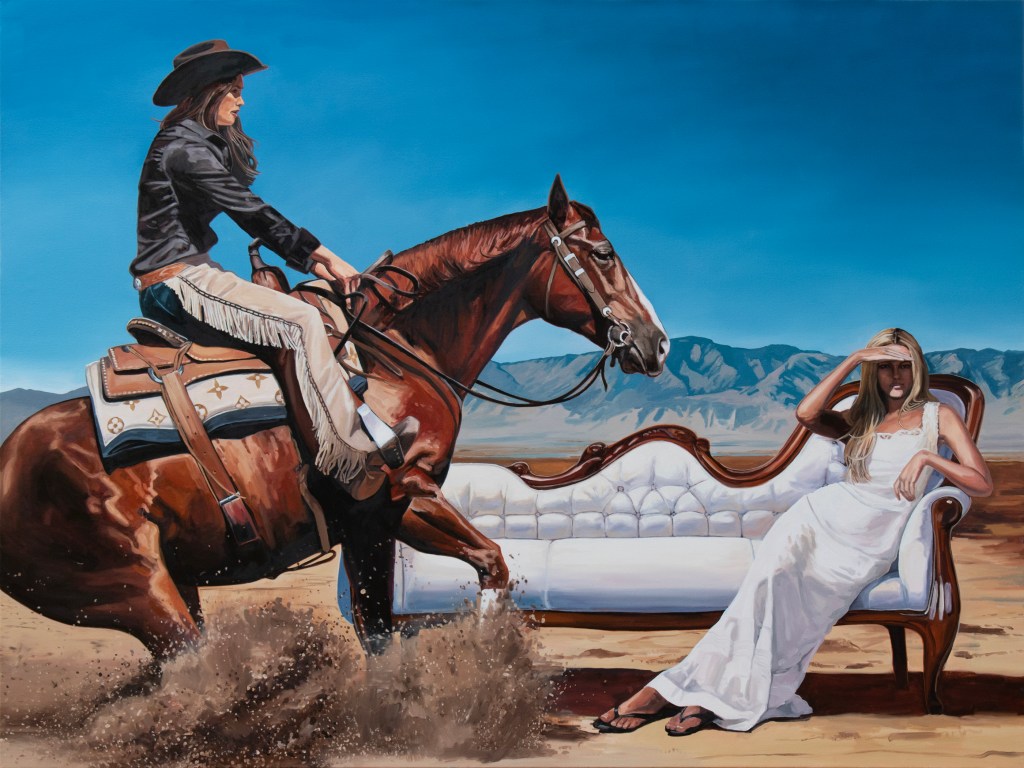
He places living-room furniture in desert settings, drops cowboys into mid-century interiors and transforms modern fashion into petroglyphs etched into rock. These stylistic inversions underscore the West’s enduring role as both fantasy and cultural mirror. Though the work frequently evokes the glamour of the mid-century Hollywood era, when Western films dominated the industry, Stuckey incorporates contemporary details throughout, such as modern rodeo imagery and synthetic objects that bring viewers back to the present.
“As someone who’s an outsider — or I don’t know, I can’t quite say that anymore; this is thirteen years in Colorado, and I had six in New Mexico — I do try to kind of keep that sort of outsider view in my work to get a different vantage point on this place,” Stuckey says. “I sort of look around and see how these Western personas, archetypes and identities fit in now, and how do people out here use them? There’s something powerful about calling back to that sort of era but making everything very contemporary at the same time.”
Courtesy of Tracy Stuckey
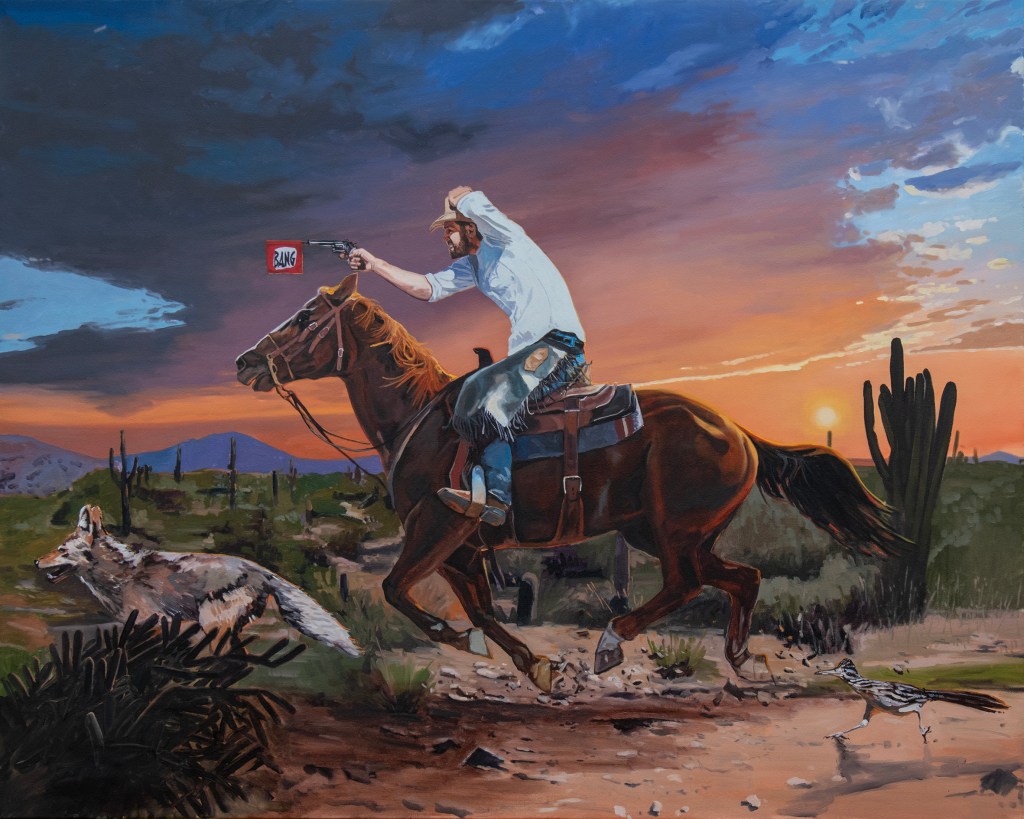
The scale of the paintings gives these contradictions room to breathe. Most of the canvases hover around four by five feet, with several larger and more panoramic works anchoring the exhibition. Stuckey also releases a new print, “Marlboro Man,” in a limited edition of thirty, each of which is individually updated with metallic leafing and bright, hand-painted details that create subtle shifts between versions.
“It’s a print where there’s a guy holding a pistol that has the safety cap on it, and he has a gold Gucci belt buckle,” Stuckey says. “I go into each print, and I’ll put in gold leafing where there’s gold in the painting; where there’s silver in the painting, there’s silver leafing, and then I do some iridescent and a few other things, like the safety orange that’s on the pistol that he has is painted with fresh acrylic, fluorescent paint, so it’s even brighter than what the print is.”
For gallery director Ilan Gutin, who joined Visions West earlier this year, installing the show means crafting a pathway through these hybrid spaces. He plans to arrange the works in a way that allows relationships to emerge between them.
Courtesy of Tracy Stuckey
“What I always do is lay all the works down, leaning against a wall on the floor, and figure out what the arrangement is,” Gutin says. “I figure out which pieces go well next to each other, what colors play off of each other and which themes can be tied in together. I’m always thinking about the narrative flow of an exhibition, how someone’s going to walk through it and how they’re going to experience it. It’s always fun to put in some surprises and keep things a little bit unexpected, too.”
Stuckey is content to let the gallery determine the final layout; he looks forward to the moment the doors open. The reception is one of the rare times he gets to see viewers respond to the work in real time. Living in Fort Collins, he makes it to Denver regularly but says he treasures these evenings as a chance to reconnect with the gallery community, longtime supporters and curious newcomers alike.
Courtesy of Tracy Stuckey
“The day of and the minutes building up to it, I’m usually a little nervous,” he says. “But once people come in, I love it. It’s great to talk to people and hear them talk about my work, especially when they notice things that I don’t. I think that part of an opening is always fun.”
Those conversations are part of why he keeps returning to the Western as subject matter: It’s familiar enough to spark recognition, yet flexible enough to invite interpretation. Mid-Century Western leans into that elasticity, offering viewers a playful, uncanny and deeply considered look at how the West continues to shape cultural identity. Stuckey has other projects in the works, including print collaborations and upcoming exhibitions in Wyoming, Montana and beyond, but for the time being, he is focused on Denver show.
Courtesy of Tracy Stuckey
“Once it starts, I just enjoy watching people take it all in,” Stuckey says. “My work oftentimes gives people something to try and figure out along the way. For example, when people think of mid-century, they think of architecture and furniture, which is true, but it also reminds me of the heyday of Hollywood and the glamour of that era, the 1940s, 1950s and 1960s, which coincided with the peak of Western film … I’m curious to hear what people think of all those different elements at play together in the same painting.”
Mid-Century Western runs through Friday, January 9, at Visions West Contemporary, 2605 Walnut Street; learn more at visionswestcontemporary.com.