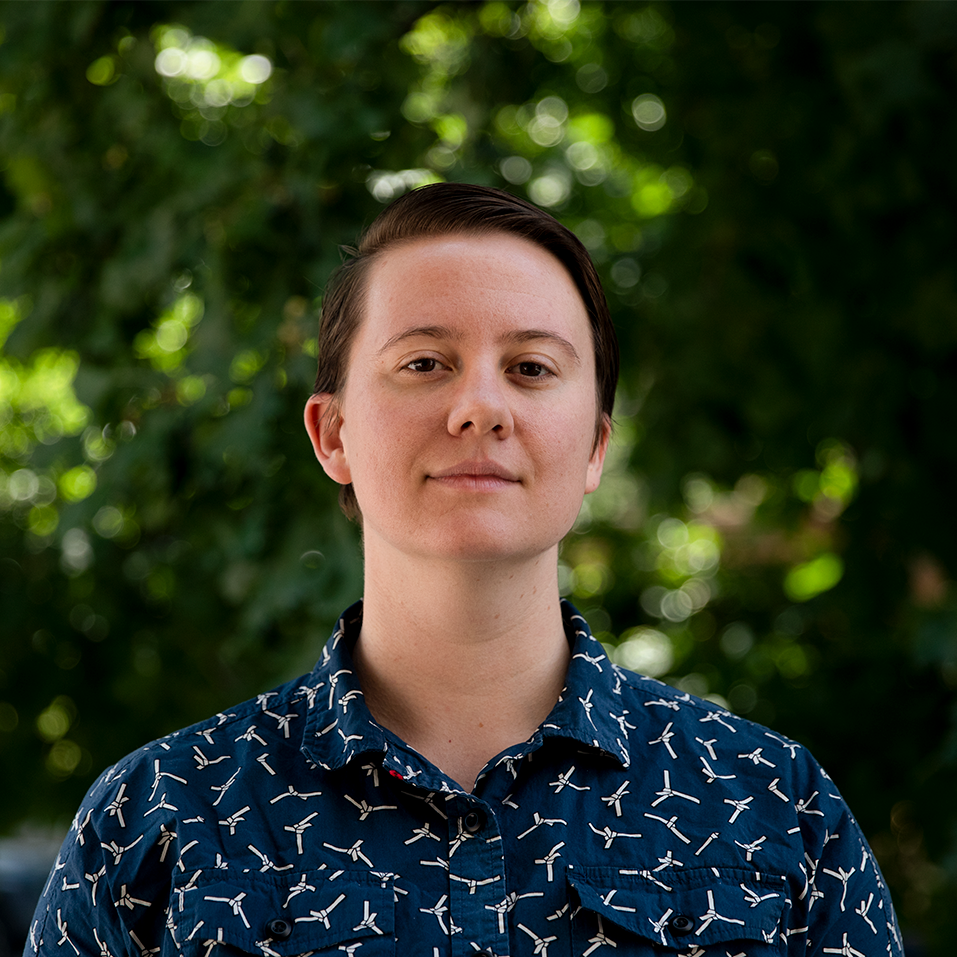
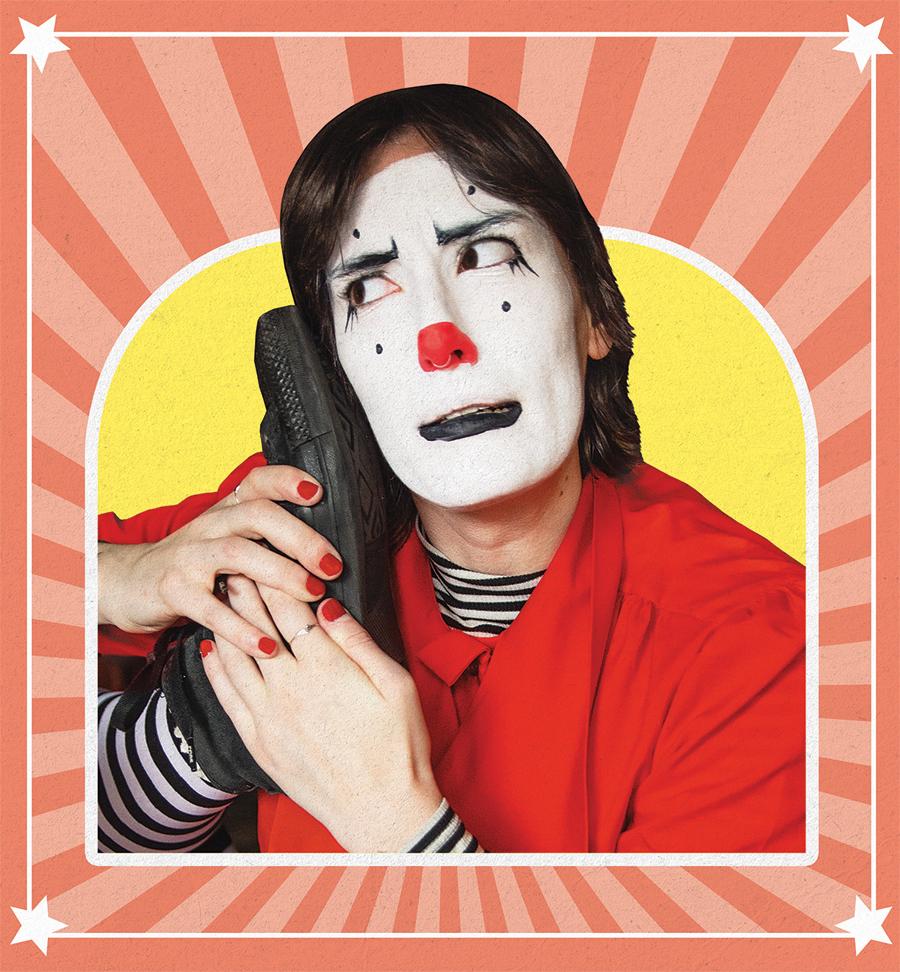
Photo by Grace Wilson; design by Kristin Bjornsen

Audio By Carbonatix
A clown with a cartoonish zit instead of a red nose awakes to a red feather sprouting from their crotch. The feather twitches; it wants things. At first it’s fun, but things devolve. The clown falls in love with Jesus, accidentally kills Jesus, becomes Jesus, all to the sound of live violin.
So goes the plot of “Featherbrain,” an award-winning clown show by Madly Forsyth.
Forsyth — known as “Madly Regular” to her fellow clowns — admits it’s hard to convey what she does. The common perception of clowning (or “clown,” in clown-speak) remains stuck in a fog of horror villains and birthday party misadventures, not avant-garde art about liberation, desire and religious trauma. “I can’t tell people I’m a clown; I usually say that I do comedy,” she says.
Forsyth is an ex-Mormon who left the church as a teenager, a theme that often finds itself in her work. She first tried creating stand-up routines, but it wasn’t the freedom she was looking for. “Stand-up felt like I was putting on this beauty mask. … If you bomb or mess up, you’re doing it wrong,” she says.
Kii Clark, a silent clown known as Skeleton Kii, started her path to clown while at work. “I literally walked off the graduation stage [of a musical theater program] into a grey cubicle and said, ‘I hate this,’ so I started watching clown videos at my desk,” she recalls.
Meanwhile, classically trained clown Buba Basishvili came to clown after feeling limited by mime as a member of the Republic of Georgia’s state pantomime group. “We’ve seen mimes trapped in walls; that is what happened to the theater itself, philosophically,” he says.
Forsyth, Clark and Basishvili’s stories are a variation on a common theme of comedians and artists looking for a release and finding clown.
The past five years have seen an explosion of modern clown, clown-prov and avant-clown in the Denver performing arts and comedy scenes, says Soleil Kohl, a clown and physical theater artist. “Maybe they don’t fit into stand-up,” Kohl says. “They want to perform, but they feel like it’s all too rigid, and now there’s this modern clown movement that is all about being honest, being vulnerable on stage, about heightening things that are uniquely you on stage and making those funny — a much more democratized system of performance as opposed to in an improv theater.”
Last year was the first year the Denver Fringe Festival had a clown genre. This year, one in every three acts was clown, 31 in total.
A clown’s ability to subvert social norms gives power to the fool to mock the king, a mirror to shine back the absurdity of our everyday lives and freedom for everyone — performers and audience alike — to laugh from the deepest pits of their bellies.

Grace Wilson for Westword
The performers
Forsyth’s first clown class was in 2023 with Nick Trotter, a long-time Denver-based clown and head of street theatre troupe Circo De Nada. Trotter started the class with an exercise called “magnets.”
During magnets, members of the class stand in a circle and make eye contact with someone across the circle, looking at one another without putting on any expression. The exercise fosters a central tenet of clown: there is no fourth wall between you and an audience.
“I felt the need to smile,” Forsyth recalls. “To just look at someone without any face, I felt I was being so rude, that they were thinking I’m awful … and I realized that it’s not the case. I don’t have to put on anything to make anyone else comfortable.”
One of Forsyth’s frequent collaborators and friends, clown and writer Mathea Tanner, also remembers the exercise’s impact on her. “Ever since I walked out of that class, I realized how much we spend our days doing what is expected of us and how often we’re masking,” Tanner says. “The absurdity frees you as the performer.

Grace Wilson for Westword
“Once you get on stage, dressed like a cat with an eye-patch over one eye, you realize that, maybe, you should put stuff into perspective,” she continues. “We’re constantly stressed out about stuff that we made up as a society. 401ks? Borders? None of it’s real! We made it all up; go make up something fun.”
A clown’s lack of deference to social cues gives them the ability to invert power, according to Forsyth. “It’s very necessary for the culture,” she says. “There needs to be someone to point out the absurd things the king is saying.”
“It’s resistance,” Basishvili adds.
This is not to say that there are not also strong and varied opinions on what is and is not clown.
There are clown schools, like L’École Internationale de Théâtre Jacques Lecoq in Nice, France, and Dell’Arte International School of Physical Theatre in California, that focus on extending the ancient lineage of mask work and commedia dell’arte, the historical basis of clown, through multi-year conservatories.
There are also modern clowns, like Courtney Pauroso, who played a sex-robot named Vanessa 5000 and spit into a consenting audience member’s mouth during a show.
Melo Acevedo, a Denver-based clown and professional entertainer who works as a presenter for the charity video game marathon series, Games Done Quick, had his introduction to clown through a workshop by Pauroso. He also recently finished up a three-month intensive at Lecoq, where two students shaved their heads, and several stopped coming to class. He credits both with furthering his clown journey.
While clowns are often thought of as jugglers or acrobats, the technical skill is in service of connection, Acevedo says. “Modern clowns are just our current expression of how we connect with an audience,” he explains. “What is impressing people is being seen in a world that is both so connected and so isolated.”
“We are in a nonchalance epidemic,” says Kohl. “It comes from growing up … in a surveillance state where anything can be online. I need to be cool and neutral, and then no one can make fun of me and nothing can happen to me.”
Clown is the opposite of nonchalance. Often relying on exaggerated physical movement — think Charlie Chaplin or Lucille Ball — a clown is a larger-than-life presence, and purposefully ridiculous.
This earnestness is what drew Alice Gillette to the form. Gillette, a clown who cofounded and produces for Denver-based clown troupe Idiot Theatre, says clown was the name for the connection she always wanted in stand-up, but wasn’t able to achieve through that form. “When I’m my most vulnerable self … something really special happens. I’m holding up a mirror, and we’re able, for a second, to remember to be ourselves, and not be so scared,” she says.
Take a scene in “Gulp!” a work in progress performed during “Freaky Weeky,” a week-long clown festival held in Denver in March that is produced by Gillette and Idiot Theatre.
In “Gulp!,” clown Prith Khalsa plays a man who falls deeply in love with a banana. He has to balance his love life with his job as a literal race car. As the audience cackles, Khalsa chugs half a gallon of brownish liquid labeled “Gas” and half runs, half leaps at breakneck speeds around the stage while making motor noises.
Somehow these furious bursts of energy only serve to make the tender moments when he comes home to massage his banana-wife’s feet all the sweeter. Because being earnest also means vulnerability, clowns must learn to accept the pain and embarrassment of failing, without the cushioning of detachment.
Clark, the silent, avant-garde clown, recalls another exercise at Pig Iron, a Philadelphia-based theatre and school. “They forced us to flop over and over and over again, because when you’re flopping, it feels like the end of the world: my ears are hot, my nose is hot, my vision goes blurry,” Clark recalls. “But after so many times, I know the feeling; I know what’s going on. Just breathe.”
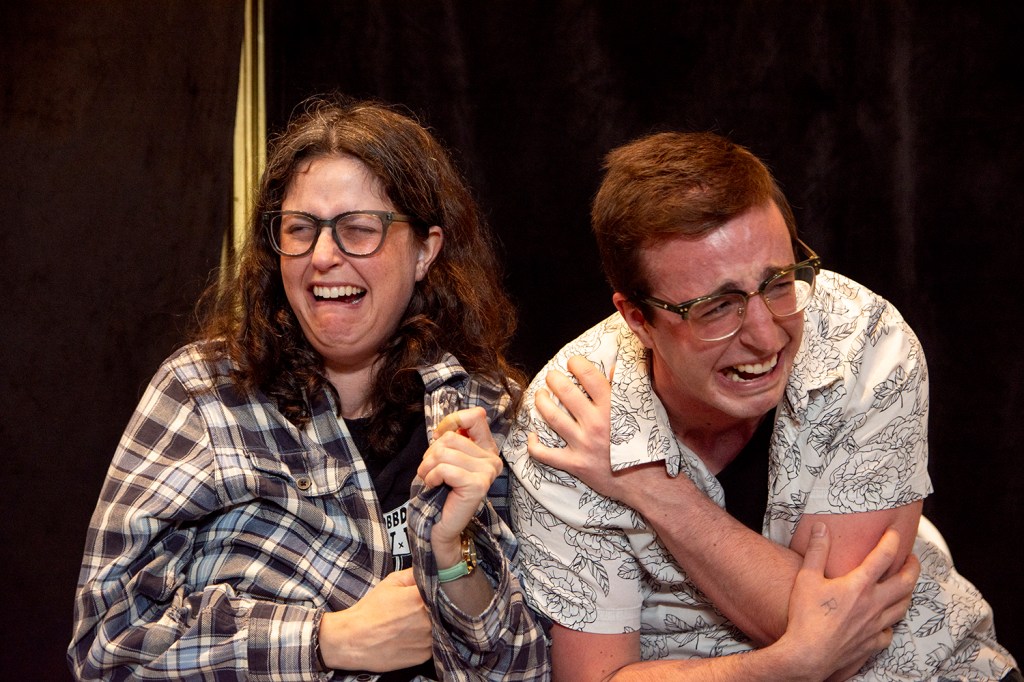
Grace Wilson for Westword
Clown school
The explosion of clowns has also led to an infrastructure gap. Far more people want to learn how to do clown than there are teachers. Self-professed “baby clowns” who have only been practicing the art form for a year or two are teaching classes to fill the need. Every clown we spoke to for this article either teaches or has taught clowning classes.
The result is a rapidly growing Denver clown community whose members are constantly traveling to other teachers and bringing back what they’ve learned; teaching one another and reaching the clown-curious while also writing, producing and directing their own shows. Clowns, Clark explains, are also often a majority of the audience.
“Every day we’ve got something to look forward to because we can be together, working on something absolutely ridiculous,” Tanner says. “When the world gets really heavy, you need to realize that everything is absurd … and find a way to make it worth something.”
Clown shows have also become a staple at theaters like Chaos Bloom, The Bug and The Savoy. Performers share events for the committed and the clown-curious through the Clown Calendar website at Clowncal.com, and post fliers on streetlight poles around Capitol Hill.
There are also supportive artists who are not clowns themselves, but enjoy working with them.
Dan Hartman, a sketch comedian and musician who has hired and worked with many clowns for his projects, says he loves that the clowns can handle anything that gets thrown at them.
The audience
The audience in a clown show, Basishvili explains, is “a live entity. It’s a conversation. There is never a fourth wall; you always interact with them, and it always affects you.”
This was one of the elements that Meghan Frank, another classically trained clown and Basishvili’s creative partner, says she finds compelling about the art form. Starting in 2003, Frank traveled to refugee camps and places impacted by war and conflict — including the Balkans, Afghanistan and Egypt — with Bond Street Theatre, a New York-based company that aims to provide levity and joy in difficult circumstances through street theater forms, including clown.
“Clown can travel across linguistic and ethnic borders. … There was no separation between me and the person sitting across from me, and that felt like a great equalizer,” Frank says.
For Tanner, who also uses clown to inform her work as a writer, it’s “a way of accessing something that is universal. I’m not just being myself, I’m being everyone,” she says. She’s currently workshopping a house goblin clown who transforms through the magical power of sweatpants.
“It’s us seeing a part of ourselves reflected that creates this funniness,” Frank says. “Wearing that vulnerability and allowing you to laugh at them so … you can laugh at yourself.”
That is not to say that all performers attempting clown are capable of doing that. Kohl acknowledges that an experimental clown show “might be the worst thing you’ve ever seen. But, at least, they’re doing something different … it feels really raw and earnest and honest. It doesn’t feel curated and practiced.”
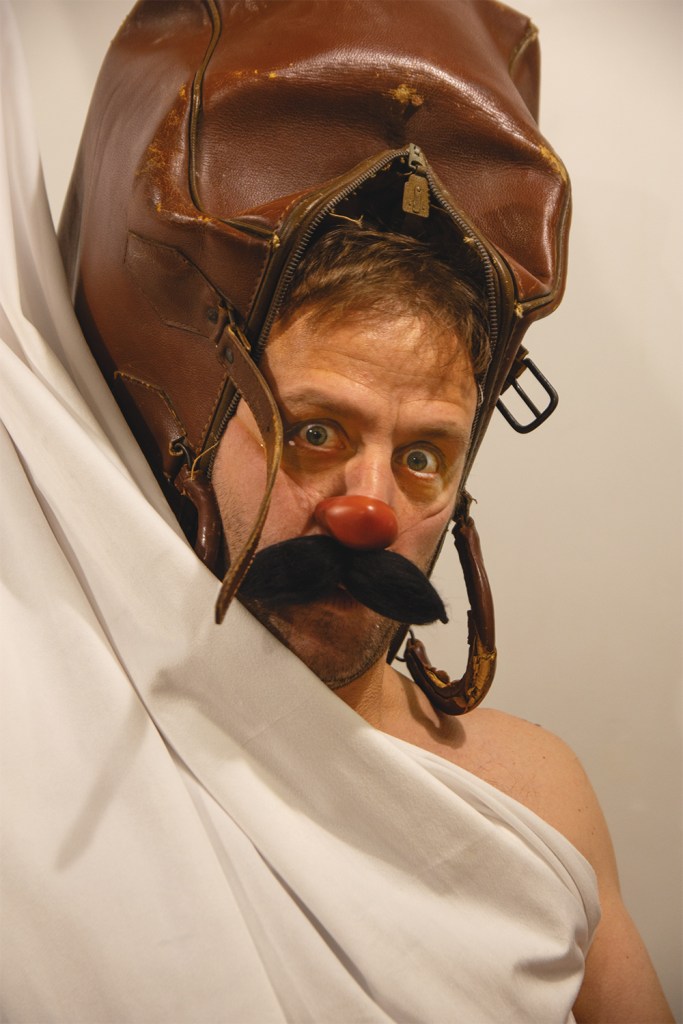
Grace Wilson for Westword
Kohl practices a form of clown called “bouffon,” which focuses on mockery. While clowns in general invite the audience to indirectly laugh at themselves by laughing at the clown, bouffon laughs directly at the audience, all of the audience.
“They mock everything and anything,” Kohl says. “In that way, it’s very equitable; I want a radical leftist and a MAGA die-hard to both be able to sit side by side, and both feel they’ve been poked at and be able to laugh at themselves. … I believe that’s the only way that change can happen.”
As the performer is freed from social constriction, so is the audience. When Acevedo is performing, he says he feels that release from the audience.
“For a brief moment in time, it’s as if everyone in the room’s beliefs fade away. If you can really make people present, they’re no longer thinking about their anxieties; they’re no longer thinking about what’s depressing and worrying them. For a moment, they are with you — and for just a moment, we’re all laughing,” he says.
In the end, regardless of style, clown is an art form used to tell a story, adds Basishvili.
“We are stories, everything is story around us,” he says.
And the story each audience member takes away can be different. Acevedo recalled a piece he performed with Blake “Isaclown,” who runs the clown calendar website and prefers to use his stage name. The two of them got into an ebb and flow of offering games to an audience, then retreating to a fort made of cardboard boxes, isolating themselves and looking sad.
“Then,” Acevedo says, “some audience member will inevitably say, ‘Hey! he looks sad!’” and encourage them to come back and play again.
One audience member, Acevedo recalls, took it as a critique of automation, another as a metaphor for our interconnectedness, and one as a path to grappling with the death of their father.
“Your version of clown is so playful,” Acevedo remembers them saying. “I haven’t done much playing since I was with my dad. He’d been sick for so long; the idea of playing hurts … but to see a sad clown play and come out of that sadness? It helps.”
“What is so enticing about the world of clown is that it can mean so many things,” Kohl adds. “…It feels really raw and earnest and honest. We’re seeing a community of people who are watching this stuff and want to make it, similar to DIY scenes [that] have really grown. Let’s just make stuff, let’s just do it. … The appeal of clown is you can have so many different kinds of flavors, and it inspires the community to experiment more and make stuff.”