Photo credit: Narelle Wilson

Audio By Carbonatix
Independent Journalism in Denver Needs You
We need to raise $25,000 by August 9 to support the reporting our community depends on. Reader support keeps us independent and is playing a larger role in funding local journalism and shaping what comes next. If you believe independent local journalism matters, make a contribution today.
If you have ever wondered what it feels like to be a fish, you have your chance at the Denver Art Museum from now until the end of July. Or at least you have the chance to to take on the vantage point of a fish, specifically an Australian fish that is being guided through the water by an elaborate fencing system, woven from bush cane, hibiscus, and jungle vines plucked from the land surrounding the shore, then engineered and placed there for your swimming pleasure, only to arrive at a corral where you are caught, whacked, cooked over a flame, and eaten for dinner. The tightly woven fence curves and rolls like it would under water as it’s pushed and pulled by a current, catching the light from above to throw a threaded shadow on the floor.
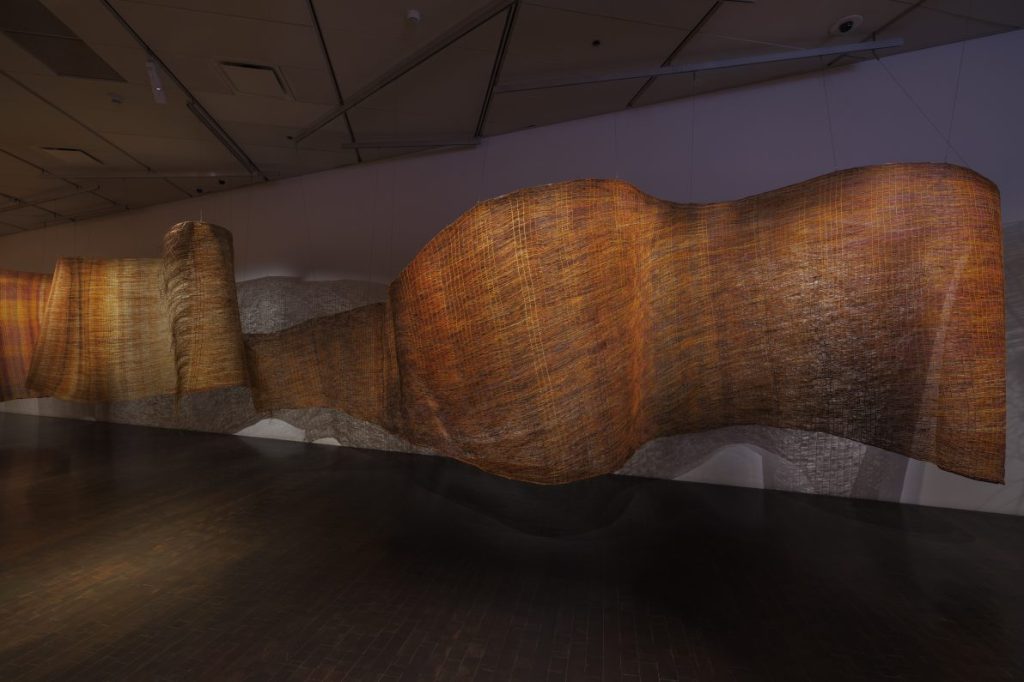
Photo by Eric Stephenson © Denver Art Museum
“Mun-dirra (Maningrida Fish Fence)” is one of many works that give Denver Art Museum visitors the chance to inhabit the point of view of someone — or something — else.
The Stars We Do Not See: Australian Indigenous Art, on view at DAM until July 27, offers many vantage points: that of the fish from the water, the bird from sky, the collective view of a tree and its roots from within the ground, and most of all, the view of the human artists interpreting it all, from every angle they can imagine and capture with the tools and materials close at hand. The view from today, from a century, and 65,000 years ago, when indigenous people on the Australian continent first began making art to visualize and render their own experience. To see the world they were living in again. To see themselves.
A collaboration between the National Gallery of Victoria in Melbourne and the National Gallery of Art in Washington, D.C., it’s the largest exhibition of Aboriginal and Torres Strait Islander art ever presented in North America.
“This exhibition is a reflection of how indigenous people from this place connect today with the past and with the future,” explains John Lukavic, curator of Native Arts at DAM. “The art here serves as a practice of cultural continuity, a bridge bridging past and present. It’s a means of communicating traditions and asserting indigenous identity. Visitors will become immersed in the history, ancestral teachings, and lived experiences of Aboriginal and Torres Strait Islander people through diverse visual language, languages and media.”
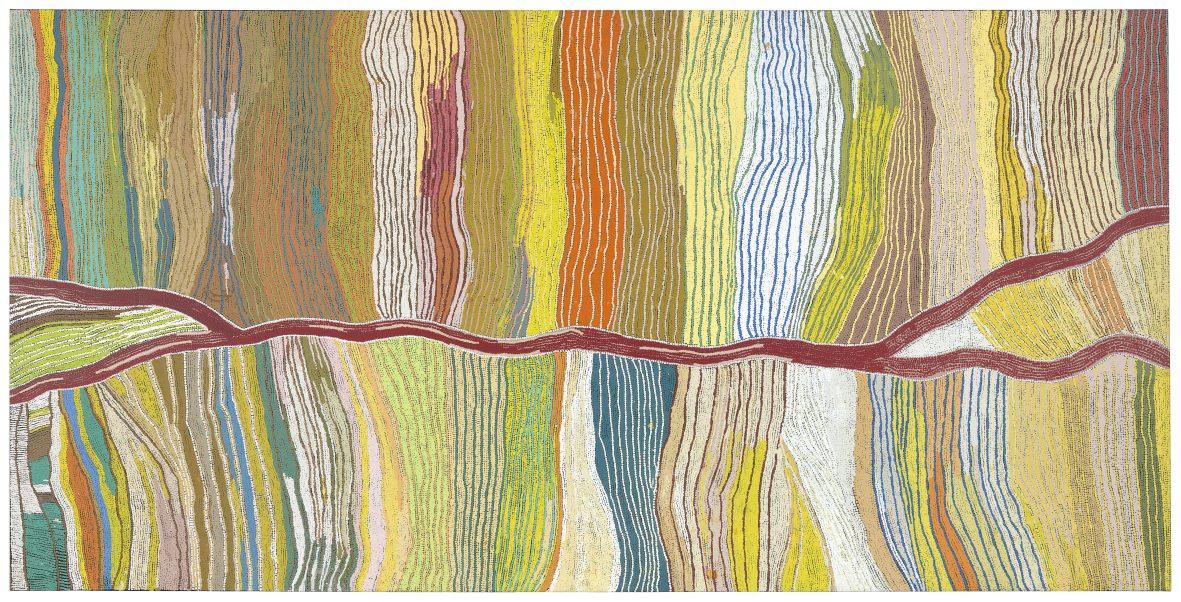
The exhibition is indeed huge, as is the scale of many of the works, so much so that the experience can be overwhelming at first. The key is to allow your eye to oscillate from a panoramic view to a narrow aperture, taking in the colors and textures of the art as one might from a bird’s view from above, then zeroing focus on whatever next catches your eye.
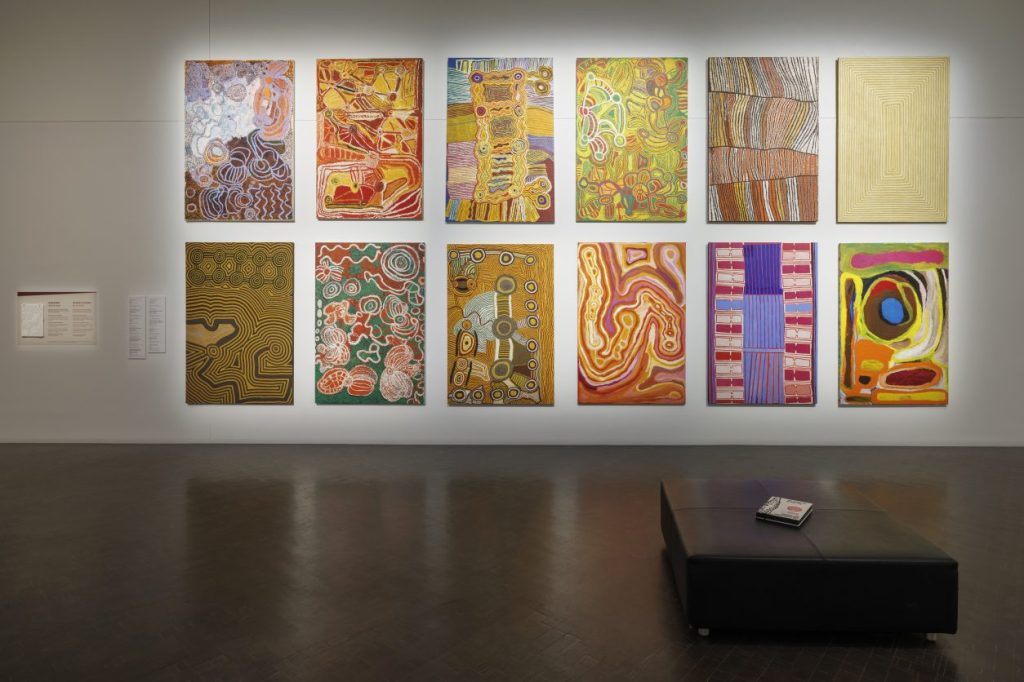
Photo credit: Eric Stephenson © Denver Art Museum
You have to look closely at “Thung-ung Coorang” by Maree Clark and Leonard Tregonning to understand not just how amazing it is, but what the piece is at all. Materials include: “Leather, earth pigment, sinew, kangaroo teeth.” The first two don’t raise an eyebrow. But yes, the string holding the four-inch-long, knife-sharp teeth together is in fact the sinew from within the tail of the marsupial itself. Maree Clarke, the Aboriginal artist who made the piece, explains the process as arduous but educational. “The most difficult part isn’t pulling the teeth,” she says with a smile, “but getting all the plaque off.”
Clarke’s goal is to replicate the process and materials used by her ancestors and pass them on to the next generation. Her nieces and nephews helped her boil the teeth and extract the sinew from the tails of kangaroos, which she found on the side of a country road outside of Melbourne. Why string up and wear the teeth of the fallen kangaroo? “The necklaces were traditionally given to people passing through Boonwurrung country as a sign of safe passage and friendship,” Clarke says. Kangaroos are figures of great spiritual and cultural importance to Aboriginal communities, making the necklace a totem of respect for whoever receives it.
The kangaroo tooth necklace — which you will have to see for yourself to truly appreciate — is just one of hundreds of works in the exhibition that illustrate a creative practice adhered to by indigenous artists across the continent. The artists and curators refer to it as being “on country.” Being on country means engaging exclusively with one’s natural environment through the entire creative process. If an artist wants to depict the country, then the pigments, charcoals, surfaces, and weaving materials they use must come from the ground, the trees, or the animals that exist on country. This explains why so many of the paintings display a somewhat narrow though richly varied color palette of ochres, yellows, pinks, and reds.
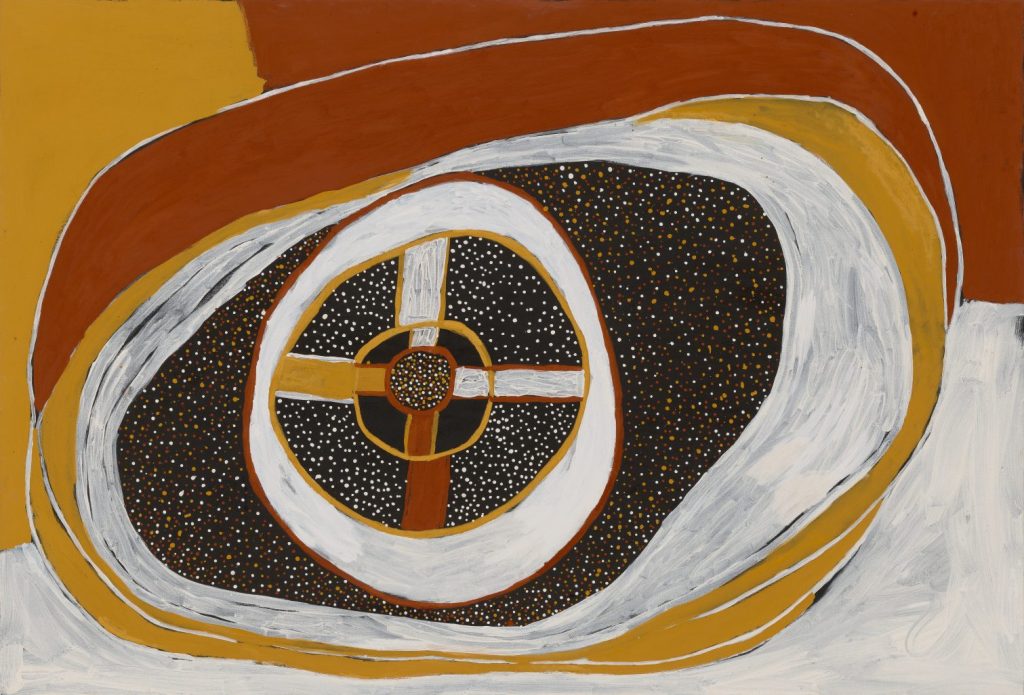
Nicholas Umek
Creating art on country has existed for millenia. “ For over 65,000 years, indigenous Australian communities have sustained varied and dynamic creative and cultural practices that long predate European arrival,” says Jessica Clark, senior curator of First Nations Art at the NGV. To put that in perspective, the Lascaux cave paintings in France are roughly 40,000 years old. While most of the works in the exhibition come from the current and previous centuries, they directly connect with the earliest known forms of human expression.
“These creative and cultural legacies carry on the knowledge, law, and stories of country across generations,” Clark continues. “They remind us to look not only at what is visible, but also to the spaces between to what is lived, loved, felt, and remembered beyond sight, guiding us to stay connected to country, to each other, and to the deeper layers of knowledge.”
In the Stars We Do Not See, time expands and contracts. From the fish’s vantage point, maybe time is just the current that carries you along. From the bird’s eye, maybe time is how long it takes to fly from here to there. From the artist’s eye, time is both an eternity and a blink.
The Stars We Do Not See runs through July 26 at the Denver Art Museum, 100 West 14th Avenue Parkway, and is included in general admission.