
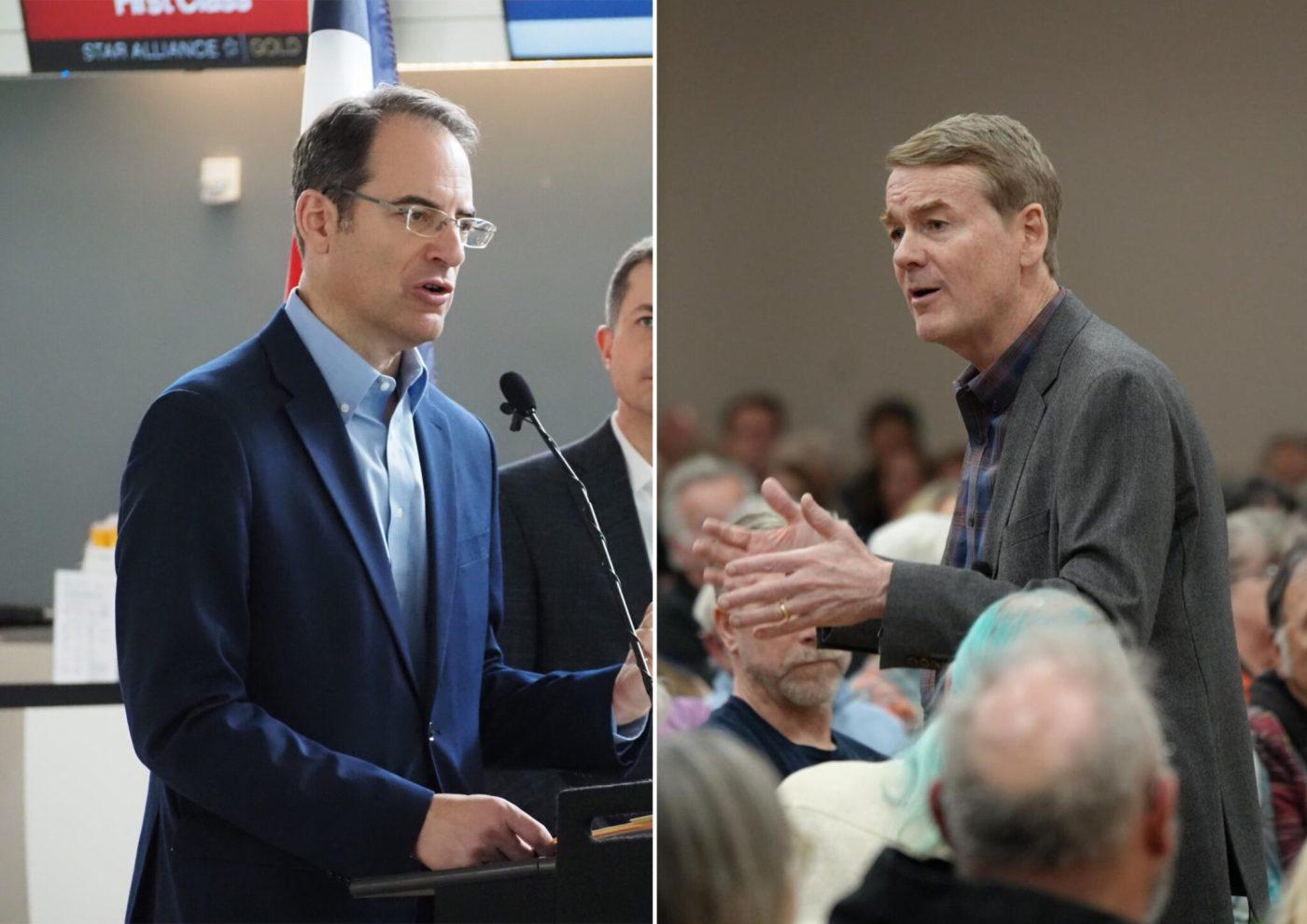
Lindsey Toomer/ courtesy of Michael Bennet

Audio By Carbonatix
Colorado’s two Democratic candidates for governor met again for a debate in Denver Thursday, less than a week before county clerks across the state will begin mailing ballots to registered voters for the June 30 primary election.
U.S. Sen. Michael Bennet and Attorney General Phil Weiser broke little new ground during the debate, hosted by 9News at the University of Denver, as each again reprised the major themes of their campaigns — Bennet touting his “vision for the future” and plans to tackle Colorado’s affordability crisis, and Weiser promising to accomplish many of the same goals by being a “fighter” fluent in the inner workings of state government.
Bennet, who has served all or part of four terms in the Senate since he was appointed to his seat in 2009, said he entered the governor’s race last April, three months after Weiser, because he “didn’t see a candidate with an agenda” equal to the state’s challenges.
“These are, in my view, the fundamental issues that we face: Can Colorado be a place where middle-class families can live, where working people can live, where teachers and others can find a home?” Bennet said. “If that is your agenda, and that’s what your concern is, I hope you’ll support my campaign.”
Weiser, however, argued that just as Bennet’s experience in Washington suits him for a leadership role in the Senate if Democrats take back Congress in November, his own eight-year tenure as attorney general has prepared him to take over as the state’s chief executive.
“I know our state, and I’ve been working with leaders across our state on the range of challenges we’re facing,” Weiser said.
“What’s best for Colorado can fit on a bumper sticker,” he added later. “Phil Weiser for governor, Michael Bennet for Senate.”
The winner of this month’s primary contest between Bennet and Weiser will be heavily favored to win the general election later this year and succeed Democratic Gov. Jared Polis, who is term-limited. Colorado has only elected one Republican governor in the last 50 years, and the party is widely expected to gain ground in a favorable midterm election year.
Thursday’s Democratic event at DU followed a debate between the three Republican candidates for governor — ministry leader Victor Marx, state Sen. Barbara Kirkmeyer and state Rep. Scott Bottoms — held there earlier this week.
A negative turn
The two Democratic hopefuls once again sparred throughout the debate over whether each had done enough to resist President Donald Trump’s agenda, with Weiser blasting Bennet’s votes in favor of some of Trump’s Cabinet nominees, and Bennet questioning why Weiser — who has filed more than 60 lawsuits against the second Trump administration since last year — didn’t join more suits against him in his first term.
After months of both candidates exchanging criticism about their approaches to fighting Trump, the race took a more sharply negative turn ahead of Thursday’s debate, as Bennet’s campaign and a pro-Bennet super PAC accused Weiser of a “pay-to-play” scheme involving donors to the Attorney General Alliance, a group of state attorneys general he chaired in 2022.
The four-year-old accusations resurfaced by Bennet’s campaign originated with the Public Trust Institute, a dark-money nonprofit with ties to a conservative advocacy network backing Weiser’s Republican opponent in the 2022 attorney general’s race.
Asked about the attacks Thursday, Bennet claimed Weiser “took a pass” on a lawsuit challenging environmental rollbacks in the Arctic National Wildlife Refuge after accepting contributions from oil and gas interests.
“That was something that … a whole bunch of attorneys general filed a lawsuit about, and Phil did not want to do it,” Bennet said. “So I suppose that’s where I would tie those two things together.”
Weiser called Bennet’s accusations “politics at its cynical worst.”
“I am saddened by these desperate, baseless claims,” he said. “This was a right-wing dark-money attack on me. It was debunked, and after it was out there, Sen. Bennet was campaigning with me, praising me to be attorney general. And here he is now basically trying to recycle those discredited attacks.”
Bennet entered the race last year as the heavy favorite, boasting endorsements from much of the state’s Democratic congressional delegation and the party establishment. A super PAC supporting him, Rocky Mountain Way, has given his candidacy a substantial financial edge, having collected more than $8 million in contributions from wealthy donors, including $2.6 million from billionaire former New York City Mayor Michael Bloomberg.
But a poll released this week by a pro-Weiser super PAC, Fighting For Colorado, purported to show the race tightening, with Bennet holding a six-percentage-point advantage but more than a third of likely primary voters still undecided.
Few differences on policy
The primary’s increasingly bitter tone comes even as Weiser and Bennet continue to identify relatively few specific disagreements when it comes to policies they would pursue as governor.
Both promised Thursday to expand the state’s supply of affordable housing and starter homes, to use the state’s authority where possible to block Trump’s mass deportation agenda and to protect Colorado water rights in an era of worsening drought.
Even when asked Thursday night to name the best thing and worst thing Polis has done as governor — barring his recent commutation of Tina Peters’ prison sentence, which both have heavily criticized — each answered identically, praising the governor for his work to enact universal preschool and full-day kindergarten, and criticizing his veto of a bill last year to hold social media companies accountable for the illicit sale of drugs and guns on their platforms.
Both said they would sign three bills recently vetoed by Polis — one to allow civil suits against federal immigration authorities, another to require social media companies to comply with search warrants within 24 hours of receiving one, and a third to ban rent-setting algorithms — but neither would say the same for a bill to ban driverless trucks on Colorado roads. And both again declined to endorse the Worker Protection Act, a bill to ease union formation twice vetoed by Polis after passage by Democratic majorities in the Legislature.
Echoing comments each made at a forum hosted by business groups last week, Bennet and Weiser expressed concern that overregulation is worsening Colorado’s business climate and driving employers out of the state. Debate moderators asked whether they regretted the decision by Palantir — the controversial surveillance technology company that supplies software to military and intelligence agencies around the world, including to aid the Trump administration’s mass-deportation program — to relocate its headquarters from Denver to Miami earlier this year. Both candidates answered in the affirmative.
“I don’t want companies to leave Colorado, I want this to be a place that all companies want to be,” said Weiser. “So I’m not going to be happy to see them or anyone go.”
“I think it’s a tragedy that companies are leaving Colorado,” Bennet agreed. “And it’s one of the reasons why I’m running for governor.”
Ballots will be mailed to all active registered voters in Colorado beginning June 8.
This story is republished from Colorado Newsline, a part of States Newsroom, a nonprofit news network supported by grants and a coalition of donors as a 501c(3) public charity.