
Sage Kelley

Audio By Carbonatix
Denver city officials claim that overall homelessness in Denver is down for the first time in nine years.
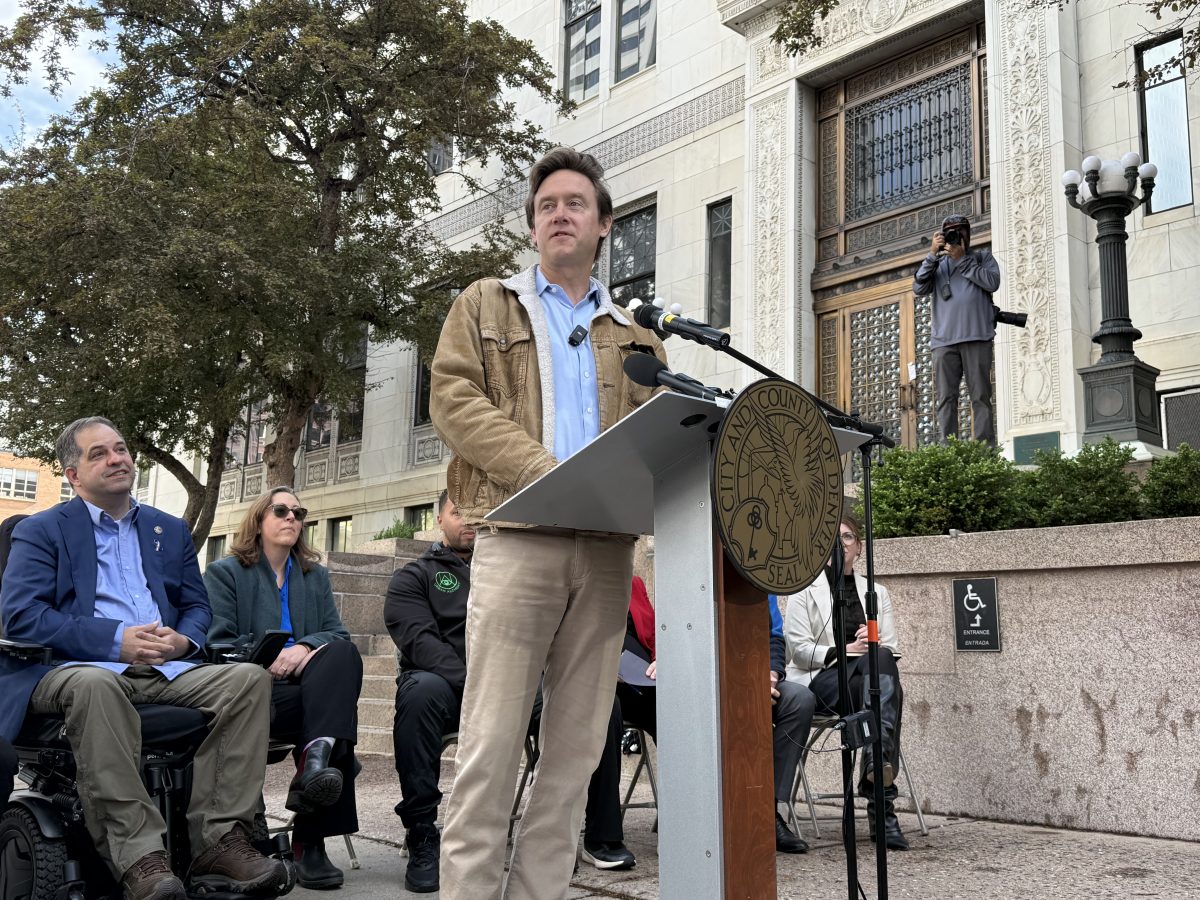
Mayor Mike Johnston appeared in his signature brown jacket — a little more tattered than when he started his tenure in 2023 — outside the Colorado Department of Human Services on May 20, touting a city-wide achievement in reducing homelessness.
According to Johnston, Denver saw a 12.5% decrease in overall homelessness between 2025 and 2026, marking the first documented reduction since 2017.
The numbers, provided by the Metro Denver Homeless Initiative’s Point-In-Time (PIT) Count, found 518 people living on Denver streets during a single January night earlier this year. That number represents a 64% reduction in street homelessness from 2023 and the lowest on record since county-specific data became available during PIT counts in 2017.
Johnston called it the “largest drop in any city in American history.”
“A goal that once seemed like a fantasy, the idea that we could end the cycle of street homelessness in Denver, now feels like a very real possibility,” Johnston said.
The decrease comes after Johnston made it his mission to reduce street homelessness by 75% by 2027.
Street homelessness is a specific number that includes people living directly on the street or in cars, not shelters. The category and the PIT’s annual county date in January have been criticized in the past for not showing the full picture, however, with some estimates that Denver’s homeless count is actually two or three times higher than what the PIT suggests.
The first thing Johnston did when he entered the office in July 2023 was declare homelessness an emergency. At the time, more than 1,400 people were living on the streets and another 4,600 in shelters, according to the 2023 PIT count.
Between 2023 and 2024, the city spent around $140 million on homelessness efforts, including buying hotels and transforming them into shelters.
Denver has helped more than 8,500 individuals access shelter and has assisted 7,700 in transitioning into permanent housing since Johnston took office, according to the city.
This work is not just on the city, according to Johnston. It involves local organizations, faith leaders and residents through the city’s “All In Mile High” initiative.
The initiative connects people to resources, such as Urban Alchemy, the nonprofit that runs the Aspen homeless shelter in the former DoubleTree hotel, to help get them into shelters and transition them to permanent housing.
“Urban Alchemy was the best thing that ever happened to that shelter,” Ny’isha Murray, a person who stayed at the shelter for nine months, told reporters during the press conference. “Me and my husband were homeless for a while. Without them, I wouldn’t be able to go get my grandkids.”
“They got us up, and I give them all the credit in the world,” Murray said behind tears, hugging the employees and Johnston.
Surrounding areas
Metro Denver Homeless Initiative also released the PIT count for the rest of the Metro on May 20.
Jason Johnson, executive director of the initiative, said that homelessness had decreased 8% across the region, not just in Denver.
He pointed toward expanded efforts in surrounding counties, including collaborative efforts in Jefferson County, preventative response in Adams County and disciplinary outreach in Douglas County, with the new navigation campus in Aurora.
Directly to the west of Denver, Lakewood saw a significant decrease in its PIT count. The 2025 iteration saw 553 homeless people, while the 2026 count only saw 265. That decrease came four months before the city opened its new navigation shelter, which is the only overnight facility in Jefferson County. However, the county did see an increase from 1,174 in 2025 to 1,231 in 2026.
Aurora also saw an increase, with 182 people counted in Adams County’s portion and 650 in Arapahoe County in 2026. The 2025 count had 185 people in Adams and 441 in Arapahoe.
Overall, Jefferson and Arapahoe counties were the only areas surrounding Denver to see a noticeable increase. Adams County did technically see an increase, but only by two people. Everywhere else, including Douglas and Boulder counties, went down.
“We believe that homelessness is solvable,” Johnson said. “These regional efforts are showing their impact. This is not an issue with a defined finish line, but one that takes ongoing, consistent effort from all of us.”