
Bennito L. Kelty

Audio By Carbonatix
Reader support matters more than ever
We're in the final stretch of our summer campaign. Our goal is to raise $25,000 to support the journalism our community relies on. Reader support is helping shape the future of local news.
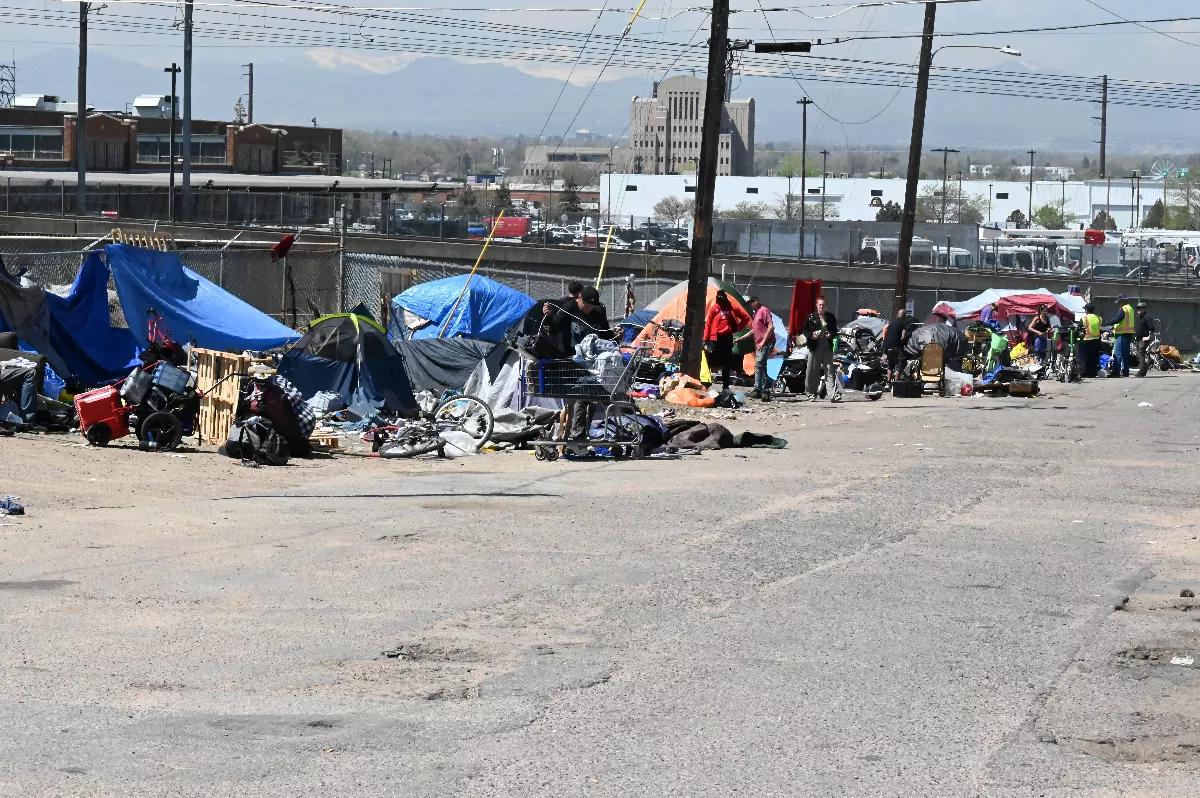
Mayor Mike Johnston recently claimed that Denver experienced the “largest drop in any city in American history” in homelessness. But some people who work directly with those living on the street disagree.
The annual Point-In-Time Count — a regional headcount of all homeless individuals during one night in January — was released on May 20; it found 519 people living on Denver streets, not in shelters. According to previous PIT counts, that is a 64% reduction in street homelessness from 2023 and the lowest on record since county-specific data became available in 2017. Johnston has also claimed that Denver saw a 12.5% decrease in overall homelessness between 2025 and 2026, the first documented reduction since 2017.
Still, questions remain regarding PIT’s methods, and how Denver could accomplish such a decrease.
“In brief, this low count is the result of increased policing pushing folks into hiding and a disconnection from houseless life and where people are at,” Terese Howard of the Housekeys Action Network (HAND) Denver tells Westword. “Not a reduction in houselessness.”
Is PIT legit?
The PIT counts aren’t just a Colorado thing. The U.S. Department of Housing and Urban Development requires that every federally funded region conduct one each January, though Denver does a second private count in the spring.
For the federally-mandated count, the Metro Denver Homeless Initiative MDHI), a nonprofit and continuum of care leader, sends people out in the middle of the night to count homeless people living on the streets, in cars, at long-term shelters and at emergency cold-weather shelters.
Groups like HAND have called the integrity of the count into question, though. “The PIT count depends on finding people. When people are not in visible ‘homeless camps,’ or at the shelters, they are not counted,” says Howard, who adds that homeless people have been hiding due to increased policing.
Ana Miller, an advocate with HAND and creator of the Trans Empowerment Alliance, was houseless in the metro area off and on until 2022, and doesn’t remember seeing a PIT counter while living on the street. “The count is unreliable. This whole count is vastly, vastly undercounting,” Miller says. “I didn’t know what the PIT count was until I started doing advocacy work. I guess I was never around when they did it.”
In a March letter sent to the mayor by HAND and other nonprofits, the groups claimed that there has been a 150% increase in ticketing for anti-houseless laws since 2023. “People are literally hiding,” Miller says. “They’re trying to stay out of view, which is going to make it harder for them to be counted.”
Jon Ewing, press secretary for the mayor’s office, says that the people conducting PIT counts aren’t just rolling down windows as they drive by; they’re looking under cars and in hiding spots.
“They’re looking every which way they can to find people because the goal is to figure out the number,” he says, adding that the count is not a definite number. The city knows that many homeless people are transient and may move overnight, but the count provides a comparable data point to help the city understand what is changing and improving, he argues.
“When the PIT count comes out, if somebody goes, ‘Well, that number isn’t going to be the same tomorrow,’ yeah, we agree,” Ewing says.
HAND reps also questioned the count being conducted in January, when people are often in cold-weather shelters. Because extreme weather shelters are only temporary, people counted as sheltered will actually be on the streets shortly after, they say.
MDHI accounts for this, Ewing responds, as counts across the country are mostly held during winter. He calls it an “apples-to-apples” comparison that provides “macro trends year over year.”
Jenn Meyers, spokesperson for MDHI, doesn’t see the PIT count as a be-all, end-all, either. “It is not intended to be used as an exact census,” she says. “Ultimately, because a single night count cannot capture the full scope of the crisis, MDHI stresses that the PIT count is just one tool. For a more all-encompassing picture, we point to our annual State of Homelessness Report.”
According to Nancy Burke, CEO of homeless service provider St. Francis Center, the organization’s staff and shelters have seen a drop in homelessness comparable to Johnston’s claims. She’s still not ready to view the PIT count as a true reflection, however. “It’s probably bad data, but it’s consistent,” she says. “That’s what is important to me: that the methodology is consistent and something you can reference.”
Pushed out of the city?
When city officials tout a recent decline in homelessness, critics often argue that law enforcement and service programs can push people out of downtown and to the city’s outskirts or bordering towns. Denver City Council members, Denver Police Department officers and homeless aid workers have all said as much.
HAND’s recent letter to the mayor, for example, accuses the city’s methods of “forcing houseless people out of visible downtown and surrounding areas.”
“I would not be surprised if the numbers are growing [outside of Denver], but the surrounding cities are pushing them right back into Denver,” Miller says.
According to Miller, even though enforcement in Denver is harsh, the suburbs are usually less tolerant of homeless residents, so most of them prefer the city.
Resources for suburban communities are picking up, if slowly. For former Lakewood City Council member Sophia Mayott-Guerrero, any dollar spent on intervention is good, regardless of what area it’s in.

Courtesy of the City of Lakewood
“I think the idea that, essentially, we’re pushing people into each other’s spaces is technically true, because people don’t respect city lines. With how people move around all of the time, why is it so bizarre that unhoused people are doing the same thing?” she asks.
Lakewood just reopened a revamped version of a Navigation Center in March; it’s Jefferson County’s only overnight, 24/7 shelter and center for the homeless. Aurora also opened a Regional Navigation Campus in late 2025.
According to the recent PIT count, homeless numbers have fluctuated in some of the metro’s suburban cities, but they’re down overall.
Homeless counts in the suburbs
Jason Johnson, executive director of MDHI, says that homelessness decreased 8% across the region, not just in Denver.
Lakewood saw a significant decrease in the 2026 PIT count. There were 553 homeless people counted within the city in 2025, and only 265 in 2026. However, Jefferson County saw an overall increase from 1,174 in 2025 to 1,231 in 2026.
Aurora also saw an increase, with 182 people counted in Adams County’s portion and 650 in Arapahoe County in 2026. The 2025 count had 185 people in Adams and 441 in Arapahoe.
“If people were being pushed out of Denver, you would see this huge rise in all these other places,” Ewing says. “The entire metro is taking a real approach to this. It’s not because people are shifting their responsibility from one county to another.”
Recovery Works, a nonprofit that runs a bridge housing program in Lakewood, agrees with the PIT count’s takeaway, but says the need for shelters still “far exceeds” available resources.
Kelli Barker, spokesperson for the nonprofit, says the narrative of people being pushed out of Denver and into surrounding cities has been around for years. “However, we’re not collecting data that would allow us to draw that conclusion, nor are we hearing it anecdotally any more than we have historically,” she says.
According to local government officials, where and when people are moving isn’t as important to monitor as the development of area-wide solutions.
“It all just misses the point that it’s already our collective problem and it needs our collective solution,” Mayott-Guerrero says.
“There’s a seven-county coordination that happens here,” Burke adds. “You can’t have all of these efforts going on in Denver, but then right over the line there’s nothing for people. You have to lift all of the efforts together.”
State of Homelessness Report
On the same day the PIT count was released, MDHI released its annual State of Homelessness Report, which is a bit more comprehensive than the PIT count. Data for the report was collected from the Colorado Homeless Management Information System, which tracks how people move through homeless systems, local nonprofits and government agencies.
This report also saw a dip in homelessness in the city — but the data is from between 2024 and 2025, so the drop isn’t as drastic as the PIT count claims.
According to the report, approximately 35,601 homeless people spent time within the entire metro area last year, a 1.3% drop from the 36,065 counted in 2024.
“You’re not going to sit here and tell me street homelessness isn’t down. We’ve moved close to 8,000 people into permanent housing,” Ewing says. “We’re just telling you that the strategies that we are using are working.”