
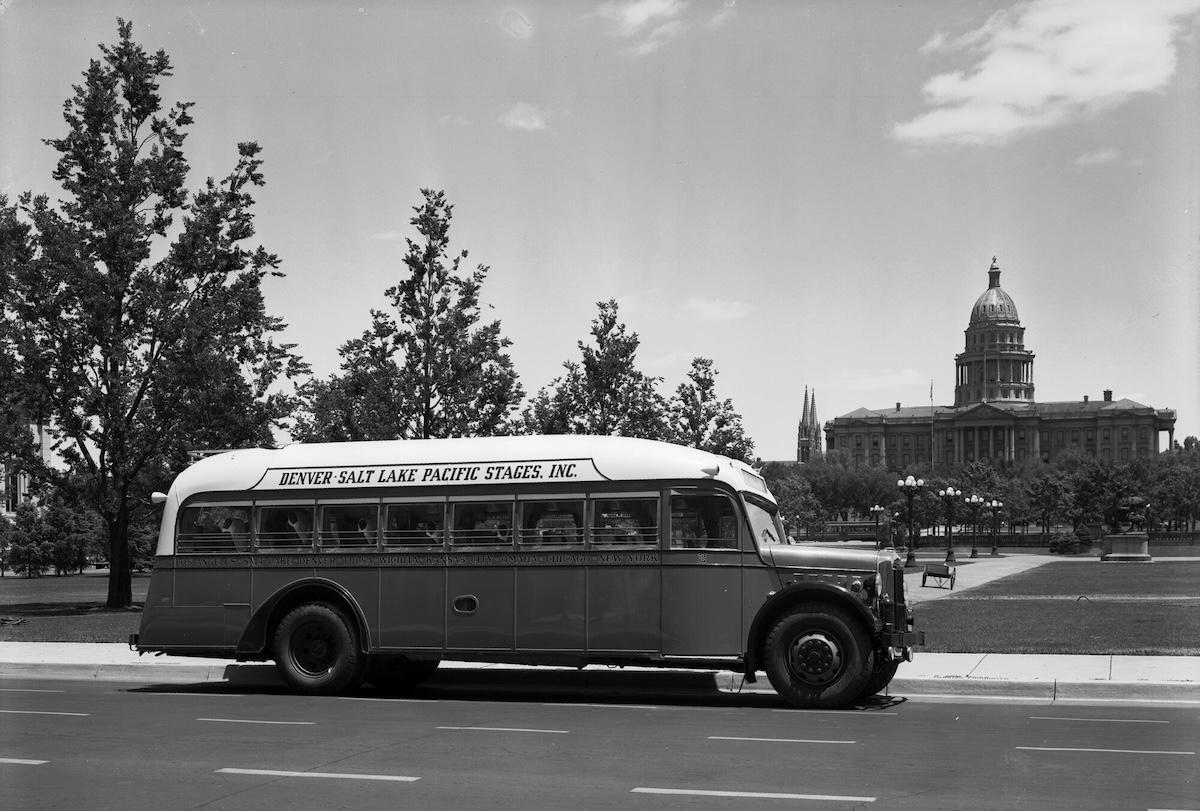
Denver Public Library/James Ozment Collection of George Beam photographs

Audio By Carbonatix
Thousands of people drive by a pair of old garages in Five Points every day, unaware of the role they played in connecting Colorado almost 100 years ago.
Located at 2100 California and 2101 Welton streets, the Federal Garage Buildings look like industrial remnants of past decades, with plywood covering much of the red-brick buildings. But underneath those boards is a rich history and potential for the future, according to Denver Community Planning & Development.
That’s why the city agency and other organizations are pushing for local landmark designations at both garages.
Century-Old History
Listed on the National Register of Historic Places, the Federal Garage Buildings are noted for their roles as bus depots while the country shifted from rail travel to highways. The California Street bus depot was built 100 years ago, city records show, and the Welton Street garage was constructed in 1947 as bus service expanded.
“It’s one that we don’t talk a lot about, transportation history in Colorado. But as automobiles and buses became more prominent, people stopped traveling by trains and wanted to get around other ways,” says Kara Hahn, a landmark planning and regulatory supervisor for CPD. “The railroad companies, they started these bus services — and, at the time, Denver, Colorado Springs and Pueblo were the three biggest cities in Colorado, so they had a transport service.”
Many of the routes were along the Front Range or serviced commuters across the state. A 1956 New York Times article claimed the 114-mile stretch of road between Colorado’s three largest cities was known as the “Ribbon of Death,” because of heavy traffic and dangerous driving conditions before Interstate 25 was built in 1963.
According to the landmark application for the Federal Garage Buildings, the Rio Grande Motor Way — part of the Denver and Rio Grande Western Railroad company — was the primary operator under a local subsidiary, the Denver-Colorado Springs-Pueblo Motor Way. The Colorado Motor Way branch joined a bussing conglomerate in 1936, adding more interstate routes, before it was sold to the Transcontinental Bus System in 1948.
Hahn believes the bus depots were “pretty heavily used.” Federal historians estimate around 1,500 passengers per day traveled through them at their peak in the late 1940s.
Bus services declined in the 1950s and ’60s as personal vehicles and air travel increased, and in 1961 the garages were sold to a real estate developer, who sold them six years later to a friend for $10…who traded it to the United States government days later for property in Arapahoe County. Since 1967, the buildings have largely been used as parking garages for federal vehicles and employees, according to Hahn and the U.S General Services Administration, the federal entity that owns and manages the properties.
Fifty years after the garages were a bustling transportation hub, they were placed on the National Register of Historic Places, an “honorary” designation by the GSA, Hahn explains. However, when the GSA was ready to dispose of the buildings in 2025, that status triggered a review through the National Historic Preservation Act, which determined that their disposal brought “an adverse effect,” according to a CDP staff report penned by Hahn.
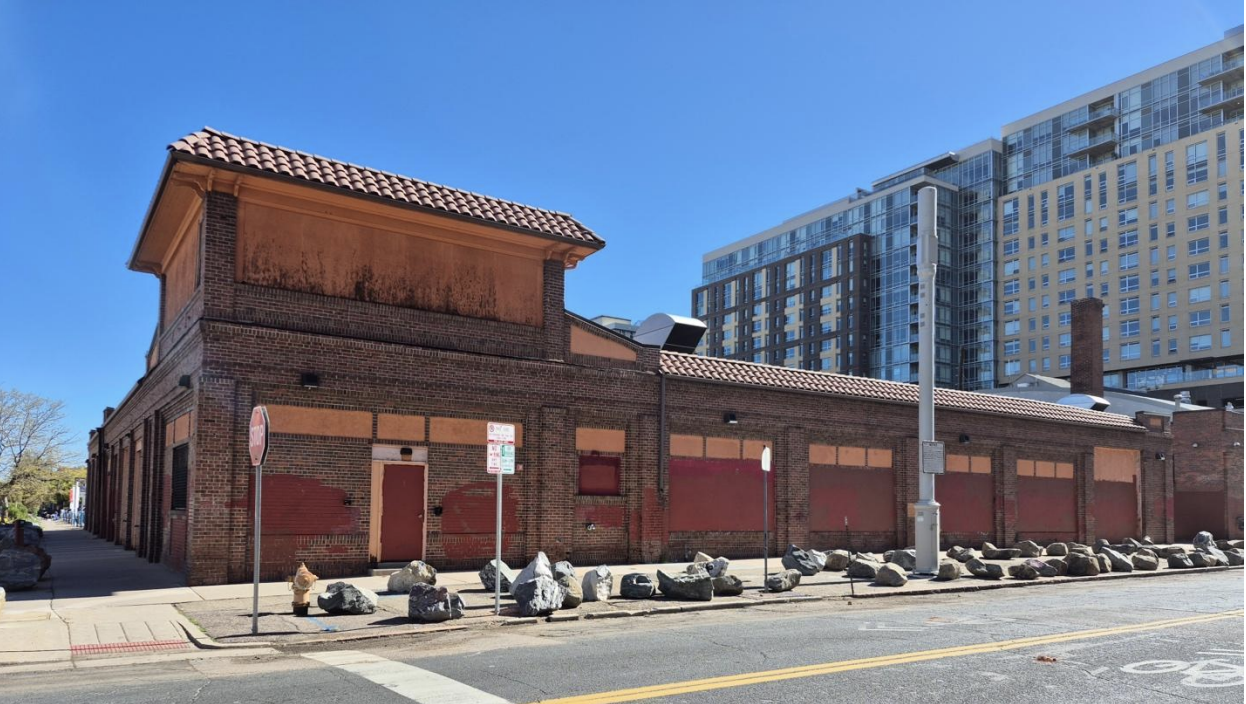
Denver Community Planning & Development
Preserving the Past With New Business
In a rare win-win-win for the city, the feds and historic preservation advocates, the GSA has applied for landmark preservation status. If approved, the buildings would still go up for sale, but they would be saved from any potential destruction and new owners would be eligible to receive special tax credits that come with the landmark designation.
The Denver Landmark Preservation Commission is scheduled to issue a decision on the application for the Federal Garage Buildings on May 19, before a final vote by Denver City Council later this summer. Among those in support will be Jay Homstad, senior director of preservation advocacy at Historic Denver.
For Homstad and others supporting the designation, the garages’ historic allure can be appreciated when you drive or walk by. Denver’s famous red bricks are easy to see, but the tops of the buildings are what set them apart, with a Spanish Colonial Revival style that includes a tiled pent roof, stucco accents and a corner tower. According to the GSA’s application, the architectural style was popular in the 1930s and ‘40s.
“The look of them, I’ve always found them satisfying. That Spanish Colonial detailing, it’s a very distinctive look for garages,” Homstad says.
In addition to researching and supporting the preservation of culturally significant buildings, Historic Denver helps connect real estate buyers with landmarked properties, aiming to give them new life while maintaining their historical authenticity. Homstad sees opportunities for business incubators, art studios, commissary kitchens and more at the Federal Garage Buildings.
“We think buildings like that are kind of primed for adaptive reuse. With the right steward, these buildings can provide affordable space that new builds just can’t provide,” he adds. “Buildings like this are increasingly rare in central Denver, and that’s exactly why the city’s creative and entrepreneurial needs should be considered at these buildings…new construction almost never pencils out rents that artists and new entrepreneurs can afford.”
A landmark designation would force any exterior changes to the buildings to fist go under board review, but new owners would be free to change and renovate the interiors as long as they meet current building codes, according to Hahn.
“It’s really open on the inside, so I think there are a lot of ways to adaptively use the space. Behind all the boarded-up windows are the originals; the windows and garage doors are still there,” she says. “I think there’s a lot of potential for both of the buildings.”
The landmark application is expected to be reviewed favorably by the commission, but if the effort fails, Hahn says that the buildings would still be protected, just in a more complicated way.
“The [CPD] reviews all demolition citywide, so we would find that these have the potential to be a landmark,” she explains. “It might be the same process again, but it would be much more controversial.”