

Scott Lentz

Audio By Carbonatix
Colorado’s struggling medical marijuana sector received a big shot in the arm on Thursday, April 23, when the U.S. Department of Justice announced that it was reclassifying state-licensed medical marijuana from Schedule I of the Controlled Substances Act to Schedule III.
The move follows an executive order issued by President Donald Trump last December directing the reclassification of cannabis to Schedule III and a 2023 mandate from the Biden administration to review the plant’s Schedule I status.
While this is a significant piece of federal cannabis reform, Trump’s order called for the rescheduling of both medical and recreational marijuana, and the DOJ’s announcement only includes the medical side as well as products approved by the Food and Drug Administration that contain cannabis.
According to the DOJ, a broad hearing on recreational cannabis will begin on June 29 to “provide a timely and legally compliant pathway to evaluate broader changes to marijuana’s status under federal law” while also “maintaining strict federal controls against illicit drug trafficking.” Activists and business owners are hopeful that recreational cannabis will be moved to Schedule III soon, but they’ve also learned that pot-related progress comes slowly.
“It is not full legalization. It is not the end of reform. But it is still the most meaningful federal cannabis-policy move of our lifetimes so far,” Ricardo Baca, former cannabis journlaist and founder of cannabis public relations firm Grasslands, said shortly after the DOJ announcement. “Why does that matter right now? Because policy shifts change business and investment behavior. They change investor appetite. They change growth plans.”
Here’s what to expect next for medical marijuana in Colorado after the DOJ’s order, and some lingering questions facing recreational weed.
Is Medical Marijuana Legal in All Fifty States Now?
Short answer: No…but there could be some changes in the future regarding employment, gun ownership and loan restrictions for registered marijuana patients. Still, federal marijuana laws remain in place for recreational marijuana use and possession, and states can still ban medical marijuana use within their borders, as Idaho and Kansas have.
There is no mention in the DOJ order of worker or firearm ownership protections under Schedule III status, but both topics are expected to be broached by the federal government soon.
Will the Feds Be Overseeing Colorado Cannabis Production?
Medical marijuana and marijuana products produced under state-legal frameworks are now under Schedule III of the Controlled Substances Act, the same regulatory level as anabolic steroids, ketamine and hydrocodone-infused aspirin. According to the DOJ, most of medical marijuana’s regulatory oversight “will continue to be met” by statutory authorities and associated regulations, such as Colorado’s Marijuana Enforcement Division or Department of Agriculture.
In a statement to Westword, the MED says it is still “reviewing the final order on rescheduling.”
“We understand the order outlines additional steps ahead that would apply to state licensees, and we are working to understand the full scope of impacts at both the federal and state level, particularly for states that have established both medical and adult-use markets in their jurisdiction,” the MED says. “As we review the details of the order, we will be prepared to support coordination with our licensees and federal agencies through that process.”
Brent McDonald, marketing director of Colorado and Oklahoma cannabis chain Apothecary Farms, says he could see some FDA practices or rules being implemented at cannabis production facilities for extracts or edibles, “but this is all still to be determined.”
“Most pharmaceutical companies under the FDA are operating under CGMP manufacturing rules…which could hurt or help the industry.” he says. “Smaller shops or people who aren’t already doing this appropriately by cutting corners likely aren’t going to last under potentially new and more restrictive rules.”
Interstate Commerce on the Horizon?
State-licensed entities can now “engage in the manufacture, distribution, and/or dispensing of marijuana for medical purposes under federal law,” the DOJ order details, relieving them of heavy tax burdens. Moving to Schedule III also opens up more opportunities for cannabis-related research outside of the DEA’s oversight, according to legal experts. However, the future of interstate commerce and recreational cannabis is still unclear.
The DOJ order states that the “DEA must simultaneously amend the regulations to require a permit to import or export such products” when referring to medical marijuana under Schedule III status, but doesn’t provide any clear instructions beyond that. According to McDonald, some states have already passed laws and regulations in anticipation of interstate commerce, but he doesn’t see those distribution routes opening up any time soon.
“I think we’re still far away from that,” he says. “But one day I could see multiple states getting together at some point for some sort of regional interstate pact, like Colorado and Texas and Oklahoma.”
How Will This Affect Colorado Marijuana Business?
“Rescheduling signals a recognition of legitimate medical use, which could make physicians more comfortable engaging with cannabis as a treatment option,” says Ryan Hunter, chief revenue officer for Colorado cannabis company Spherex. “It’s a huge win for consumers, patients, businesses and scientists alike.”
But Colorado’s medical sector may be too far gone to fully resurrect; it’s faced challenges since recreational sales began in 2014.
From 2014 to March of this year, the number of registered medical marijuana patients in Colorado dropped by 52 percent, from 111,030 to 52,617, according to the state Medical Marijuana Registry, while MED data shows that the number of licensed medical marijuana dispensaries in Colorado has dropped by 43 percent, to 278 stores, many of which are part of dual-licensed stores that also offer recreational sales. Medical marijuana sales have never been lower in Colorado, either, dropping below $10 million on a monthly basis for the first time in 2025 — a far cry from 2020, when monthly marijuana sales eclipsed $40 million several times.
The rise of recreational marijuana around the country has taken away from medical marijuana’s earning power in Colorado, and so did a 2022 state law that restricted medical marijuana doctor recommendations and dispensary sales limits.
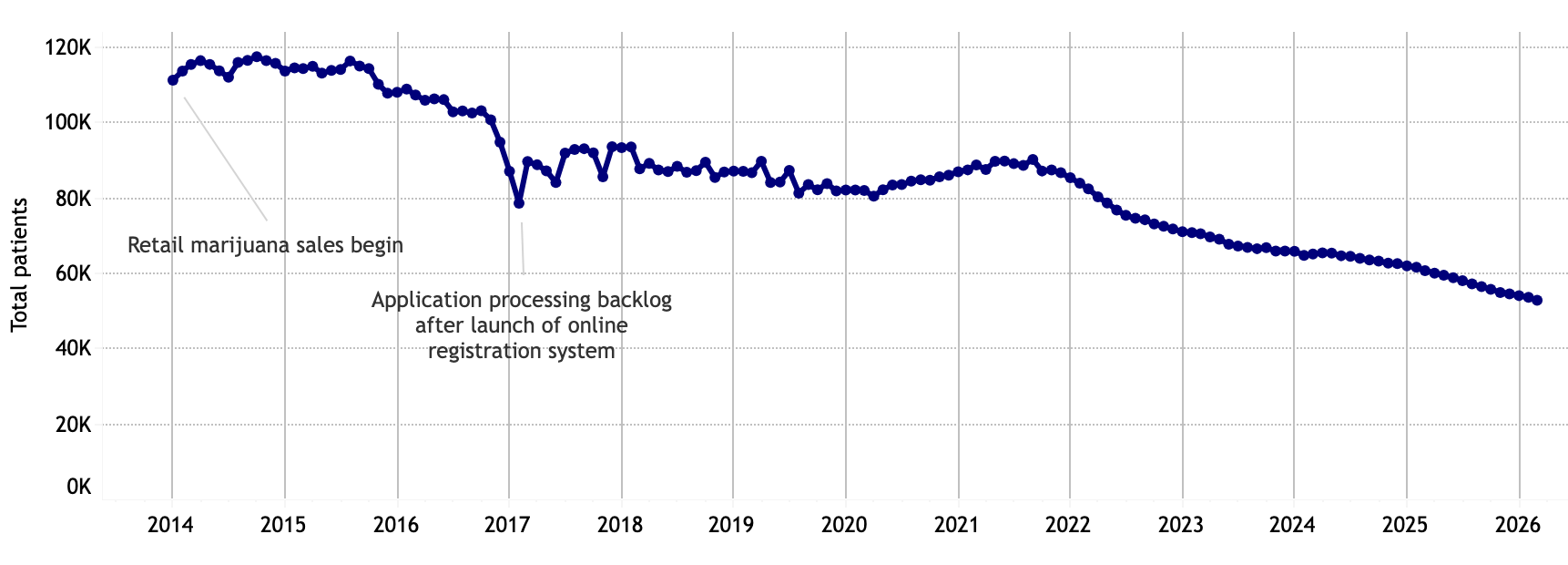
Colorado Medical Marijuana Registry
McDonald says he believes that cannabis as a whole should benefit from the new research opportunities under the Schedule III status, but “I don’t know if this is going to breathe life into the medical sector.”
Apothecary Farms has eight dispensaries in Colorado, six of which offer both medical and recreational sales, as well as licensed medical production facilities and a handful of medical dispensaries in Oklahoma. Recreational sales are where the real money is made for the vast majority of businesses, including Apothecary Farms. Still, McDonald sees positive things to come and worthwhile practices to learn with the latest reform.
Big Tax Implications
Because of the plant’s Schedule I status, medical and recreational cannabis companies cannot file for tax deductions, resulting in federal tax rates as high as 70 percent. That IRS tax code, 280E, was created to ward off narcotics kingpins in the 1980s but applies to all Schedule I substances. According to the DOJ order, medical state licensees “will no longer be subject to the deduction disallowance imposed by Section 280E of the Internal Revenue Code.”
Schedule I status also bars state-legal cannabis businesses from the majority of financial institutions, blocking them from services like loans, bank accounts and payment processing.
“The big changes I see are some of the tax relief implications and in banking. There could be some more traditional lending options that have been unavailable to us in the past: capital and payment processing, which could be huge. Right now were still dealing with tons of cash, so just being able to add in debit and credit card transactions, potentially, could be huge,” McDonald says. “Now it’s easier to prove to the bank that you need more funding.”
Although the next steps are cloudy, marijuana business owners are hopeful that the DOJ’s order will remove many of these barriers.
“While many of the details remain uncertain, the potential tax relief associated with rescheduling — particularly relief from the burdens of Section 280E — is critical for state-licensed cannabis businesses and has been a long time coming. Ensuring that this benefit is implemented in a workable and equitable way will be essential to the success of this policy change,” says Chuck Smith, CEO of cannabis industry group Colorado Leads
According to Smith, the impact on business owners in Colorado will be “significant but relatively narrow.” And dispensaries, growers and other facilities that are licensed for both medical and recreational use had better prepare for compliance homework.
“Hybrid businesses should expect a transitional period in which federally covered medical activity and federally non-covered adult-use activity may be treated differently for registration, tax, and compliance purposes,” Smith adds. “As this process moves forward, we will be watching closely to understand how these actions are implemented and what they ultimately mean for state-regulated cannabis businesses and consumers in Colorado and across the country. It is essential that federal reforms build on the strong regulatory frameworks states have already put in place and provide certainty for the industry going forward.”
What About Recreational Weed?
Recreational cannabis wasn’t included in the announcement; there’s a hearing on its own rescheduling path scheduled for late June. The hearing is expected to last multiple days, according to the DOJ, and mimght have to pause from July 3 to July 6 “to allow all parties to celebrate 250 years of American Independence.”
With medical marijuana’s Schedule III status secured and recreational pot’s hearing set, Spherex’s Hunter wonders where this puts intoxicating hemp products, which are set for a nationwide ban at the end of this year. Hemp also has medical and industrial applications, but as Hunter points out, it’s all the same plant at the end of the day — with three different sets of federal regulations.
“Today’s announcement is also both surprising and confusing. It is hard to understand how the government will manage and regulate a third classification of cannabis-related products, but it seems like state-legal marijuana for adult use is getting edged out of this important opportunity after spending years to establish clean and safe products while intoxicating hemp providers have been responsible for the proliferation of untested and unsafe gas station products,” he says.
According to McDonald and Smith, many of the changes coming to medical marijuana are likely signs of what’s to come for the recreational sector, whether those be new financial opportunities or more FDA oversight. But neither are expecting major changes immediately.
“I’m not holding my breath. I think they’re pretty happy with this current change,” McDonald says of the Trump administration. “I don’t foresee federal legalization happening on that [June] date, but we are expecting it to fall within the next four, five years.”