
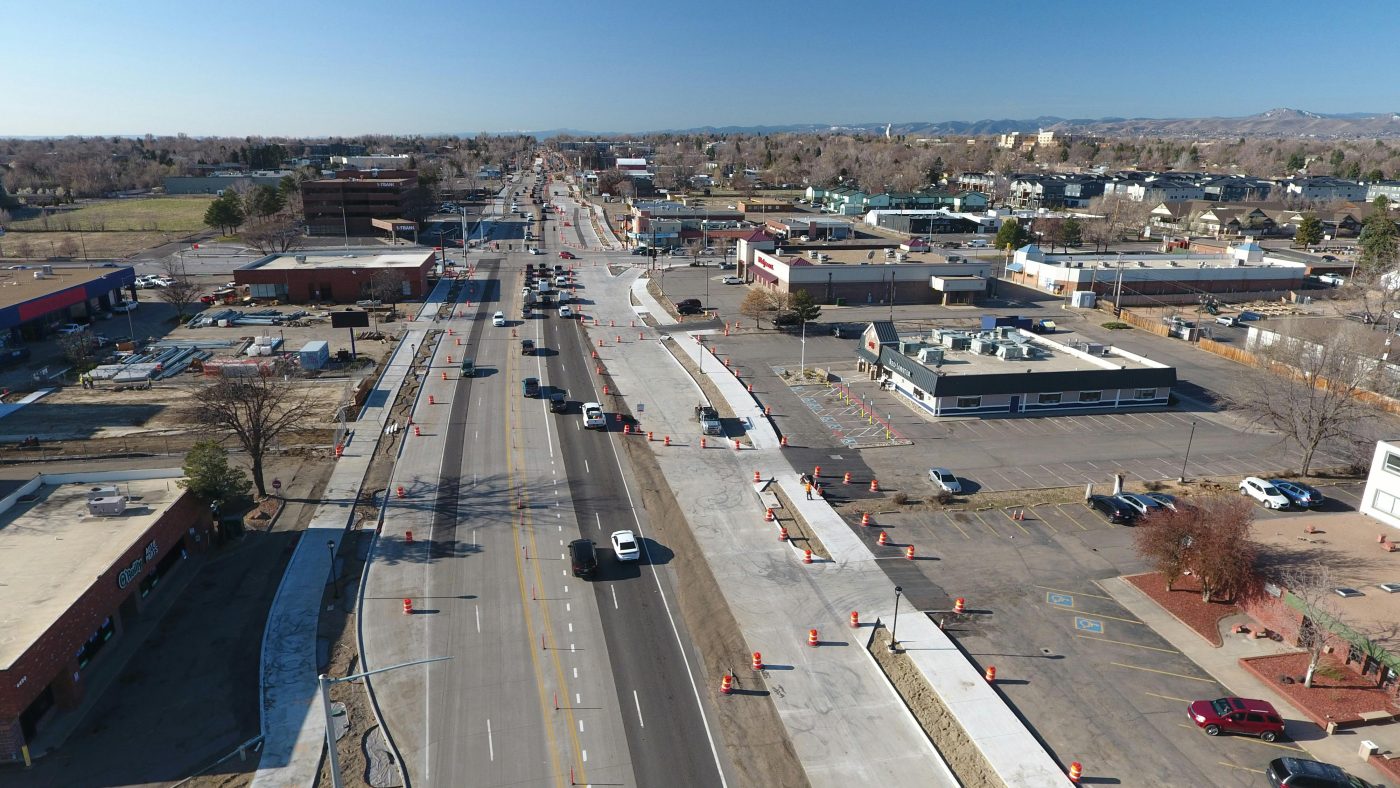
Provided by the City of Wheat Ridge

Audio By Carbonatix
Reader support matters more than ever
We're in the final stretch of our summer campaign. Our goal is to raise $25,000 to support the journalism our community relies on. Reader support is helping shape the future of local news.
Newly implemented intersections on Wadsworth Boulevard in Wheat Ridge were built to reduce traffic and crashes, officials say.
Two Continuous Flow Intersections (CFIs) were opened on Wadsworth at 44th Avenue and at 38th Avenue last December after nearly two decades of planning and tens of millions of dollars in construction costs — all with the intention of creating more efficient traffic flow and safer commutes.
The unique layout has caused some confusion among drivers and raised questions, including one from Mike in Arvada who asks, “The new Wadsworth in Wheat Ridge. Has the new configuration increased traffic flow and reduced accidents?”
For the latest edition of our Weekly WTF series, we take a spin on Wheat Ridge’s wacky intersections on Wadsworth.
What’s a continuous flow intersection, or CFI?
The two new intersections were planned since 2009, when the city first began formulating the Wadsworth Improvement Project, the largest infrastructure investment in Wheat Ridge history. The $85 million corridor plan included raised medians, a continuous sidewalk, new landscaping and the aforementioned CFIs.
Construction officially started in 2021 and lasted five years. Localworks, a business development nonprofit in the city, provided over $117,000 in grants to 19 businesses to help with recovery after the long project was completed. The “massive” project was largely completed in December, though some of the plants and shrubbery are still being put in place, according to city spokesperson Alex Rose.
For many drivers, the CFIs still look confusing — almost like snaking roads winding into one another — but it’s a simple concept: Right before the intersection light, there’s a left-turn lane that runs alongside the left side of oncoming traffic. This allows cars to turn left without waiting at a red light because they do not need to cross in front of oncoming traffic.
Vehicles turning right must proceed with more caution now, because oncoming cars will always be able to turn left.
Make sense?
The design was invented by Mexican transportation engineer Francisco Mier in 1987. The first one in the United States was built in Shirley, New York, in 1995.
Similar CFIs have been implemented elsewhere over the past few years, including three along Santa Fe Drive in Douglas County. The Wheat Ridge iterations were the second to come to the Denver metro.
Are the new Wadsworth intersections working?
Rose says it’s too early to have complete traffic-improvement data — the city expects solid traffic data to be available after the end of the year — but longer-standing versions in Kentucky have seen wait times reduced by up to 26% and overall delays by up to 40% in comparison to conventional lights, according to the Kentucky Department of Highways.
The city settled on the idea about six years ago as traffic in the area increased, with main roads like Wadsworth and Kipling Street directly affecting residents’ quality of life, Rose says. According to 2024 CDOT data, 44,000 people drive that stretch of Wadsworth every day.
The city wanted to be innovative about how to handle the challenge, Rose adds. And while everyone has differing opinions on the new idea, he believes it’s working as intended.
“Wheat Ridge has become more of a cut-through community,” Rose says. “It is so much more effective in getting those 44,000 cars that are going from Lakewood to Arvada or coming off of I- 70 and heading south through and limiting congestion.”
According to Rose, there has been only one “significant” crash at the intersections, which occurred when power to the traffic lights had gone out and responders hadn’t yet set up road conductors. With an extra stoplight for drivers to get into the oncoming turn lane, pedestrian safety should also be improved, he notes.
There is still a learning curve, though, but it hasn’t resulted in anything tragic. “People get confused the first time they encounter something new,” Rose says, adding that the police department has seen people ride up onto sidewalks or take wrong lanes before.
“Everybody was anticipating it was going to be constant crashes, and all these other things,” he says, “and that’s really not the case.”
Wacky? Yes. Winding? Surely. Effective?
It seems so!
Do you have a question you want Westword to answer? Submit it here, and we may respond in our next Weekly WTF column.