Courtesy of Birdy magazine

Audio By Carbonatix
Birdy magazine is one of Denver’s cultural treasures — and it’s struggling for survival.
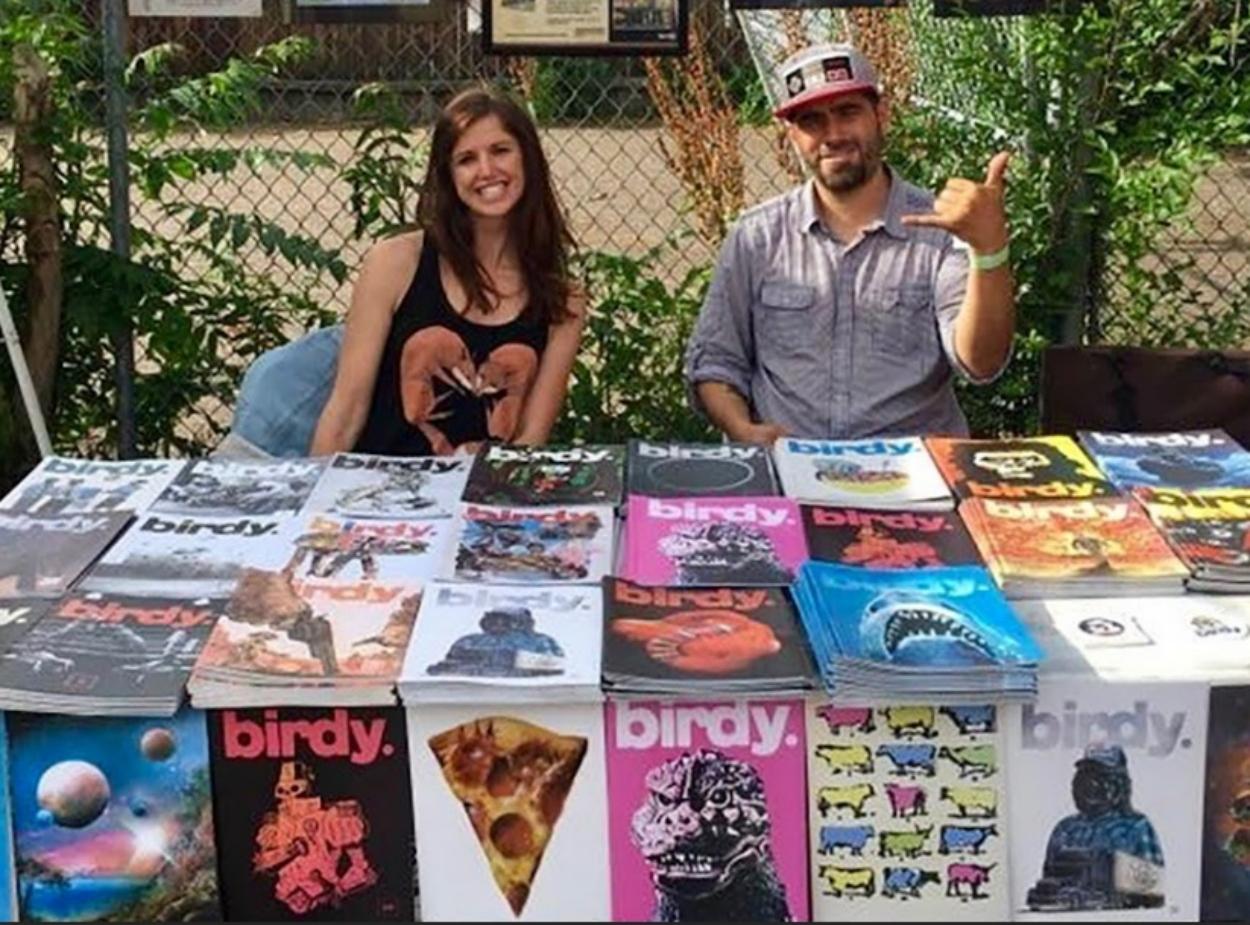
The brainchild of Krysti Joméi and Jonny DeStefano, Birdy hatched more than a dozen years ago and quickly took flight as a free publication dedicated to art, comedy and plenty more in Denver and beyond. At its height, Birdy’s circulation numbered in the tens of thousands per month, with copies available in major cities nationwide.
Now, however, Birdy’s 150th edition, fortuitously set to debut around the date of Colorado’s 150th birthday, is in limbo. “We need immediate support to even print issue 150,” Joméi says.
“It’s really urgent to keep this thing alive,” confirms Dan Landes, an entrepreneur who’s contributed art, essays, fiction and poetry to Birdy for the past decade-plus and has a vision for a major expansion of its footprint.
Birdy’s current instrument of financial salvation is a GoFundMe page with the amusing subtitle “Keep Print Undead.” But to DeStefano, this joke has a serious subtext. “Don’t tell us analog doesn’t matter,” he stresses. “We feel what we’re doing is really important. We’re fighting to preserve a human connection through an old-school technique.”
The GoFundMe effort has already provided one notable success: The page bankrolled issue 149, featuring a front image courtesy of Devo mastermind Mark Mothersbaugh and a back cover from skateboarding hero Stacy Peralta, whose contributions neatly summarize Birdy’s reach and the fondness with which the mag is regarded inside the artistic sector writ large. But Joméi hopes that the crowd-sourcing will lead to more long-term sustainability.
“It’s literally not letting us die,” she acknowledges. “But it’s also something that will let us take a breath and actually build the long-needed infrastructure to help Birdy keep going into the future.”
Birdy’s genesis tale is shot through with coincidence and serendipity. Joméi, who has a background in radio and magazines, moved to Denver in 2012 and landed a job at City, O’ City, the venerable restaurant and coffee shop fonded by Landes at 206 E.13th Ave. DeStefano not only worked at City, O’ City, but also had a place in the same apartment building where she lived. Once they connected — after DeStefano complemented her white leather platform boots — she learned that he helped run Deer Pile, a now-defunct alternate performance space directly above the eatery; he’d been hired by Landes to promote Deer Pile. (DeStefano had been originally hired to promote City, O’ City, which Landes sold in 2018.)

Courtesy of Birdy magazine
In conversations that followed, Joméi and DeStefano, later joined by Michael David King, the former layout editor of The Onion, began talking about assembling a magazine that would capture the fresh, innovative essence of Deer Pile. “We had access to all this talent,” DeStefano points out, “and we just thought we would continue the venue in magazine format: art, sci-fi, comedy, cool stories.”
Even then, the notion of launching a physical periodical, as opposed to putting everything online, struck many as flat-out cockamamie. But DeStefano, who had once been in the Hate Fuck Trio, among the very best Denver bands of the 1990s and early 2000s, stresses that such negativity “actually fueled us. It was like the punk-rock spirit.”
The first Birdy arrived in December 2013, thanks in part to the assistance of Sexy Pizza entrepreneur Kayvan Khalatbari, who bought around $1,500 in advertising — enough cash to pay for printing. Joméi proudly notes that “we haven’t missed a month since.”
Another key patron was Mothersbaugh, with whom Joméi and DeStefano connected in 2014, when the multi-hyphenate was in town with his blockbuster art show Myopia. Adam Lerner, then MCA Denver’s director, allowed Birdy to publish some of Mothersbaugh’s work, a move that instantly established the mag’s credibility on the global stage.
From the beginning, Birdy’s vision extended beyond Colorado. Artists from China, Chile, Uganda and other far-flung countries have been showcased in its pages over the years, alongside lots of local talent, including contributors such as Josiah Hesse, an author and onetime editor of Suspect Press (another Landes project). Birdy also established significant beachheads in Los Angeles and Brooklyn, as well as Chicago, Seattle, New Orleans and Asheville, North Carolina.
Joméi thinks one reason for Birdy’s widespread appeal is its brand of feisty open-mindedness. “One of our main mottos is inspired by Trent Reznor, my favorite artist of all-time: art is resistance,” she notes. “But Birdy is an oasis, which is crucial for us. In this day and age where you’re bombarded by terrible news all the time, you need something that’s positive.”
“That’s more important now than ever, with your phone hijacking your amygdala and the billionaire narrative trying to control everything,” adds DeStefano. “Grabbing your phone is stressful every morning — like, how are you going to be traumatized today? But there’s something about holding a magazine that’s inviting. We’re inclusive, we care about the world, the planet, animals, and yet we’re having fun. We’re a safe space for ideas and creativity.”
Unfortunately, producing this platform has never been cheap, and in the wake of the 2020 pandemic shutdown, costs, particularly involving paper, have continued to rise. Trump-era tariffs further exacerbated the situation, as did the departure of a major Birdy supporter who essentially underwrote printing costs. (The 2024 arrival of Denverse, a new quarterly arts magazine that recently made headlines after thousands of copies were stolen, didn’t complicate things for Birdy, Joméi and DeStefano stress. They express solidarity with Denverse and all local publications.)
As a result, the size of the workload on the shoulders of Joméi and DeStefano has grown heavier and heavier. Despite assistance from a small cadre of volunteers, the couple are near collapse.
Their sacrifice has been substantial, Landes emphasizes: “Jonny and Krysti have endured a lot for this moment, and now this moment is calling for an infusion of cash to keep it going.” But he also thinks Birdy has tremendous potential to make a mark beyond the Mile High City. “We’d basically like to use Birdy as an analog print-media format where local advertisers in different cities around the country can put their local advertising into Birdy, but the content stays the same,” he says. “It could be specifically for Nashville, Austin, Lawrence, Kansas, wherever we’d like to expand. And we can also start to attract national brands that want to market to these new cities.”
In his view, “we’ve amassed a pretty great team” to make this happen,” Landes says. “Jonny and Krysti are spectacular artists and visionaries, and I’m also working with the former CCO (Didi Bethurum) of Meow Wolf. Right now, we’re raising enough money to keep the print version of Birdy going, and once we have that, we’ll do a friends-and-family fundraise to begin to develop and execute the national expansion plan.”
Landes is another believer in the value of print in the 21st century. “I think what we’re really experiencing is the power of the algorithm, and what the algorithm is doing is creating a biased influence on what we see and consume,” he says. “But it’s different with print media. We like to say is that Birdy is novelty in the hand and every page is a new experience that’s not brought to you by an algorithm. It’s brought to you by artists and your own experiences.”
Even so, Joméi admits that the decision to reach out for assistance via GoFundMe wasn’t easy. “It’s like swallowing your pride and asking for help — or maybe not pride, but just that we need to put on our oxygen mask first,” she says. “There’s such a weird flux of emotions. But as horrifying and scary as it is, I do really feel this unshakable hope. Our community is so passionate, and I feel so lucky to live in Denver. I say this in a gentle, loving way, but Denver is kind of a city with training wheels on. It’s not this huge sea you get lost in. It still has this cowtown niche, and I feel the hunger from people about coming together to make spaces for art. It’s just a matter of putting the word out.”