
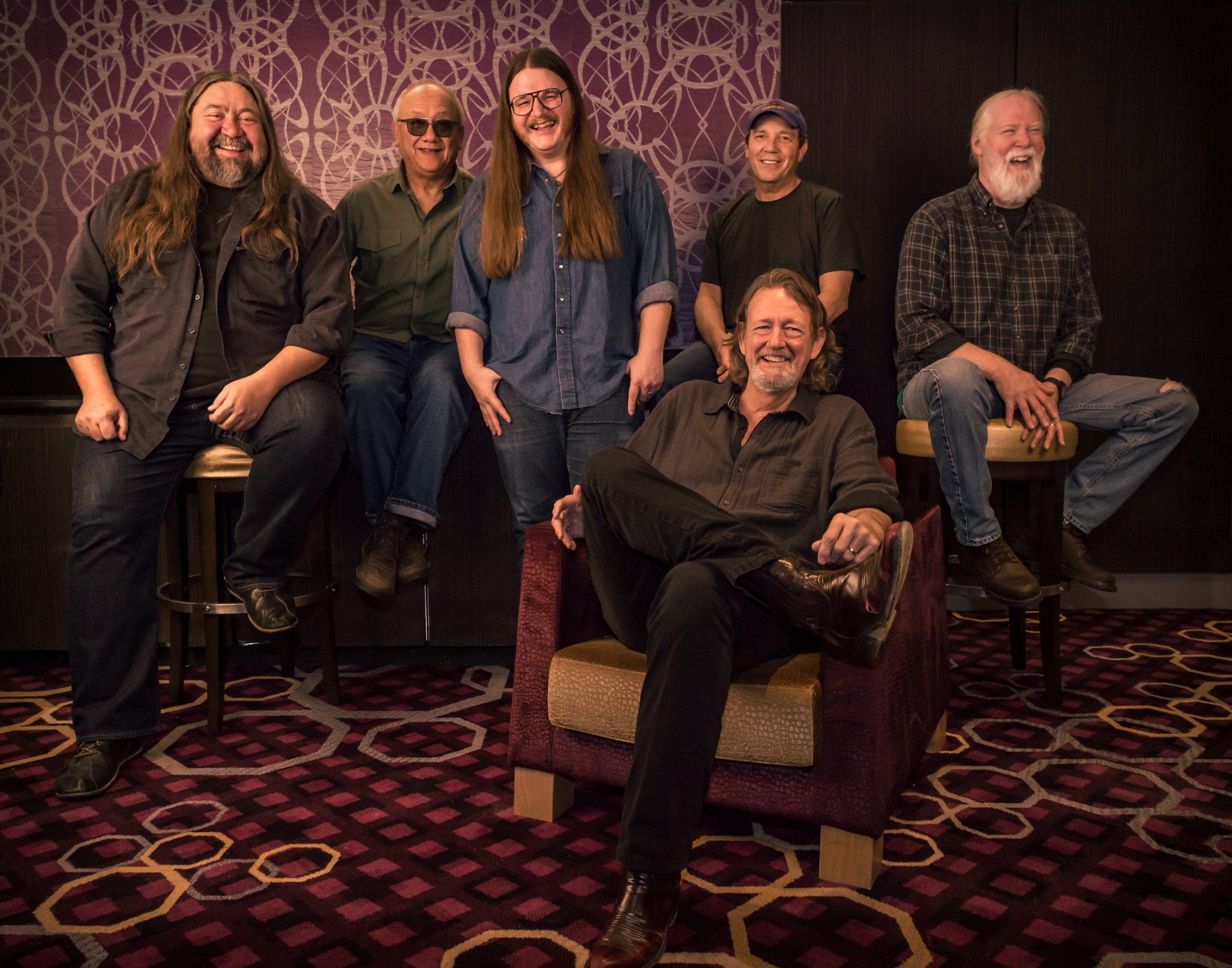
Photo by Josh Timmermans

Audio By Carbonatix
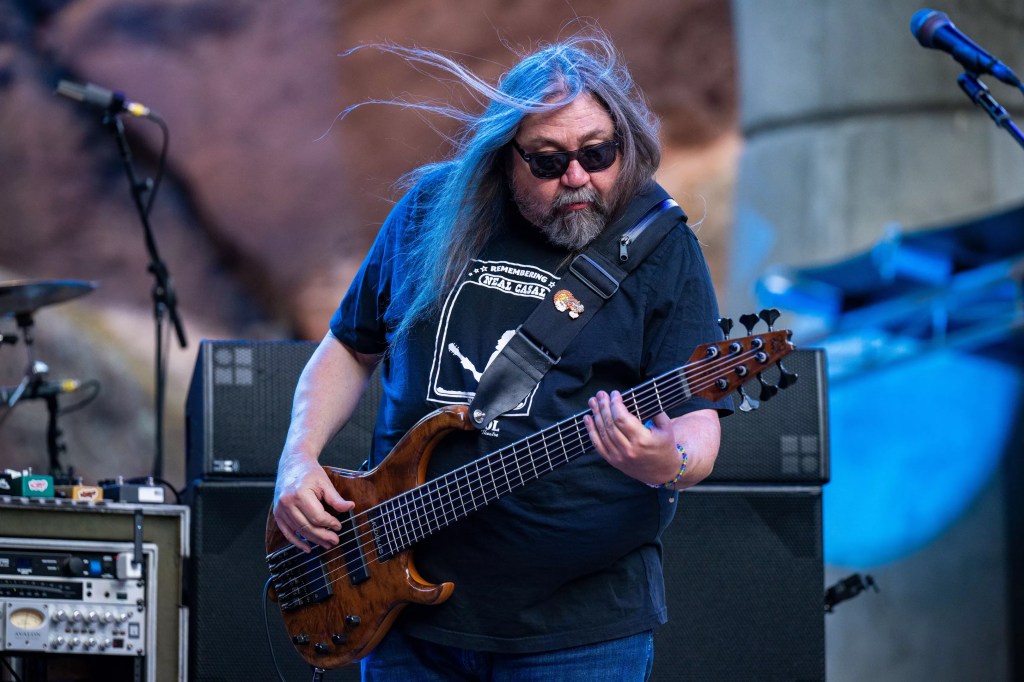
At the end of Widespread Panic’s annual summer Red Rocks run in 2002, the band performed one of its most memorable songs, “Ain’t Life Grand.” It would be one of founding guitarist Mikey Houser’s last performances, not long before he passed away from pancreatic cancer on August 10 of that year.
“I remember getting really, really choked up performing it,” says Dave Schools, the band’s bassist. “It was one of those moments. And I got so out of the moment that I really botched the bridge, and I was kicking myself. But I looked over at Mikey, and he was just enjoying the last times he would get to play with his band.”
Then, Schools looked at keys wizard Jojo Hermann. “He caught me,” Schools recalls of the flub, with a laugh. “He’s like, ‘Yeah, I heard that.'”
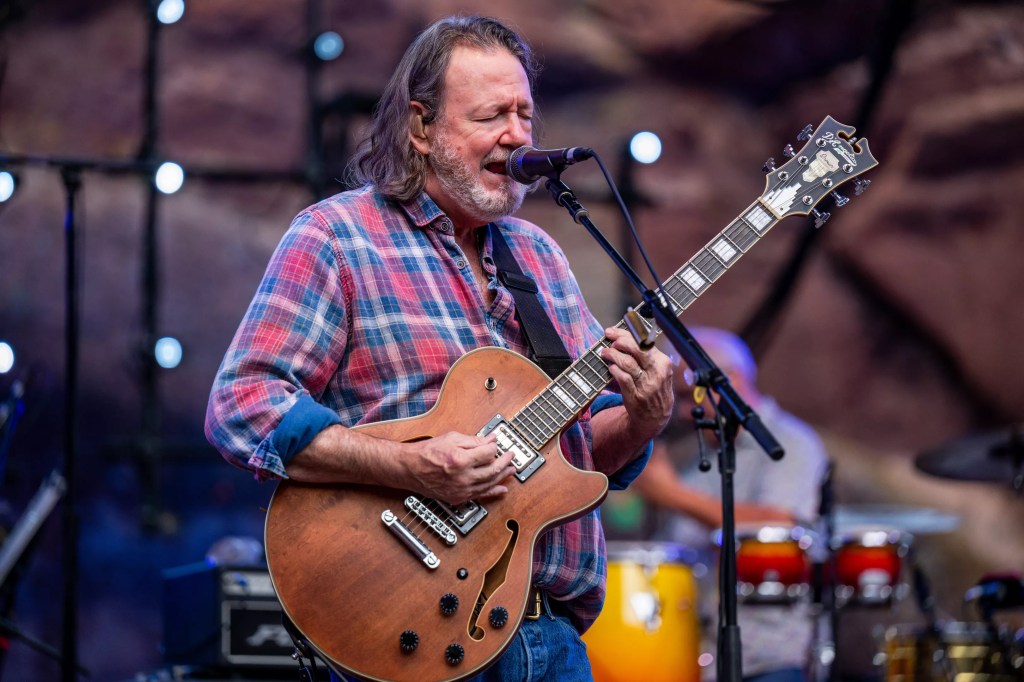
The band continued performing after Houser’s death, as he’d wished. And his spirit is still the wind to its sails, whistling out from songs written with fellow founding member John Bell (vocals/guitar) on their porch when they formed the band as University of Georgia students in the early ’80s. “That was the spirit of the band — the way he approached playing,” Bell says of Houser. “We started out as a duo, and we learned to play together. … We were both very content with just wandering around and seeing where the music would take us.”
That music would take Widespread Panic to historic heights. At this point, Panic and Red Rocks may as well be synonymous. The southern-rock jam band has played the legendary venue more times than any other act, a historic record that won’t be broken anytime soon, if ever: This year’s three-night run, which kicks off tonight, June 26, will culminate with the 78th consecutive sold-out show at the amphitheater on Sunday. And on Saturday, the act will be inducted into the Colorado Music Hall of Fame with the first Honorary Coloradan induction; promoter Bill Bass will also be inducted into The Hall.
“Colorado is an inspiration in itself,” Bell tells Westword. “Playing Red Rocks Amphitheatre is a dream come true, and being asked to join Bill Bass and many of our friends in Colorado Music Hall of Fame is one of the happiest surprises Widespread Panic will forever be humbled by.”
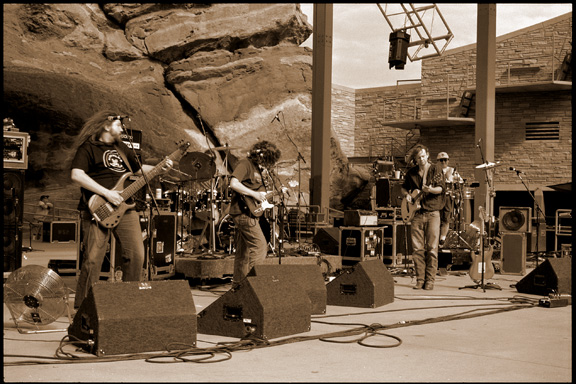
Photo by Dave Vann / provided by All Eyes Media
“I’m gobsmacked,” Schools says of the record run. “When these watershed moments occur in one’s career, it’s really one of the only times I feel like I can sort of cast my gaze into the past. I like to keep moving forward, but when people remind us of the staggering number of times that we’ve been lucky enough to play at Red Rocks, gratitude is what I feel. … It sure feels like family, and we’ve always been graciously welcomed in Colorado.”
“It’s a big deal for us,” Bell says. “When we decided to stop touring in the traditional sense, about eight years ago, maybe, and just go out and do about a long weekend a month, Red Rocks was definitely the first one that was still on our list. It’s definitely something everybody wanted to play forever.”
Schools is unsure what his younger self would have said if he were told Panic would make Red Rocks history. “I’d probably find a way to screw it up somehow, though,” he says with a chuckle. “The reasons that we started the band in that day and age, in the town of Athens, Georgia, I don’t think that we could have ever predicted that it would become something that would allow for that many performances at any venue. Because we started it as a way to not have a job and work in some awful, corporate place in the early ’80s, when Reagan was running the show. I went to school for journalism, John Bell went for English, and Mike Houser was the only one who graduated, and he got a degree in chemistry! But you know, we just had so much fun playing together, and the opportunities kept presenting themselves.
“We didn’t just run away and join the circus,” he adds. “We started our own.”
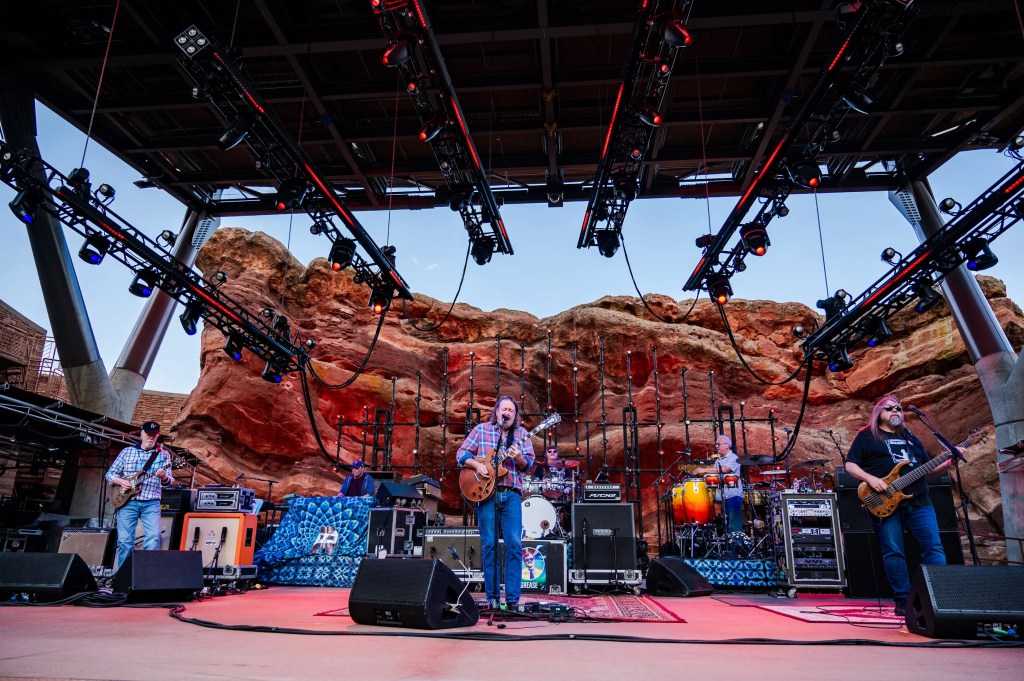
Ross Jones (@rossjonz)
The music never stops
Schools was also at UGA when he joined Bell and Houser; the band would officially launch in 1986 with drummer Todd Nance, a friend of Houser’s since middle school, and percussionist Domingo “Sunny” Ortiz, with Hermann hopping on board in ’92. Unfortunately, Houser wasn’t the only death that Panic has endured: After suffering from chronic illness, Nance left the act in 2016 and passed away in 2020. Duane Trucks (nephew of Butch and brother of Derek) is now behind the kit.
But music still captures the souls of its creators. Houser’s family came to a more recent Red Rocks run, and Schools recalls spotting them sitting up front. “This is probably 14 or 15 years after Mikey passed,” he says. “And I know that for Mikey’s family to come shows, there had to be a level of difficulty and emotionality that I can’t even begin to get in my heart. But they were all smiling, and that’s important. And I think Mikey would really appreciate that.
“Like I said when Todd Snider passed away, we’ve lost a great one. We lost a great one with Mikey,” he continues, “a really, very uniquely talented individual artist. But they leave a body of work behind, and that’s never going to go away — in fact, it’s going to keep giving.”
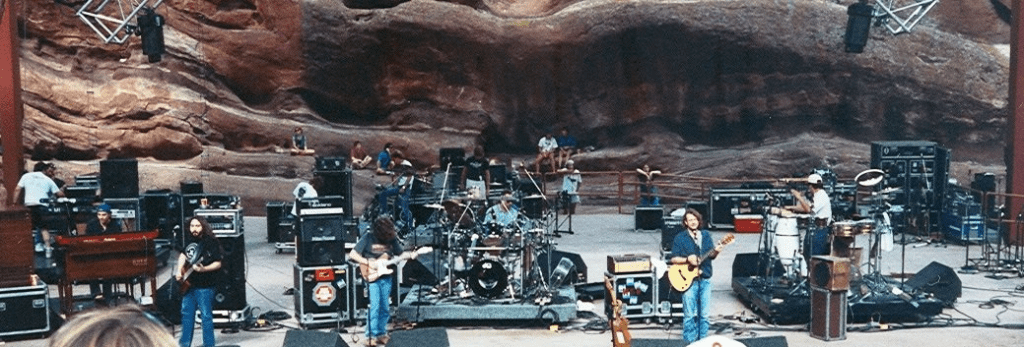
Photo by Mark Pucci
The music gives more than just a good time. At Panic shows, people you meet can become friends, and then like family. through the years, some of those friends may end up crossing the rainbow bridge. But when you see Panic perform, they become alive again.
That’s what guitarist Jimmy Herring, who took Houser’s place after George McConnell, was able to accomplish in playing Houser’s phrases, Schools says, noting that Herring has now been in the band longer than Houser was. But Herring, who also performed with The Allman Brothers Band, Phil Lesh and Friends, Derek Trucks Band and more, is now on hiatus after being diagnosed with tonsil cancer. “I think things are all best-case,” Schools says now. “His humor is back. He’s excited to get to playing.”
Ross Jones for Westword
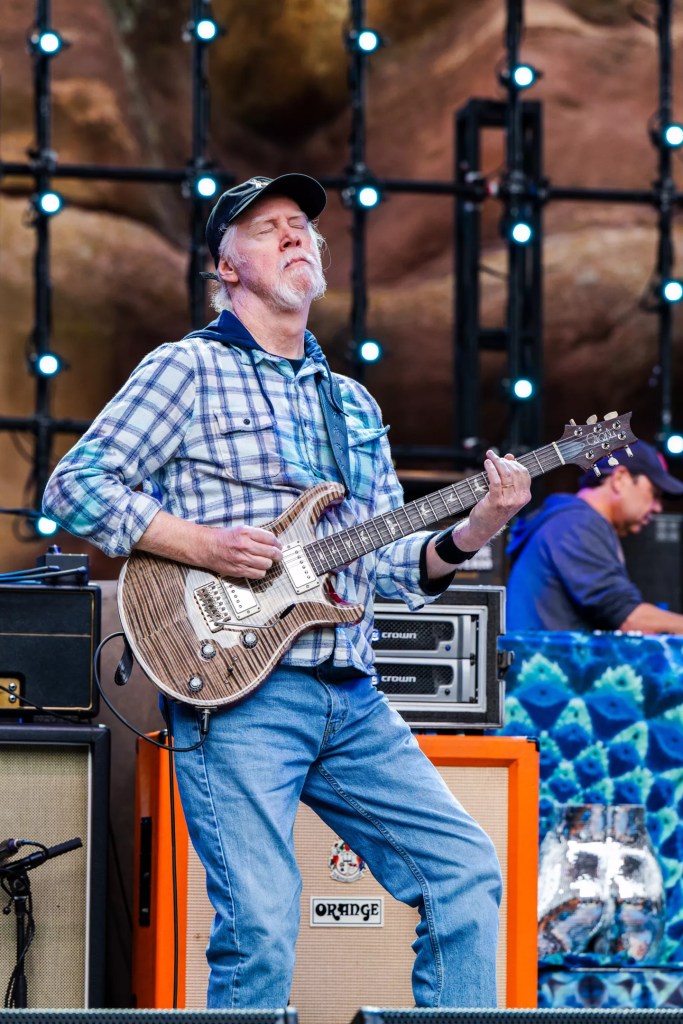
Earlier this year, Herring tapped guitarist Nick Johnson, who performed with the late, great Col. Bruce Hampton as well as a spate of metal bands, to take his place. Notes Bell: “Not a day goes by on the road where we don’t get reminded of Bruce Hampton,” the southeast music legend who passed in 2017.
“If you come from the school of Bruce,” Bell says, “you at least have a little notion that it’s gonna be a jump-in-and-hang-on kind of thing.” And Johnson’s been able to do just that.
“He’s amazing,” Bell adds. “Our first gig together was in Mexico in January this year, and that’s a four-night run, so that’s 80-plus songs he had to be ready to know. That’s including intros and signature guitar phrasings. It’s mind-blowing what an amazing student and craftsman he is.”
Schools agrees. “I hear Mikey a lot of times when he’s playing,” he says.
Ross Jones for Westword
Red Rocks memories: Balloons attack the band
Panic’s first show at Red Rocks was opening for Blues Traveler, another venue stalwart. It was the Fourth of July, and the members’ first time there. After Panic’s set, Bell recalls, “we walked to the top, and there was Blues Traveler and their light show, and the city lights of Denver. I think there were fireworks out in the sky, too, and there was lightning. … We were just happy to be there, and we keep coming back.”
Schools remembers that evening well. “It was a ‘wow’ moment,” he says. “And I’ve had a heck of a lot of ‘wow’ moments at Red Rocks, and that is something that I am personally very grateful for the opportunity to have seen and experienced.”
When the bassist thinks back on the 75 times the band has played Red Rocks, he’s flooded with memories. Through the decades, the band has seen the venue change, too: He remembers when the members had to travel a switchback road to unload backstage (upgrades have made that much easier), and when screens first came to the stage, which the band has famously refused to use — because what could be a better background than the natural rocks, with Panic’s phenomenal light show swirling on top?
“We used to just dream of the time we could afford the kind of production that would allow a video screen, visuals and things,” Schools says. “But really, if I was a lighting designer, I would leave it on the truck at Red Rocks. I mean, that’s the most amazing backdrop you could imagine.”
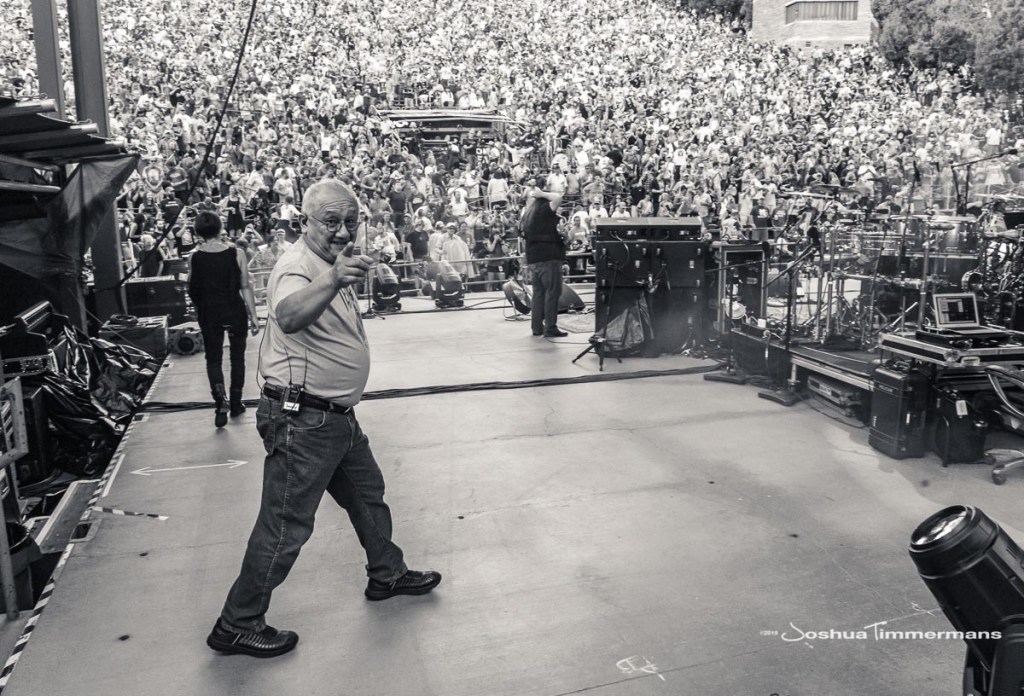
Photo by Josh Timmermans
Whether it’s fighting the elements or hiking with your gear to the venue, “every aspect of [Red Rocks] that is unusual from your average arena and outdoor venue is worth dealing with,” he says. “I mean, sometimes it’s been so bright that I remember I blew up an amplifier before we even started because it was baking in the sun.
“I have so many stories,” he adds. “I’ll tell you one of my favorites about the weather conditions at Red Rocks: We had just made a record — I can’t remember what it was. But Capricorn Records, our label — they were always into promotional gimmicks — they thought that it would be a really good idea if they…printed up a bunch of those big, concert-type balloons with the logo of the band and release them into the audience, which is cool, except it’s so vertical, and the wind happened to be prevailing down through the amphitheater between those rocks, right onto the stage.
“These balls, these beach balls, or whatever they were, became missiles,” he recalls with a laugh. “The wind caught them, and they were kind of rolling downhill as they came at the stage, and I swear the crew could not get there fast enough to prevent, like, one of them from smacking into a wire. And one of ’em probably hit Houser while he was sitting there with his eyes closed, playing; maybe knocked over a cymbal stand. And it was so funny.
“It’s like they always say: Come prepared for anything. But giant concert balloons becoming anti-band wasn’t on our radar!”
Ross Jones for Westword
Colorado’s calling
The band has a dedicated following in Colorado, which inspired Bell to pen such songs as “Surprise Valley.” There’s also the track “Postcard,” which Schools says was based on a postcard that Panic friend Bear (you know, of “Bear’s Gone Fishin'”) wrote to the band after he moved to Telluride. “Literally the chorus of that song, word for word, is what his postcard said,” he says. “The last time we played Telluride at the park’s beautiful stage, he had passed recently. … And at this concert, someone had reproduced that postcard — obviously there’s a photograph of it in existence, and some fan got it and made a huge, flag-sized banner of his message and the postmark and stamp, and was holding it up. It was one of those full-circle moments.”
There’s something about Panic’s music that resonates with Colorado’s Wild West nature. “I’d venture a guess that it’s just because it’s good ol’ rock and roll with the ticks and twists and turns,” Bell says. “That’s kind of descriptive of the recreational lifestyle of folks that are out in Colorado, too. You know, you never ski or hike the same mountain the same way twice. And even though we might be playing the same songs, they’re gonna come out differently.”
In forming the Red Rocks setlist, Bell says, “We look at what we played recently and steer away from that, and we’ll look at what we played last year, and keep that in mind. Usually, I’ll put together the set for the first night, and then the guys will get in there, tear it apart, and put it back together. And then we’ll have something that everybody wants to play.”
Ross Jones for Westword
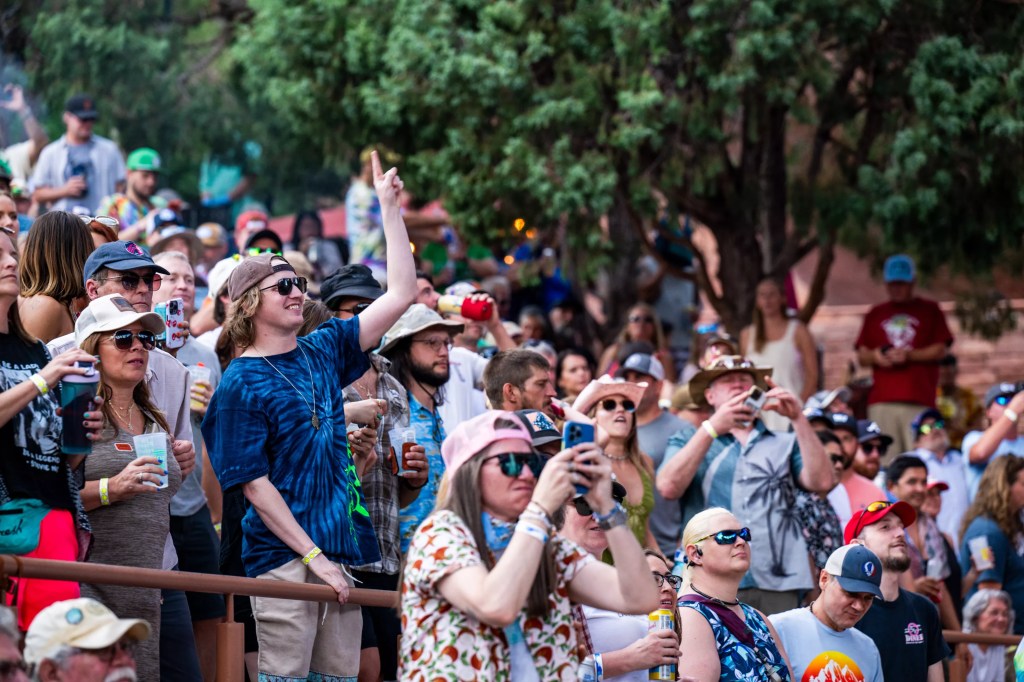
But Red Rocks wasn’t the band’s only Colorado stop last year: Widespread Panic snagged the opening slot for none other than the Rolling Stones, whose fans were stunned by the waterfall of water and beer that Spreadheads chucked during a memorable rendition of “Chilly Water.” Bell laughs just thinking about it. “Well, the water thing’s not really our tradition,” he says, giving credit to the fans. “But that gig was kind of surreal. We don’t play many 45-minute sets, but we were going to be there for Red Rocks, and the invitation was there. And we were like, ‘Well, we’ve never done that before, so let’s do it.'”
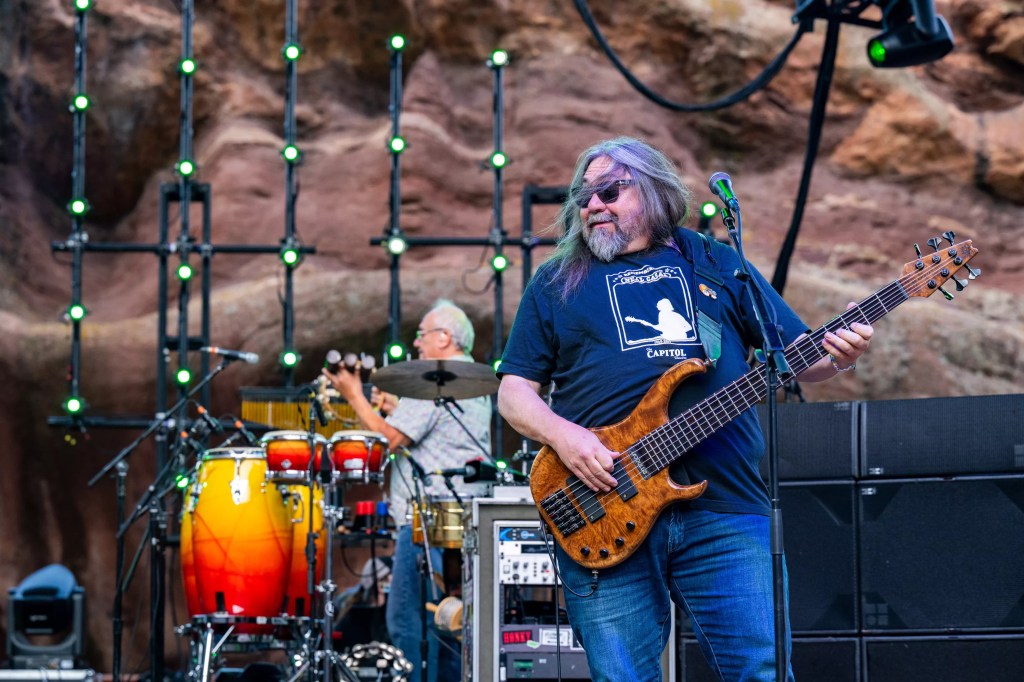
The Panic members had already met the Stones through keys player Chuck Leavell, but the grandiosity wasn’t lost on them. “It’s amazing that I’ve come this long in my career and lifetime, and here they were,” Bell says. “They were a part of my very early childhood; as soon as we were listening to the radio, the Stones were there. So it’s kind of wild. It’s not like athletes, where you’ll watch an athlete from his rookie year to retirement, and then three or four generations get spit out like that. But the Stones came before us and, well, they’re probably going to be here after us.”
Ross Jones (@rossjonz)
Fans are family
The band’s nomadic following could be compared to Deadheads. Once Jerry Garcia died in ’95, Widespread was one of the remaining groups that shared the Grateful Dead’s freewheeling, improv-based ethos, and it’s hard not to fall in love with the long and winding guitar solos or spaced-out drum jams. As Bell put it to Rolling Stone in a 2024 feature, “We’re in there and exploring the music together. … And when you’re catching it together, you get that big inward smile going. Everybody’s listening, everybody’s present.”
Schools himself was a major fan of the Dead, and he sees the overlap and commonalities. “It is similar, in a way, with a culture based around the music and vibe of a band that I loved,” he says. “I think that there’s a sense of family there, and it’s been shown to me in so much as…we’re starting to see three generations show up. To me, I don’t know what it is about what we do that brings it — I think it speaks more to the power of what our fans have developed amongst themselves, which is a sense of family, which is super important to us.”

Ross Jones for Westword
Just as it was with the Dead, the concerts do become an almost mystical experience (if you can ignore the wooks’ projectile vomiting during the rowdier Saturday shows). The band carries that intangible quality that only the most soulful music can bestow — something that almost resembles nostalgia, an elusive feeling that can only be experienced, not put into words. But given that this is Panic, it’s also a wild time. Spreadnecks wait on the Red Rocks lots all day before the shows, an unforgettable, psychedelic type of tailgate you won’t find anywhere else.
“You get to enjoy that family get-together,” Schools says, “and that sense of catching up and sharing an experience that you both love. Throw that in with it being at Red Rocks? To me, every time we play the song ‘Pilgrims,’ it really has a big resonance for me. Because people do make their annual pilgrimage to Red Rocks. If their lives have gotten busy that they can only come see one run of shows a year, many of them will pick that one.”
He’s reminded of the run’s importance by a Stanley Mouse poster created for Panic that the later venue gifted the bandmates, framed in wood carved from the old seating. “It never gets old being reminded that, A., there’s a lot of stairs, and, you know, we were lucky enough to play it that many times,” he says. “At this point, I mean, we’re lucky to still be alive. And by virtue of that, I can still join my brethren and play at this beautiful venue.
“It stands for more than just the achievement of playing that many shows,” he adds. “It stands for what a family we’ve developed, and a reminder to myself of really, just what a lucky dude I am.”

Ross Jones for Westword
The future of jams
At some point, there’s a changing of the guard in music. “All of those purveyors that started this stuff, there are very few of them left,” he says, referencing “The Allman Brothers guys, the Grateful Dead guys, and others of that generation. So we carry the torch of the spirit of the way they played that music forward. It’s never been about emulating anything other than the so very obvious spirit which they created with their collaborative music, live and on stage. I think that’s entrancing, and for a number of reasons.”
While we enter an era in which AI threatens creatives, Schools knows there’s one thing such machines can’t capture: soul.
“Soul comes from being yourself and laying it all out there,” he says. “And part of doing that is making mistakes, and part of creating from yourself is based in absurdity or pain or some sort of very, very human feeling that poets and artists, sculptors and painters and songwriters have been using their medium to try to describe, because it’s an indescribable thing. Those representations are the best way that we can come up with to share a feeling.
“It’s sort of an intangible lovable human charm about what us humans do that I don’t think even the most intelligent supercomputer is going to be able to do. It’s frightening and daunting, but it’s also the future, and here it is,” he adds. “But you know, AI can never come up with someone like Colonel Bruce Hampton or Jerry Garcia. It’s never gonna come up with a Mike Houser or John Bell or John Hermann.”

Ross Jones
Schools now works on producing records for the next generation of bands. He’s worked with a young group called Wolph out of his native Virginia, which just released its first single, “Blue Miracle,” as well as Americana artist Andy Thomas and Kendall Street Company. “I also have a record that I’ve been working on for myself that I’ve been putting together for some time now, that’s ready to go to mastering at BassMtn.,” he says. “It’s very different, it’s something I needed to get out of my head.”
But being able to uplift young artists has been a real treat. “I love when I can pick up on the sensibility that’s familiar to me that I’ve experienced with Widespread Panic as a family,” he says. “The folks that are in it together for the journey and the adventure of traveling and making music together, rather than setting sales records or moving units or whatever.”
Before hanging up with Schools, I told him how much Panic’s work has meant to me, personally. I told him about the family of friends I had made through their shows, some of whom have passed away. That includes artist Jessica McMillan; I mentioned that friends and I would be painting a mural in her honor in Denver before heading to Friday’s show. Such an outpouring may leave some artists flustered, but Schools took it in stride.
“Thank you,” he said warmly. “That’s the best reward for doing what we do: It’s having it have meaning for people. There’s no better reason to do anything.”
Widespread Panic will be back at Red Rocks June 26-28. All three shows are sold out. At the Saturday show, the band will be inducted into Colorado Music Hall of Fame, in the very first Honorary Coloradan induction.