
Tuff Gong Worldwide-Zach Weinberg

Audio By Carbonatix
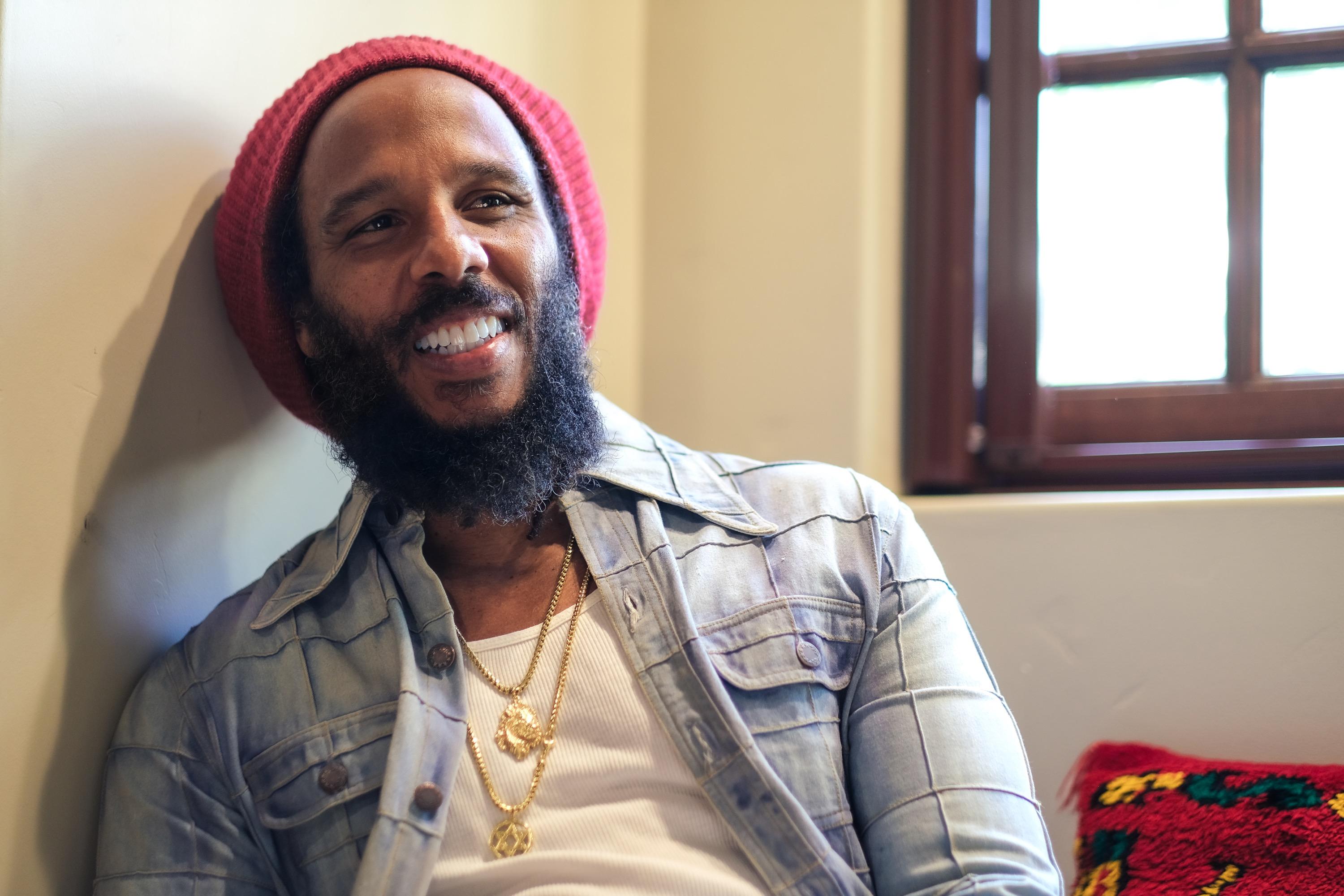
When Ziggy Marley logs into our virtual meeting, he emerges from behind a cloud of freshly puffed smoke. As it clears, he beams a big, warm smile.
He has a lot to be happy about: He just released a killer new album, “Brightside,” which he recorded at his newly built L.A. studio, Rebel Lion, and is about to head off on a tour. The album is classic Ziggy — powerful in its positivity, extending and emphasizing the peaceful ethos espoused by his father, Bob Marley. He and his brother, Stephen Marley, will pay tribute to Bob at Red Rocks on Wed., June 24, performing a set of his influential and timeless music.
The remainder of Ziggy’s tour will focus on his new album, which sees the musician experimenting with something new. While most musical instruments are tuned to 440 Hz, the entirety of “Brightside” employs a slower, lower 432 Hz tuning, whose vibrations are said to harmonize with those of the earth and human beings (though this is not scientifically proven) and to reduce anxiety. While the tuning has mostly been adopted by New Age musicians such as Steven Halpern, less woo-woo requests for it date back to the 1890s, when the Italian composer Giuseppe Verdi petitioned for 432 Hz as the country’s operatic tuning standard, noting that it was less harsh on vocals. More modern musicians have dropped to 432 Hz as well, including producers/songwriter James Blake and Radiohead guitarist Ed O’Brien in his solo work, referencing its relaxing elements.
Ahead of his Red Rocks show, Ziggy took the time to discuss why he landed on 432 Hz, the spirituality behind his music and his dad’s legacy.
Tuff Gong Worldwide-Zach Weinberg
Westword: You used 432 Hz tuning for your new album. What went into your decision to employ that tuning specifically?
Ziggy Marley: I read something a long time ago about this music, that it’s very spiritual. I’m always on a journey with music. Eventually, I came upon the information of 432 Hz, what it’s meant to do … vibrate closer to frequencies as human beings, meditation, all that jazz, blah, blah, blah. I liked what it said, and it let me try it out for myself. Because I’m still looking for something, my musical journey is still an ongoing journey. … Experimenting with it, I personally like it; it felt better to me. For my own personal self, it vibrates at my frequency. It vibrates with me, and I vibrate with it. It embraces me, and I embrace it. That’s why I went with it. The cherry on top is that it’s different.
On a recent podcast interview with Joel Madden, you had said that creating the album was very spiritual for you. How so?
Creation is always spiritual. It’s connecting with something beyond yourself. Because if it wasn’t spiritual, if I wasn’t connecting beyond myself, I don’t think I could be writing what I’m wriiting. It’s not just from me. I don’t think my intellectual mind could just be writing this down. The way I write songs, it’s a spiritual thing. It’s not a normal thing. … It’s something really special, really spiritual and magical. That’s how I receive it, that’s how I connect with it. I feel like my mind was very clear; what I wanted to touch on and do was very clear. I spent a lot of time building a relationship between these words and these songs.
When establishing a relationship with these songs, for example, what was that like with writing “JAH We Give Glory”? What was your connection to it as you were writing it?
My relationship with Jah, my experience with my spirituality, I’ve learned about confidence in it. For me, “Jah We Give Glory,” is a song that, firstly, that’s where all the glory belongs to. Any accolades that are given me, they don’t belong to me, they should be given to Jah. That’s why it’s the first song on the album. Because everything is from Jah, never from me. I’m just an instrument. When a painter paints a painting, do you give credit to the painter or to the brush? I’m just a brush. Jah is the painter.
What do you think is the importance of looking on the bright side, or the importance of our mindset, and how does music help that?
Mindset is the first point of defense and offense. Because a lot of what goes on outside of us is trying to affect our mindset; it’s trying to get us to think one way or the other; it’s trying to get us to feel something or the other. I feel like the society has programmed a lot of us to be doubtful of the potential of humanity. And that’s exactly the mindset that will hinder us from getting where we want to go. That’s the fight. To beat us mentally, you beat us every other way. If you beat us every other way, except mentally, we still have a chance. That’s the mindset: It’s not ignoring the other side, or just looking on the bright side. But it’s always understanding that there’s a bright side.
There’s never dark without light. Remember, when in the dark, there’s a light, there’s always a light. The “Brightside,” for me, was always acknowledging that there’s [negative things], but check it out the other side. Look what the negative is showing us. There’s a lot of positive to take away from within the darkness; you learn a lot.
And music is the most important tool in culture. Music is one of the biggest influences on Earth. Music is a tool for us that we use because of the inspiration that we get to hopefully inspire other people through what we do.
You recently released a music video for the song “Racism Is a Killa,” in which you’re portrayed as Dr. Brightside. What did you want to get across in the video?
Well, even though the topic is a serious topic, we wanted to have fun. I’m an imaginative person — I want to get into filmmaking one day. This was the first time we did a video ourselves [via Rebel Lion Studios]. The whole thing with the video is that racism is a virus, a sickness, a disease. And it’s a curable disease within society. We have the cure, we have the medicine. When Covid happened, it reminded me of a virus like that. It’s not just, “This guy is a racist.” It’s, “This guy has a sickness.” This is an unnecessary disease. That’s why the song portrays it as a virus. It could be a heart issue, it could be a mental issue, but it’s a sickness, a sickness of humankind, and it’s about time we minimize it and eradicate it out of existence.
What do you think holds humans back from moving in a more conscious direction collectively?
Within the whole of society, there’s too much materialism, and the materialism also breeds a kind of selfishness. “I want to get money, I gotta get mine, I gotta get mine.” A lot of the morals and a lot of the consciousness have gone out of businesses. Instead of, “How can I help the community?” it’s “How much can I get from it?”
Within the music industry — I’m an independent artist — they won’t take a certain song, even if it’s good for humanity, because it’s not going to make money.
Are there any songs in particular you’re excited about performing live?
All of them! I love all of my songs, but this album, these songs hit me differently.
You also released the song “Many Mourn for Bob” back in February. You’ve probably been asked this a million times, but how do you feel that your father’s legacy has intertwined with yours?
My relationship with my father is not about legacies — it’s one of a parent to a child; it’s one of a brother to a brother; it’s one of peer to peer. It’s one of human to human. “Many Mourn for Bob,” it’s like he’s my brother. It’s a song a brother would write. [Laughs.] But I feel like, in some way, during the process of writing that song, his part of his story that he wants to tell us is within that. He has told it in some of his songs, but again not in the most popular songs. There’s pain, there is sorrow, there is anguish, there is vulnerability in his world, in his life. There is emotional strain, mental strain, not expressed in most of the songs that people listen to. You get into the deeper cuts, like “I Know” — and I use some lyrics from that song — some of that inspired me to understand what he was going through that he did not show on the outside, because we’re men, you know, we’re tough, we’re not supposed to [allow people] to see our emotions.
The deeper I get into him, the more I understand him, because of my own experiences, but because I can’t think of him on the same level I did when I was younger. He was going through stuff that, as a child, I couldn’t realize what it was. But as an adult, I can consider he went through some stuff that must’ve been emotionally heavy. So I’m connecting with that stuff, and also more of my experiences from the time period of when he passed away. It’s difficult remembering things, bringing things back up that I had probably forgotten but was just in my subconscious. But overall, my explanation of this song is that it’s a collab between me and my father. It’s a spiritual collaboration.
You’re about to be at Red Rocks, which seems like the perfect venue for you. Is there a favorite thing you have about playing Red Rocks?
The Red Rocks show is me and my brother and a celebration of my father, mostly. And being at Red Rocks is another spiritual element. We are within nature, and that is the foundation of the essence for us. We love that energy. It’s nature energies, God energies, father Jah. To be closer to Jah is to be closer to nature.
This interview was edited for length and clarity.
Ziggy Marley & Stephen Marley, 6 p.m. Wed., June 24, Red Rocks Amphitheatre, 18300 West Alameda Pkwy., Morrison. Tickets are available on the Red Rocks website.