
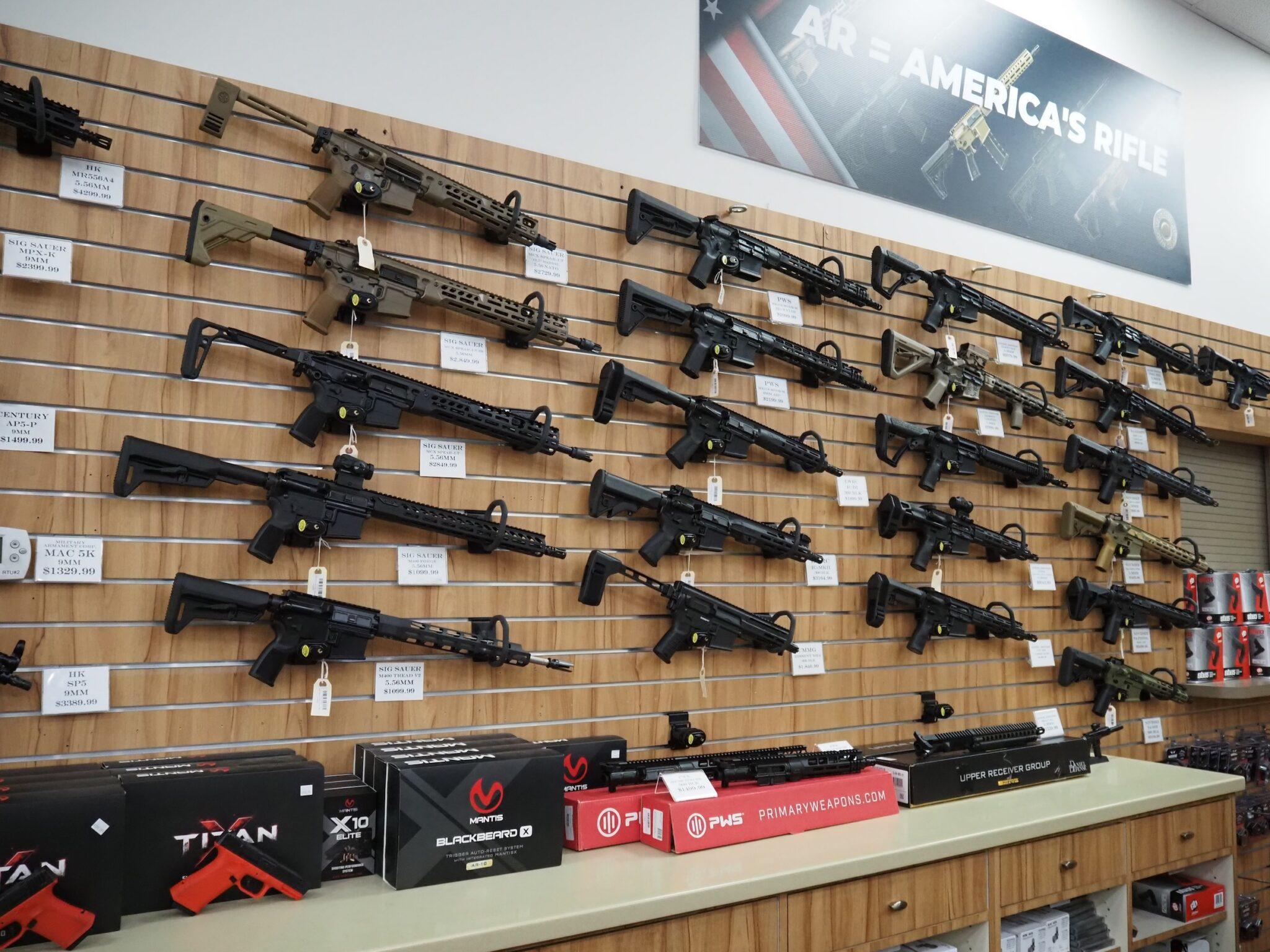
Photo by Sara Wilson/Colorado Newsline

Audio By Carbonatix
In one of the largest shifts to gun purchasing laws in Colorado, residents who want to buy some of the most popular types of semiautomatic firearms will soon need to complete training through a new permit-to-purchase program.
State officials say they are nearly ready to implement the new law. Starting Aug. 1, people will need to undergo a multi-step process to buy many semiautomatic firearms that accept magazines — such as AR- and AK-style rifles and pistols. It will include an eligibility review by a county sheriff, lengthy safety training with a firearm instructor and a written exam. Today someone can walk into a gun shop and buy the guns covered by the law without any training.
It is a massive overhaul of how Coloradans purchase common firearms with few similarities elsewhere. Seven states currently have safety training requirements to buy or own some types of guns, according to a 2025 report from Johns Hopkins University.
“We looked at other other states and some of the laws that they had,” said Dan Coil, Colorado Parks and Wildlife firearms safety project manager. “Some of it was kind of parallel, but nothing really mirrored it. We were really on our own for this.”
Democrats in the Legislature passed Senate Bill 25-003 last year as one of the most restrictive gun regulations adopted in the state, following years of new laws regarding waiting periods, age restrictions and state licensing requirements for gun shops. It was introduced as an outright ban on semiautomatic firearms with detachable magazines to further enforce the state’s prohibition on large-capacity magazines. But it was amended to allow people to purchase those guns if they complete the permit-to-purchase process. If someone does not undergo the training and testing, they could buy a gun covered by the law if it has a permanently attached magazine that meets the state’s 15-round maximum, though that style of gun is less common. The law does not affect possession.
It also bans so-called rapid-fire trigger devices that can make a semiautomatic weapon fire at a rate similar to an automatic gun.
After Gov. Jared Polis signed the law, the implementation process was kicked down to state agencies. Much of the planning fell on CPW, which worked with other state industries, firearm instructors and gun store owners to map out the customer process and develop the safety course curriculum. Coil said the department started planning in November — when everything went into “fast forward”— and is set to launch the program when the law goes into effect.
“I’m cautiously optimistic, though, because there’s always going to be issues. Something will come up, I just don’t know what,” he said.
Coil has spent most of this year on a public information blitz about the new law, hosting over a dozen meetings across the state outlining the requirements and speaking in person at any firearm store or shooting association that asks. He believes face-to-face interactions can be more effective.
“The biggest struggle is getting the correct information out there,” he said. “I need to be able to get out there and answer questions, talk to people about their concerns, about what this is and what this isn’t. We’re trying to reach all avenues we can.”
A lot of his work, he said, is combating persistent misinformation about the law, such as that CPW helped develop the list of guns affected, that it is an outright ban or that people will need to go through the permitting process to buy ammunition. That misinformation can be compounded by the highly political nature of gun regulations and the intense pushback it faced while it moved through the Legislature. The law is the subject of ongoing litigation.
“Whether you like this or not, it doesn’t matter, but the truth of it is that it’s a process before acquiring them. It’s not an outright ban. That’s just not true,” he said.
The new process
The Firearms Dealer Division within the state’s Department of Revenue on July 1 released a list of guns that fall under the law. After feedback on a draft list the agency released in May, it removed 33 firearms from the initial list. That includes the Mauser M1916 model and the Fix Series from Q Firearms, both bolt-action rifles. It also took out the Ruger 10/22 I-Tac Series, which had a “????” note on the May draft.
“The Division also recognizes that the Specified Semiautomatic Firearms Guidance provided in this document is not all-inclusive of firearms currently available, or that will be available in the future. As a result, the guidance document will be reviewed on an ongoing basis,” the division wrote in a letter to the firearms industry.
Prospective buyers will first need to submit an online application, which will go live on CPW’s website July 20. That application heads to the buyer’s local sheriff’s office, but CPW advises checking with the sheriff to ensure they are accepting and processing applications. San Miguel County Sheriff Dan Covault wrote in an email that his office is planning to process only county residents’ applications, since they will have “institutional knowledge of the people applying,” which will help maintain accountability.
During a March CPW Commission meeting, Rio Blanco County Sheriff’s Office Operational Officer Jeremy Muxlow warned that the administrative responsibility of reviewing background checks, going through applications and verifying approved training courses could become a problem for small offices.
“For a large urban agency with massive staff, maybe that’s manageable. For small rural sheriff’s offices, such as ours, covering thousands of square miles with limited deputies, it’s a serious burden,” he told commissioners. “Policies created in rooms like this will eventually become the problems sheriff deputies have to deal with.”
At the sheriff’s office, a buyer will need to provide a name-based background check and identification card for that application to get processed. The sheriff will collect a $52 fee for CPW and any additional fee for administrative costs, depending on the county. Weld County, for example, decided not to impose a sheriff’s fee, while Adams County plans to charge $50 for county residents and $100 for people outside the county.
“Our demand is probably going to go be pretty high, but we don’t know what that looks like, if it’s going to be a couple weeks (after Aug. 1), six months, or if it’s going to be in flux since these cards are good for five years,” Adams County Sgt. Shea Haney said. “We have no idea, so we’re preparing for a large influx when this happens, and we’re just going to be flexible in that process.”
Sheriff offices will then issue the buyer an eligibility card and enter that information into an online database that different entities can check throughout the process. The database will show whether someone gets an eligibility card and completed a course, and will be accessible by sheriffs, course instructors and firearms dealers. It won’t track or show any purchasing data.
Once someone gets an eligibility card, they can find an approved course. This is where the process splits: people who have taken a hunter education course certified by CPW will be eligible for a four-hour, basic firearm safety course. People without that hunter education will need to enroll in a 12-hour extended course. The law requires the extended class be taught over at least two days.
Hunter education numbers have remained relatively steady since the law passed and there hasn’t been a rush to complete that training to avoid the extended class. So far this year, 7,019 people passed hunter education, according to CPW numbers. During the same time frame in 2024 and 2025, 7,941 and 6,732 people passed, respectively.
Unpredictable demand
CPW relied on an advisory panel of firearm instructors to develop those courses, and those instructors said a lot of the work was fitting aspects of existing classes into one big curriculum.
“We’re not reinventing the wheel,” said panelist John Pashain, a Fort Collins instructor and owner of 7 Hills Security. “It is your basic safety knowledge for firearms and firearm handling. It follows many of the courses that are already out there.”
The law specifies that the course must cover safe handling of semiautomatic firearms and ammunition, safe storage, child safety, firearm deaths associated with mental illness, extreme risk protection orders and victim awareness.
“We all agreed that we needed to leave it open, that no matter who was going to teach this, we’re teaching the same underlying principles and concepts, but it allows freedom for the instructor to teach it in their own way,” said Cindy Coker, an instructor at Lakewood’s Bristlecone Shooting on the panel.
Students will need to pass a hands-on practical and written exam with at least a 90% score to become eligible to purchase a semiautomatic firearm. Eligibility will last five years.
Pashain said that when he speaks with local gun stores and other instructors, they can’t predict demand for the courses and what enrollment could look like, and they won’t know until sheriff offices begin issuing eligibility cards. That makes scheduling tough.
“I’m hearing from some people that they’ll never take it, hearing from people that they’re going to take it as soon as possible. Everything right now is speculation,” he said.
As the owner of a firearms academy, Pashain said he also sees his role as providing people with accurate information about the law as it rolls out. He’s helped host two information sessions, but repeatedly hears from people who are not aware of the upcoming changes. He’s also been the target of frustration.
“I’ve been told that I’m a Nazi, that I’m a jack-booted thug, that I’m assisting CPW in taking away gun rights of people, and that is the furthest from the truth,” he said. “A bill was passed. It will be law. If a course needs to be made and they are asking for help, I’m going to do the best that I can to help — without politics, without individual opinions, and simply put out the best product possible.”
Owners of the more than 1,700 licensed gun stores in Colorado are uncertain about how the permitting program will affect their businesses.
“When you look at purchase rates of the guns that are going to be regulated versus your typical handgun and your shotguns and things like that, the guns that are falling onto the list don’t have as high a demand as guns that are not on the list,” Coker said.
There might have been an uptick in gun sales as SB-3 moved through the Legislature, as sometimes happens amid debates on new restrictions. There was an increase in background checks performed by the Colorado Bureau of Investigations for firearm transfers the month the bill was introduced, though that is not a perfect measure of actual gun purchases, does not differentiate which type of gun might have been sold and does not consider a potential buyer’s reason for shopping.
Background checks went from 30,289 in February 2025 to 40,050 in March 2025, when the Legislature passed the bill. The number of background checks per month hovered between 20,000 and around 25,000 for the rest of the year, before shooting up to 28,724 in December 2025, according to CBI statistics. In January and February this year, the only data currently available, there were 24,967 and 25,738 background checks, respectively.
Wayne Price, the president of The Gun Room in Lakewood, said there was a sales bump last April but it didn’t hold. The store’s inventory is mostly consignment and doesn’t fall under the list of restricted guns, but he still worries about the law’s impact and potential dips in sales.
“We are blessed with the type of inventory we have. I have lots of revolvers. I’ll be like, ‘You want to protect yourself? Here’s a revolver,’” he said. “But what’s going to happen on August 1 is that not a single person will be ready (to buy). How long will it take someone to get ready? How long will we go without sales before someone actually is?”
This story originally appeared in Colorado Newsline, part of States Newsroom, a nonprofit news network supported by grants and a coalition of donors as a 501c(3) public charity.